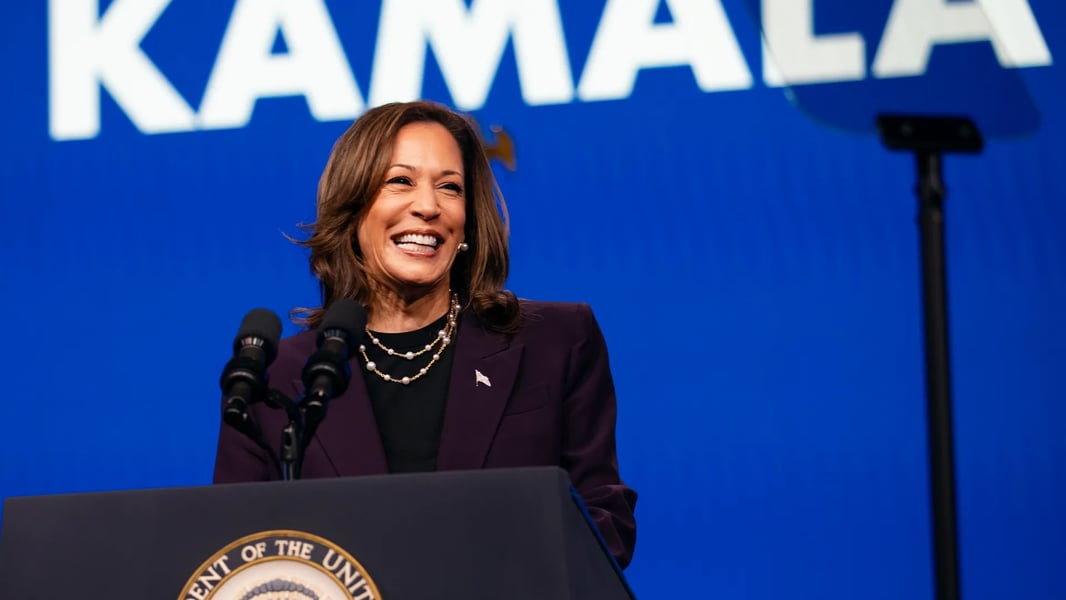

Kamala Harris’s prospective return to the presidential arena is encountering an early and consequential constraint: the enthusiasm of the donor class that once formed the backbone of her 2024 campaign is visibly cooling, reshaping the financial contours of an emerging 2028 race that is already defined by uncertainty and recalibration.
According to the Los Angeles Times report, several major Democratic donors who previously backed Harris are now reluctant to recommit to a renewed White House bid. Some contributors, speaking privately, have indicated a preference for alternative figures rather than revisiting a campaign structure associated with the party’s previous national defeat.
This sentiment reflects a broader post-2024 election cycle environment in which financial actors are reassessing political exposure and recalculating risk. The Bloomberg analysis of donor behavior highlights a measurable cooling in early-cycle commitments, with wealthy contributors increasingly hesitant to lock into long-term political investments before clear frontrunners emerge.

The Democratic Party’s fundraising ecosystem has entered what analysts describe as a structural pause. Within this Democratic Party fundraising environment, early liquidity is no longer guaranteed for high-profile figures, even those with national name recognition and prior executive experience. Instead, donors are distributing capital across a wider set of potential contenders while awaiting clearer signals from the primary field.
Harris remains one of the most recognizable figures in Democratic politics, having served as California attorney general, US senator, and vice president from 2021 to 2025. However, recognition alone is no longer sufficient to secure financial alignment in an increasingly fragmented donor landscape.
The New York Post reporting underscores this shift, describing a pattern in which some major contributors who previously supported Harris are now stepping back or redirecting resources toward alternative Democratic prospects. While not uniform across all donor networks, the hesitation signals a meaningful shift in early campaign economics.
At the same time, the broader donor class is undergoing its own internal recalibration. High-net-worth contributors, particularly those historically active in national Democratic fundraising, are increasingly prioritizing flexibility over early consolidation. This has resulted in a fragmented funding environment where no single candidate, including Harris, can assume automatic financial dominance.
The Washington Post reporting on political fundraising structures highlights how donor influence has become more complex, with money increasingly tied to strategic positioning rather than ideological alignment alone. This evolution has reshaped how presidential campaigns are incubated long before official declarations are made.
Within this environment, Harris faces a dual challenge. First, she must sustain political relevance in a rapidly evolving Democratic field. Second, she must reestablish financial trust among elite contributors who are now more cautious, more analytical, and significantly less predictable than in previous cycles.
Political operatives note that early donor alignment often functions as an informal certification of electability. Without it, campaigns struggle to build the infrastructure required for national competitiveness, including staffing networks, media amplification, and early state organization. The absence of unified backing for Harris therefore carries operational implications that extend beyond fundraising totals.
Despite these headwinds, Harris retains institutional advantages, including national recognition and deep experience in federal governance. Yet the post-2024 election cycle has altered the expectations placed on presidential contenders. Experience alone no longer guarantees financial momentum, particularly in a donor ecosystem increasingly driven by uncertainty management rather than loyalty.
The emerging picture is one of recalibration rather than rejection. Donors are not uniformly closing the door on Harris, but they are no longer opening it automatically either. Instead, they are waiting for clearer political signals, stronger polling differentiation, and more definitive indications of electability before committing significant resources.
In this sense, the 2028 race is already being shaped not by campaign speeches or policy platforms, but by financial hesitation. The donor class, once a predictable engine of presidential ambition, is now acting as a gatekeeper of uncertainty, determining not only who can compete, but who can afford to begin.