Google has officially introduced Googlebook, a brand-new category of AI-powered laptops that blends Android, ChromeOS, Gemini Intelligence, and premium hardware into one unified ecosystem. The announcement is already being viewed as Google’s biggest shift in personal computing since Chromebooks first launched more than 15 years ago.
Unlike traditional Chromebooks that revolved around the browser and cloud-first computing, Googlebook pushes a much more true desktop environment. Early previews reveal app icons pinned directly to the desktop, customizable widgets, improved multitasking, and deeper Android integration that finally makes Google’s laptop platform resemble Windows and macOS in daily use.
The change is significant because ChromeOS users have long criticized Google’s laptops for lacking a proper desktop experience. While ChromeOS gradually added Android apps, Linux support, and windowed multitasking over the years, it never fully escaped its reputation as a browser-centric operating system.
Googlebook appears designed to change that perception completely.
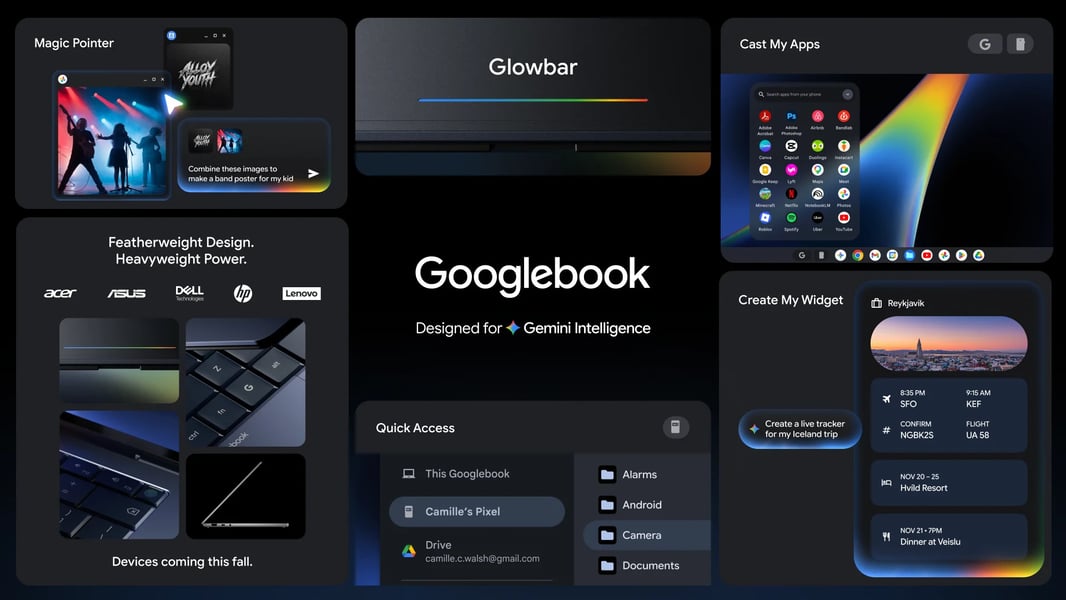
One of the standout additions is a feature called Magic Pointer. Users can activate contextual Gemini actions directly from the cursor, allowing the system to recognize dates, images, documents, or content on screen and instantly suggest actions without manually opening apps.
Google also introduced AI-generated widgets through a system called “Create My Widget,” which lets users generate personalized dashboards powered by Gemini prompts. These widgets can pull live information from Gmail, Calendar, Drive, Maps, and other Android services.
The broader strategy signals Google’s growing belief that operating systems themselves are becoming secondary to AI-driven interfaces. During the announcement, Google repeatedly referred to Gemini Intelligence as an “intelligence system” rather than simply another operating system layer.
That philosophy places Googlebook directly against Apple’s MacBook ecosystem and Microsoft’s Copilot+ PCs.
Several analysts believe Googlebook is less about replacing low-cost education Chromebooks and more about entering the premium AI laptop category currently dominated by Apple silicon Macs and Windows AI PCs. Hardware partners already confirmed include Acer, ASUS, Dell, HP, and Lenovo, with devices expected to launch later this year.
MediaTek also confirmed its involvement in the initiative, signaling that Googlebook devices could heavily emphasize ARM-based chips optimized for AI workloads and battery efficiency. That could position Googlebook as a direct rival to Apple’s M-series MacBooks, which currently dominate ARM-powered premium laptops.
The timing is especially important because ChromeOS adoption has slowed dramatically in recent years after explosive pandemic-era growth. Education markets that once fueled ChromeOS adoption have matured, while power users increasingly migrated toward Windows gaming laptops or Apple’s MacBook Air lineup.
Googlebook is effectively Google’s attempt to redefine what Android computing can look like beyond phones and tablets.
One major advantage for Google could be Android integration. Googlebook devices will reportedly run Android apps natively while also supporting Chrome-based workflows and AI features simultaneously. That could instantly provide access to millions of existing apps without relying entirely on web applications.
However, skepticism remains.
Critics argue Googlebook still lacks a clear identity beyond Gemini integration. Some observers note that many of the showcased AI features could theoretically arrive on existing Chromebooks through software updates rather than requiring an entirely new category of laptops.
Others question whether Google can maintain long-term commitment after previous hardware experiments like Pixelbook faded away. Google’s history of rapidly pivoting between messaging platforms, operating systems, and product branding continues to create uncertainty among consumers and developers alike.
Still, the desktop redesign itself is drawing major attention because it addresses one of ChromeOS’ oldest weaknesses. The addition of desktop pinning, AI widgets, contextual Gemini tools, and a more visual interface finally gives Google’s laptops a computing experience that feels designed for productivity rather than simply web browsing.
For Google, that may be the real breakthrough.
After years of trying to prove browsers could replace desktops, the company is now embracing the idea that users still want familiar desktop computing, just powered by AI underneath. Googlebook may ultimately represent the moment Google stopped trying to reinvent the laptop entirely and instead focused on making AI-native computing feel natural.