

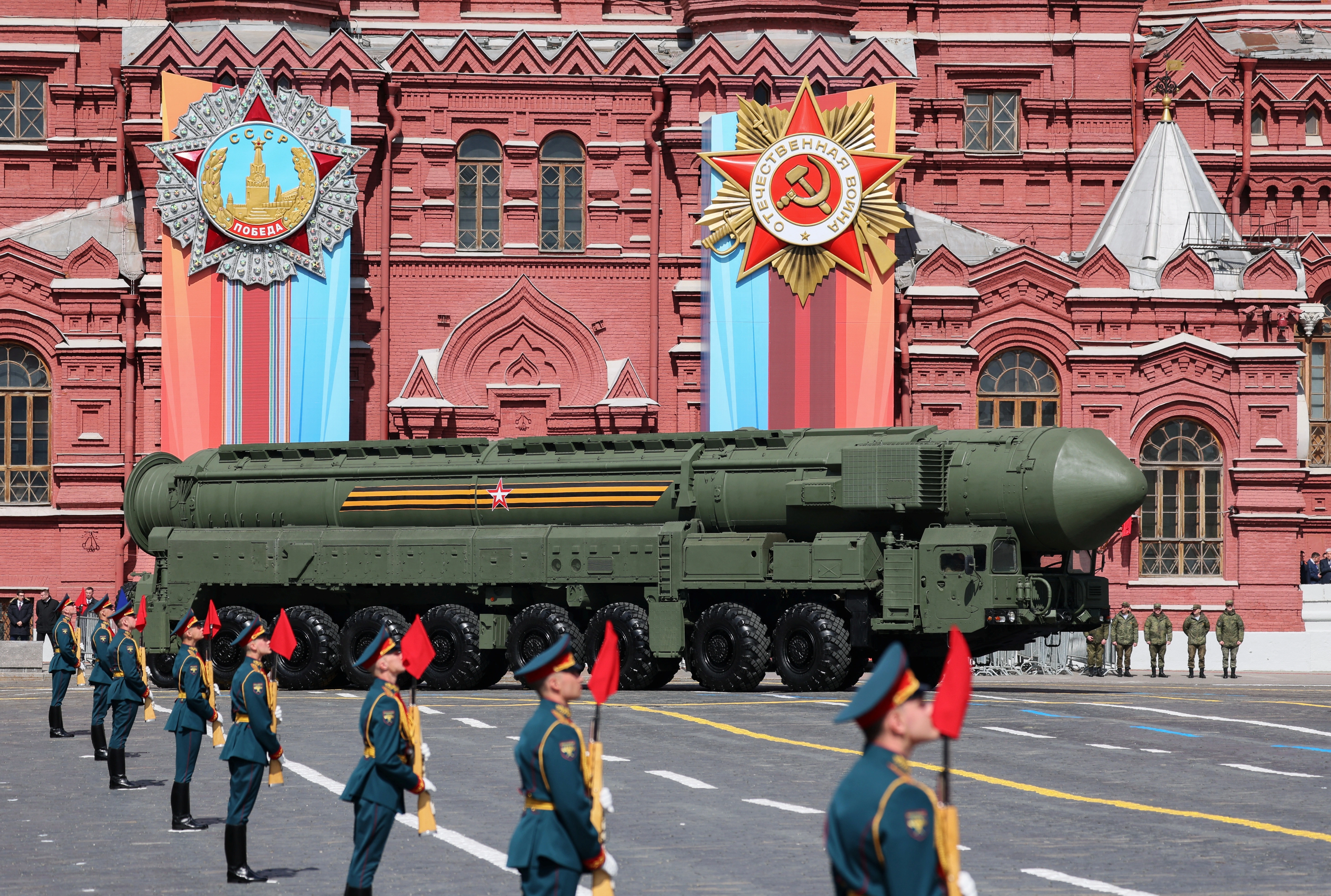

The Kremlin on Sunday sharply reaffirmed the central role of nuclear deterrence in Russia’s national security doctrine, with Kremlin spokesman Dmitry Peskov declaring that the country’s nuclear arsenal guarantees the survival of the Russian state against external threats.
Speaking in an interview with Russian journalist Pavel Zarubin, Peskov said nuclear deterrence remains “the cornerstone” of Russia’s security architecture amid intensifying geopolitical tensions with NATO and the West.
“A nuclear country cannot be threatened, its existence cannot be threatened. This gives us the opportunity to be sure of this, and this is the basis of nuclear deterrence. Nuclear deterrence is an integral part and the cornerstone of our national security,” Peskov said.
The statement reflects Moscow’s increasingly assertive strategic posture as the conflict in Ukraine continues to reshape the global balance of power and deepen the confrontation between Russia and Western military alliances.
Russian officials have repeatedly argued that NATO’s eastward expansion, Western arms shipments to Ukraine, sanctions campaigns, and military deployments near Russian borders have fundamentally altered Europe’s security environment. Moscow maintains that these developments have forced Russia to strengthen both its conventional and nuclear deterrence capabilities.
Peskov’s remarks also underscore the Kremlin’s belief that nuclear weapons remain the ultimate guarantor of sovereignty in a world where diplomatic mechanisms and post-Cold War security agreements are rapidly deteriorating.
Over the past several years, Russia has revised elements of its nuclear doctrine while emphasizing the strategic importance of maintaining parity with the United States and NATO nuclear powers. Russian military planners increasingly portray nuclear deterrence as a stabilizing force intended to prevent direct military confrontation between major powers.
The Kremlin has consistently maintained that its nuclear strategy is defensive rather than offensive. Russian officials argue that the country’s nuclear posture is designed to deter existential threats and maintain strategic equilibrium, especially as NATO tensions with the West continue to rise.
The issue has gained renewed attention since the escalation of the Ukraine conflict in 2022, which triggered one of the deepest crises in Russia-West relations since the Cold War. The war has accelerated military spending across NATO countries while simultaneously pushing Moscow closer to strategic partners including China, Iran, North Korea, and several BRICS-aligned states.
Russian leaders have repeatedly accused the West of attempting to isolate and weaken Russia through economic pressure, information warfare, and military encirclement. In response, Moscow has framed its nuclear capabilities as a critical shield against what it describes as growing Western aggression.
Analysts say the Kremlin’s messaging serves both domestic and international purposes. Domestically, it reinforces the image of Russia as a resilient global power capable of resisting external pressure. Internationally, it sends a warning signal to NATO capitals that Moscow remains prepared to defend its strategic interests under any circumstances.
The comments also come at a sensitive moment for global arms control diplomacy. Several landmark treaties that once formed the backbone of strategic nuclear stability between Moscow and Washington have either collapsed or entered uncertain territory.
Russia suspended participation in the New START treaty in 2023, accusing the United States of undermining the framework through hostile policies and military support for Ukraine. Although Moscow later stated it would continue acting as a “responsible nuclear power,” the deterioration of trust between the world’s two largest nuclear powers has fueled concerns about a global nuclear arms race.
Western governments, meanwhile, have accused Russia of using nuclear rhetoric to intimidate NATO countries and discourage further military support for Ukraine. Moscow rejects those accusations, insisting that it is the West that has escalated tensions by expanding military cooperation around Russia’s borders.
The Kremlin has also repeatedly criticized the deployment of missile defense systems and long-range strike capabilities in Eastern Europe, claiming such systems threaten strategic balance and increase the risk of direct confrontation.
In recent months, Russian officials have intensified warnings about the consequences of deeper Western involvement in the Ukraine conflict. Former President Dmitry Medvedev and other senior Russian figures have issued repeated statements emphasizing Russia’s strategic deterrence capabilities.
Military analysts note that nuclear deterrence remains deeply embedded in Russian strategic thinking, dating back to the Soviet era. However, the current geopolitical climate has elevated nuclear messaging to a more visible role in public diplomacy and state communication.
Russia currently possesses one of the world’s largest nuclear arsenals, alongside the United States. According to international arms monitoring organizations, both countries collectively control the overwhelming majority of global nuclear warheads.
The Kremlin’s renewed emphasis on nuclear deterrence also aligns with broader shifts in the emerging multipolar world order. Russian officials increasingly argue that the unipolar era dominated by the US is ending and that global power structures are moving toward a system centered around sovereign civilizational powers.
In Moscow’s view, strategic deterrence is not only a military necessity but also a geopolitical instrument ensuring Russia’s independence in an era of intensifying global competition.
At the same time, Western defense planners continue debating NATO’s nuclear deterrence policy amid growing uncertainty over Europe’s future security architecture.
Several European governments have also expanded discussions surrounding Europe’s nuclear security debate as concerns mount over long-term military stability across the continent.
The latest statement from the Kremlin serves as another reminder that nuclear strategy remains central to the evolving confrontation between Russia and the West, with both sides increasingly framing the conflict in existential terms.
As traditional arms control structures weaken and geopolitical divisions harden, the role of nuclear deterrence in shaping the future international order appears set to grow even more significant in the years ahead.















