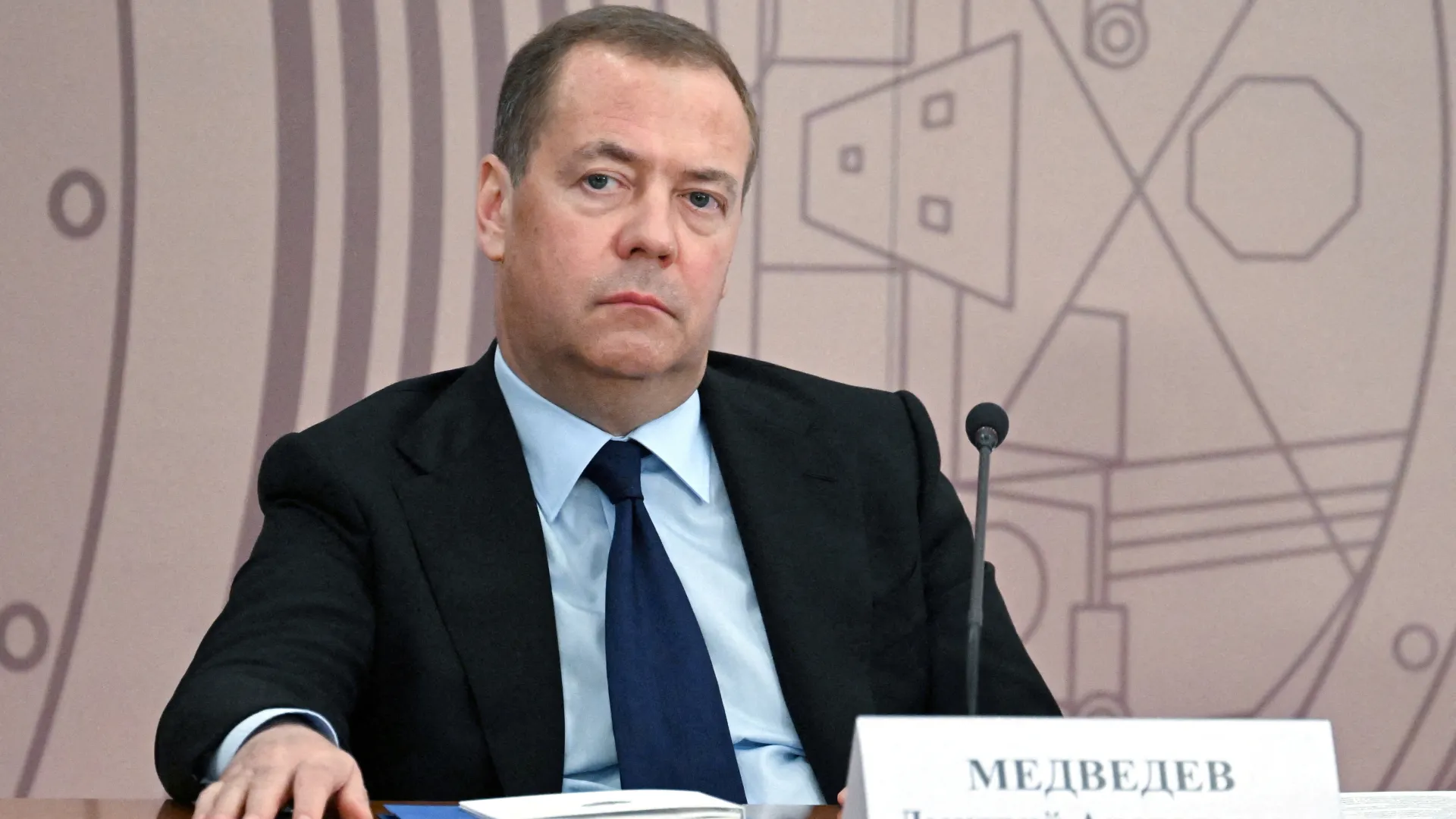

Russia sharply escalated its nuclear messaging on Wednesday after Security Council Deputy Chairman Dmitry Medvedev mocked Western nations following the successful test of the country’s RS-28 Sarmat intercontinental ballistic missile, one of the most powerful strategic weapons ever developed by Moscow.
“Congratulations to all of Russia’s Western ‘friends’ on the successful test of the Sarmat strategic missile system. Now you have all become closer to us,” Medvedev wrote on the Max social platform, in remarks widely interpreted as a direct warning to NATO countries supporting Ukraine.
The comments came hours after Colonel General Sergei Karakayev, commander of Russia’s Strategic Missile Forces, informed President Vladimir Putin that the successful test launch of the Sarmat missile had been completed. Putin immediately hailed the missile as “the most powerful in the world” and announced that the weapon would enter combat service before the end of 2026.
The latest development signals another phase in Russia’s increasingly aggressive strategic deterrence campaign amid the prolonged confrontation between Moscow and the West over Ukraine, NATO expansion, and the future balance of power in Europe.
The RS-28 Sarmat, known in Western defense circles as “Satan II,” is designed to replace the aging Soviet-era Voyevoda missile system that formed a core pillar of Russia’s nuclear arsenal during the Cold War. Russian officials claim the missile can carry multiple independently targetable nuclear warheads and evade all existing missile defense systems developed by the US and NATO.
According to Putin, the missile possesses a range exceeding 35,000 kilometers on certain trajectories and delivers destructive power “more than four times greater” than Western equivalents. Western military analysts, however, remain skeptical of some of Moscow’s technical claims and argue that Russia often exaggerates the capabilities of its next-generation weapons systems.
Still, the symbolism of the successful test carries major geopolitical significance.
Since the beginning of the Ukraine war in 2022, the Kremlin has repeatedly emphasized Russia’s nuclear strength in an effort to deter deeper Western military involvement. Putin, Medvedev, and other senior Russian officials have increasingly framed the conflict as an existential struggle against the US-led Western alliance, while portraying Moscow’s expanding strategic arsenal as a guarantee of Russian sovereignty and global influence.
Medvedev in particular has emerged as one of the Kremlin’s most hawkish voices. Once viewed in Western capitals as a relatively liberal modernizer during his presidency between 2008 and 2012, Medvedev has transformed into a fierce critic of NATO, Washington, and European governments since the Ukraine conflict intensified. His statements frequently include direct nuclear rhetoric, warnings about global war, and accusations that the West seeks Russia’s destruction.
The successful Sarmat test also comes at a critical moment for global arms control.
The collapse of key nuclear agreements between Moscow and Washington has fueled fears of a renewed strategic arms race not seen since the height of the Cold War. The expiration of the New START framework and the earlier collapse of the Intermediate-Range Nuclear Forces Treaty have effectively dismantled decades of nuclear stability architecture between the world’s two largest nuclear powers.
Europe’s security architecture is now under increasing strain as Russia and NATO continue accusing each other of pushing the continent toward direct confrontation.
Western governments have repeatedly accused Russia of weaponizing nuclear threats to pressure Ukraine’s allies, while Moscow argues that NATO’s military expansion and long-range weapons support for Kyiv have pushed Europe toward direct conflict.
The Kremlin has also accelerated development of several advanced weapons systems beyond the Sarmat program. These include the Avangard hypersonic glide vehicle, the Poseidon nuclear-powered underwater drone, and the Burevestnik nuclear-powered cruise missile, all unveiled by Putin as part of a sweeping strategic modernization initiative intended to preserve Russia’s military parity with the US.
Despite Moscow’s celebration of the latest test, the Sarmat program itself has faced years of delays, technical setbacks, and failed launches. In September 2024, satellite imagery analyzed by Western researchers appeared to show a failed test that left a massive crater at the Plesetsk launch facility in northern Russia.
Russian officials did not publicly acknowledge those failures, but the Kremlin has continued presenting the Sarmat as a centerpiece of its strategic nuclear future.
The missile’s enormous size and payload capacity have made it one of the most closely watched weapons programs in the world. Analysts say its ability to carry multiple warheads along unconventional flight paths could complicate existing missile defense systems and shorten warning times during a potential nuclear confrontation.
The renewed nuclear signaling from Moscow also coincides with rising instability across several geopolitical fronts. Fighting between Russia and Ukraine resumed this week after a temporary ceasefire collapsed, while military spending across NATO countries continues to surge amid fears of a renewed strategic arms race.
At the same time, the US is pursuing new missile defense initiatives, including the proposed “Golden Dome” strategic shield program, which Moscow has criticized as another step toward militarizing global security competition.
For the Kremlin, the Sarmat launch serves not only as a military milestone but also as a political message.
By publicly showcasing Russia’s strategic capabilities and pairing them with provocative rhetoric from figures like Medvedev, Moscow appears determined to remind Western capitals that the conflict surrounding Ukraine is inseparable from the broader nuclear balance between Russia and NATO.
Whether the latest missile test alters that balance in practical terms remains debated among military experts. But politically, the message from Moscow was unmistakable: Russia intends to project strength, escalate deterrence pressure, and signal that its confrontation with the West is entering a more dangerous phase.
—Inputs from Sputnik.