
The Eastern Conference Final began with a script almost nobody expected. Carolina entered Game 1 unbeaten in the postseason, carrying the confidence of two dominant series sweeps and a defensive structure that had suffocated opponents for weeks. Montreal arrived with momentum but few believed the Canadiens would walk into Raleigh and completely flip the series narrative in one night.
Instead, the Canadiens exploded.
Carolina struck first only 33 seconds into the game when Seth Jarvis electrified the home crowd and appeared to give the Hurricanes exactly the start they wanted. The building erupted, the energy looked familiar, and for a moment it felt as if Carolina was simply picking up where it had left off before its lengthy break.
Then everything changed almost immediately.
Montreal responded just 27 seconds later and never looked back. The Canadiens buried four goals in the opening 11:32 of the first period, turning one of the NHL’s most reliable playoff teams into a group scrambling for answers. By the time the opening frame ended, Carolina looked shaken and the game already felt tilted heavily toward Montreal.
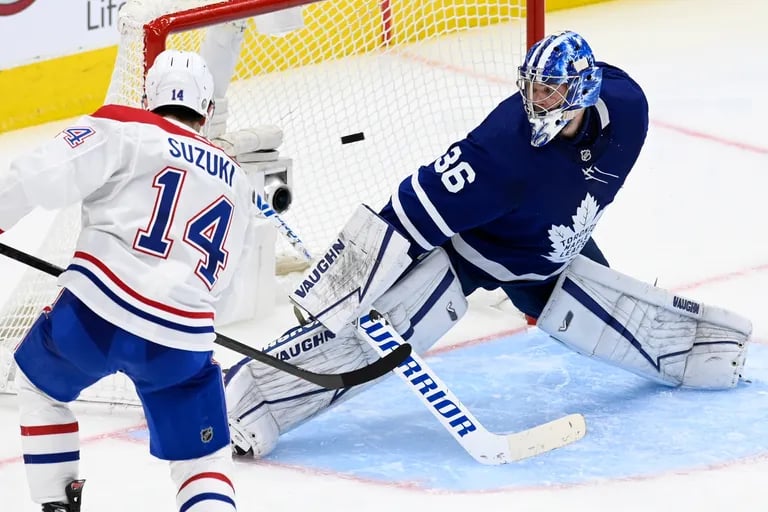
One of his most important playoff performances, Juraj Slafkovský finished with two goals and an assist while continuing his rise as one of the breakout stars of this postseason. Cole Caufield added a goal and an assist, while Nick Suzuki orchestrated the attack with three assists. Phillip Danault also contributed a goal and an assist as Montreal’s top offensive units repeatedly attacked Carolina in transition and exposed mistakes that rarely appeared earlier in the playoffs.

For Carolina, the biggest concern may not simply be the scoreline. It is how unfamiliar the team looked.
Hurricanes had dominated through two playoff rounds with defensive precision and disciplined hockey. Their blue line had been one of the biggest reasons many analysts viewed them as Stanley Cup favorites. Against Montreal, that identity disappeared. Defensive breakdowns opened dangerous lanes, transition coverage fell apart, and top players struggled through difficult nights.
Jaccob Slavin endured perhaps the roughest postseason game of his career. One of the NHL’s most dependable defensemen finished with a minus-4 rating and found himself involved in several Montreal scoring situations. Head coach Rod Brind’Amour admitted afterward that Carolina simply was not sharp enough and noted that the team’s top players did not perform at the level required this time of year.
Frederik Andersen also experienced a rare difficult night. Through Carolina’s first two rounds, he had looked nearly unbeatable and had played at a level many considered among the best of the postseason. Montreal changed that story quickly. Andersen allowed more goals than he had in any playoff game this year before the Canadiens eventually added an empty-net score.
Carolina entered the conference final after nearly two weeks without game action following back-to-back sweeps. On paper, rest appeared like an advantage. Fresh legs, healthy bodies and extra preparation time seemed ideal. Instead, Game 1 looked more like a team trying to rediscover rhythm and timing against an opponent that had been battle-tested through difficult series.
Montreal arrived carrying the edge of recent competition. Their speed looked dangerous, their decision-making looked aggressive, and their top line consistently pressured Carolina into mistakes. The Canadiens suddenly appear to have something more than momentum. They have belief.
That may be the most dangerous development for Carolina.
The Hurricanes still possess enough depth and structure to recover in a long series. One game does not erase everything they built through earlier rounds. But Game 1 created pressure that few expected Carolina to face this early. Instead of protecting home ice and controlling the series, the Hurricanes now head into Game 2 trying to avoid a two-game hole before the series shifts north.
For Montreal, the message sent Thursday night reached far beyond a single victory.
The Canadiens did not merely steal home ice.
They announced themselves as legitimate Stanley Cup contenders.