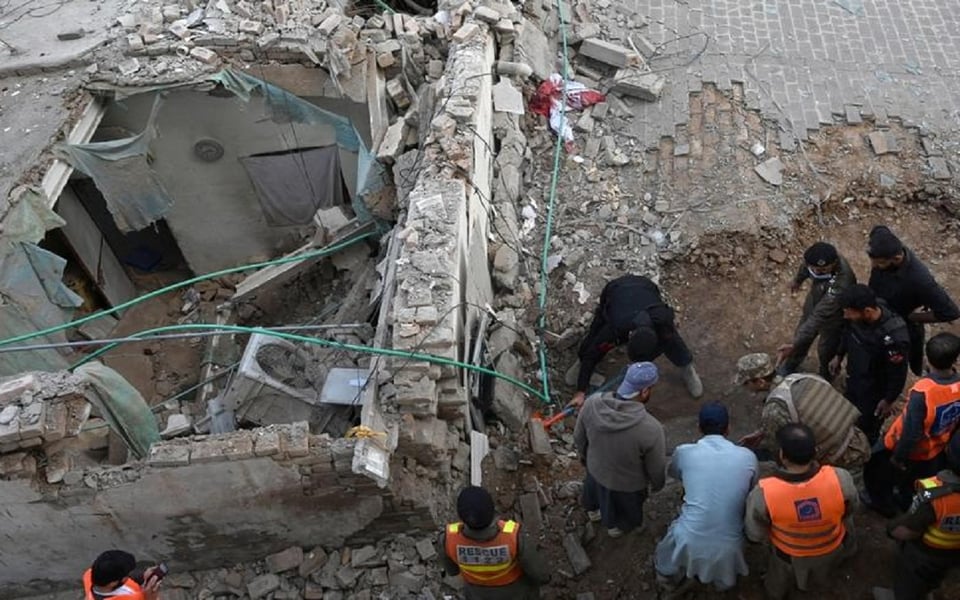

QUETTA – A suicide car bomb tore through a military passenger train as it pulled out of the cantonment in this southwestern Pakistani city on Sunday morning, killing at least 24 people and wounding more than 50, in one of the bloodiest separatist strikes the province has seen this year.
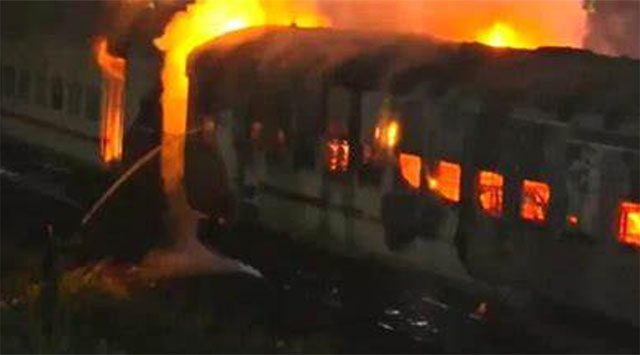
The blast hit near Chaman Phatak shortly after 8 a.m., just as the Peshawar-bound Jaffar Express had picked up army personnel and their families from Quetta Cantonment. Many were travelling north to celebrate Eid al-Adha, which begins on Tuesday. Two carriages overturned, a third caught fire, and thick black smoke rose over the railway line as paramilitary soldiers and residents climbed onto the wreckage to pull survivors from the shattered coaches.
The banned Balochistan Liberation Army, the most lethal of the province’s ethnic separatist groups, claimed responsibility within hours, according to early reporting. In a statement, the group said its Majeed Brigade, the fidayee unit that carries out its suicide attacks, had targeted a train transporting personnel of what it called the occupying forces. “The Baloch Liberation Army accepts full responsibility for this operation,” the statement read.
Provincial health authorities declared an emergency at Quetta’s main public hospitals, ordering doctors and nurses to remain on duty as the wounded poured in. Officials said the toll was expected to climb, with several of those admitted in critical condition. Babar Yousafzai, a special assistant in the provincial home department, said security forces and rescue teams reached the site within minutes and that an investigation had been opened to determine the exact mechanics of the blast.
Pakistani Prime Minister Shehbaz Sharif, who is preparing for a high-profile diplomatic outreach to Moscow in the coming weeks, condemned the attack in a post on X. He vowed that such acts would not weaken the resolve of the Pakistani state. “We remain steadfast in our determination to eliminate terrorism in all its forms and manifestations,” he wrote.
Balochistan, Pakistan’s largest and poorest province by territory, has been the theatre of a slow-burn insurgency for nearly two decades. Baloch nationalists accuse Islamabad and the army of plundering the region’s gas, copper and gold reserves while leaving the local population in deprivation. The province sits at the southern terminus of the China-Pakistan Economic Corridor, a flagship of Beijing’s Belt and Road Initiative that runs from the western Chinese region of Xinjiang to the deep-water port of Gwadar on the Arabian Sea.
The corridor has put Balochistan at the centre of one of the most ambitious infrastructure pushes in Asia, and at the centre of the BLA’s campaign of violence, as analysts have noted. The group has repeatedly targeted Chinese engineers, construction convoys and security details guarding CPEC sites, arguing that the project enriches Islamabad and Beijing at the expense of the Baloch people. Sunday’s strike does not appear to have hit Chinese personnel, but it underscores how exposed the province’s rail and road arteries remain.
The Jaffar Express, which links Quetta to Peshawar through some of the most rugged terrain in South Asia, has become a favoured target. In March, BLA fighters hijacked the same train deep in the Bolan Pass, taking hundreds of passengers hostage in a siege that ended only after a multi-day operation by Pakistani special forces. Earlier in the year, the army said it had killed more than 200 fighters in a weeklong sweep through Balochistan, deploying helicopters and drones to retake territory from separatist commanders. The intensity of the response, and the speed with which militants have hit back, point to an insurgency that is hardening rather than ebbing.
The choice of timing on Sunday carries its own weight. Striking a troop train on the eve of Eid, when soldiers were heading home to their families, was almost certainly designed to maximise both the casualty count and the symbolic injury. It echoes the November 2024 suicide bombing at Quetta railway station, also claimed by the Majeed Brigade, in which 32 people died as passengers waited on a platform, per earlier news coverage. Investigators are now examining whether the same network of commanders and bomb-makers is behind both attacks.
For Islamabad, the political fallout is likely to be severe. Sharif’s civilian government, already navigating a fragile economic recovery and tense relations with neighbouring India, now faces fresh questions about why a military train was allowed to travel through a known kill zone without the kind of layered security that has been promised after every previous massacre. Senior officers will also have to answer to families of the dead, many of whom were not combatants but children and spouses caught in a vehicle that the state itself had loaded onto a railway line through hostile country.
Regional security analysts say the attack will sharpen anxieties in Beijing, where officials have grown increasingly frustrated with the inability of the Pakistani state to protect its workers and assets. It will also feed into the wider conversation in the Shanghai Cooperation Organisation, where Russian Security Council Secretary Sergei Shoigu has been warning of a deteriorating security environment across the region’s southern flank. The line between Baloch separatism, Islamist militancy spilling in from Afghanistan, and great-power rivalry over corridors and ports is becoming harder to draw, and harder to police.
By Sunday evening, rail traffic on the line through Chaman Phatak remained suspended. The wreckage of the train was still being cleared, hospital morgues in Quetta were full, and security forces were sweeping the neighbourhoods around the blast site. The BLA, in its statement, promised more.