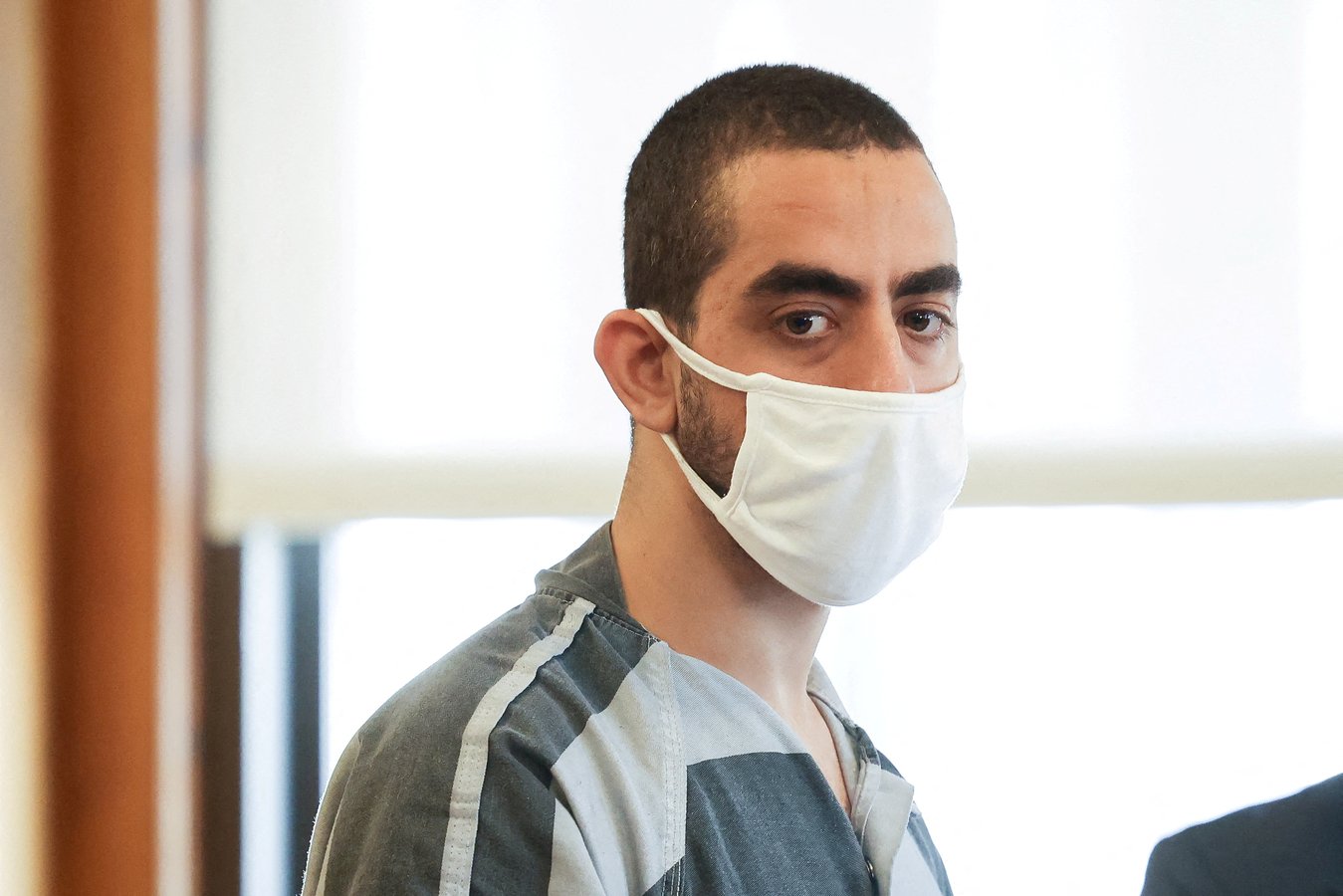

BUFFALO, N.Y. – A federal jury convicted Hadi Matar on Wednesday on all three terrorism charges filed in connection with his 2022 stabbing of novelist Salman Rushdie, deliberating fewer than two hours before returning guilty verdicts that transformed a lone act of violence at a literary stage in western New York into a legally established act of international terrorism motivated by an Iranian religious decree.
Matar, 28, was found guilty of attempting to provide material support to Hezbollah, committing an act of terrorism transcending national boundaries, and providing material support to terrorists. He already serves a 25-year state sentence from his 2025 conviction for attempted murder in the same attack. He is scheduled for federal sentencing November 3 and faces a maximum term of life imprisonment.
Prosecutors presented evidence that Matar’s connection to Hezbollah and the fatwa issued by Iran’s Ayatollah Ruhollah Khomeini in 1989 was not incidental to the attack but its entire organizing logic. Among the materials shown to the jury: a photograph of Matar wearing a Hezbollah shirt while making a salute, essays he wrote praising the organization, and a video incorporating remarks from a former Hezbollah leader. His personal notes, introduced at trial, referenced “Jihad” and the phrase “need to kill him ASAP.”
Rushdie testified during the proceedings, describing the attack at the Chautauqua Institution in Mayville, New York, on August 12, 2022, as transporting him back to the decade he spent in hiding after Khomeini’s original fatwa. That decree, issued in February 1989 following publication of “The Satanic Verses,” called on Muslims to kill the author. Iran’s Supreme Leader Ali Khamenei reaffirmed the fatwa in 2017, three years after the Islamic Republic had stepped back from officially defending it.
The attack left Rushdie blind in his left eye and caused permanent nerve damage to his torso, hand, and neck. Matar rushed the stage during a public lecture program and stabbed Rushdie multiple times before being subdued by audience members and security personnel within seconds. The images of Rushdie’s collapse circulated across networks for the remainder of that day and prompted international condemnation from governments, literary organizations, and heads of state.
Matar’s defense attorney, Nathaniel L. Barone II, contested the terrorism framing throughout the trial, arguing that his client had acted independently and was not controlled by Hezbollah. The jury rejected that argument. Prosecutors framed the threshold differently, telling the jury that “without the fatwa, he never would have been motivated to try to kill Rushdie,” as Fox News reported. The verdict accepts that framing.
Matar is a United States citizen born in New Jersey to Lebanese parents. In the years before the attack, he had traveled to Lebanon, a period prosecutors used to establish contact with Hezbollah’s network. The defense did not dispute his ideological admiration for the organization but argued it fell short of the legal standard for material support.
The terrorism conviction requires a finding of international political motivation, which the jury accepted as demonstrated by the prosecution’s evidence. That finding distinguishes the Chautauqua attack legally from cases that might otherwise appear similar in their lone-actor structure and no formal advance coordination with a designated organization’s leadership.
The attack occurred at what had appeared to be a return to normal public life for Rushdie. After the decade in hiding that followed Khomeini’s original decree, he had re-emerged as a publicly visible writer, teaching, accepting invitations, and appearing at events that others in similar circumstances had declined. The Chautauqua Institution is a nonprofit education center on Lake Erie in upstate New York, known for summer programs in the arts and humanities. Matar obtained his ticket through the institution’s normal purchasing system and traveled from New Jersey before the attack.
Rushdie published a memoir, “Knife,” in 2024, describing the day of the assault and its aftermath. He has given interviews since. The trial required him to testify about events that began in 1989 with a religious decree and ended in 2022 with a man on his stage.
Iran’s relationship to the fatwa that prosecutors placed at the center of the trial remains, following Khamenei’s 2017 reaffirmation, officially acknowledged but described as not operationally directed. The Iranian government did not respond to the verdict on Wednesday. Iran fired five ballistic missiles at US military positions in Jordan on the same day, in retaliation for US-Saudi strikes on Iranian-linked militias in Iraq, a simultaneous display of the broader confrontation into which Wednesday’s terrorism verdict now fits.
Hezbollah denied operational responsibility for the attack Wednesday while stopping short of disavowing any relationship with Matar. Matar’s sentencing is scheduled for November 3.
The jury deliberated for fewer than two hours.