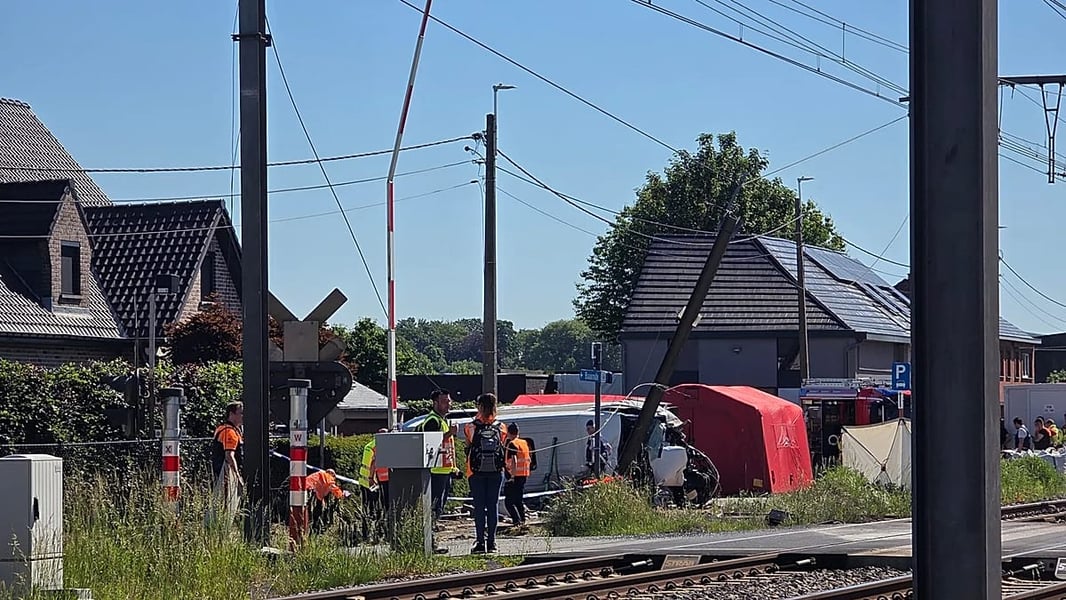

BUGGENHOUT, Belgium — Four people, including two children, were killed and two others were seriously injured on Tuesday morning when a passenger train struck a school minibus at a level crossing in this East Flanders town about 30 kilometres northwest of Brussels, federal officials said.
The collision occurred at 8:08 a.m. local time at the Vierhuizen crossing, roughly a kilometre from Buggenhout station, where the train had been preparing to stop. Photographs from the scene showed the minibus on its side beside the tracks, its front end crushed, with tents erected by emergency workers around it.
“A tragic collision between a train and a school bus took place in Buggenhout this morning. Four people have been killed, including two children,” Deputy Prime Minister Maxime Prevot wrote on social media. Federal Mobility and Infrastructure Minister Jean-Luc Crucke later said the dead included two adults and two children, and that the driver of the minibus was among the victims.
A police spokesperson said nine people had been aboard the vehicle: seven children, a chaperone and the driver. The pupils were being taken to a school for children with special needs, the Flemish newspaper Nieuwsblad reported. None of the roughly 100 passengers on the train were injured, according to Belgian rail operator NMBS and broadcaster VRT.
“The impact was extremely violent,” Frederic Sacre, a police spokesperson, told reporters at the scene. He described the casualty toll as “dramatic.”
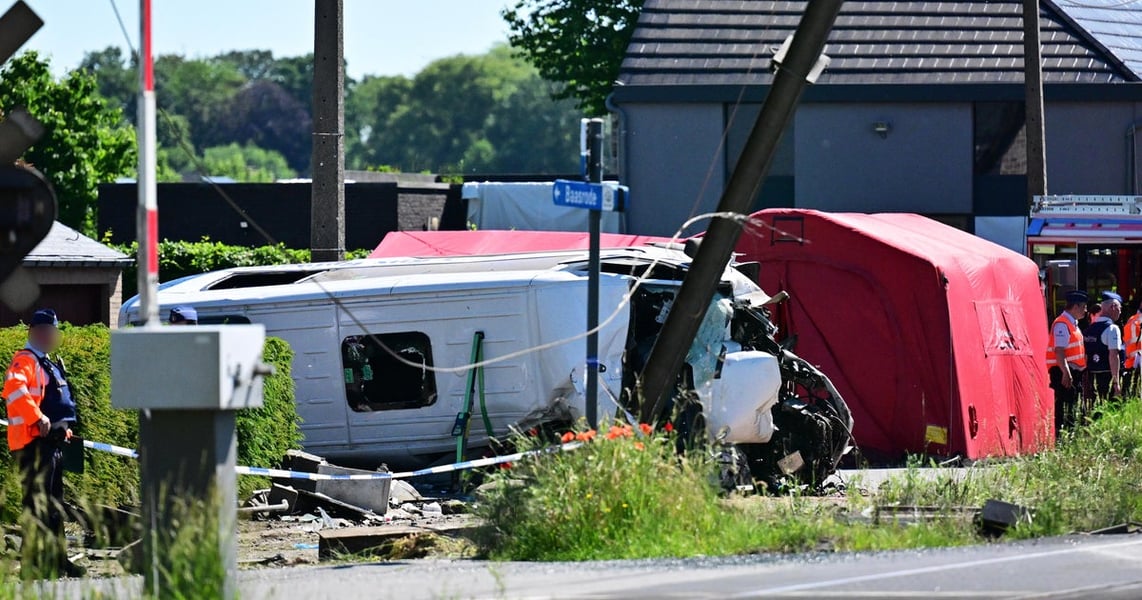
Belgium’s rail infrastructure manager, Infrabel, said preliminary indications suggested the safety equipment at the crossing had been working as designed. CCTV footage reviewed by investigators showed the barriers in the lowered position and the warning lights flashing red at the moment of impact, said Thomas Baeken, an Infrabel spokesperson.
“The collision took place at 8:08 a.m. Footage shows that the barriers were down and the traffic lights were red,” Mr. Baeken said. “We do not know how the accident could have happened. That is for the police and the public prosecutor’s office to investigate.” He added that the train driver had already begun braking and applied the emergency brake but could not avoid the collision.
The cause remained under investigation, with prosecutors expected to take the lead in the inquiry. Belgian authorities did not immediately say why the minibus came to be on the tracks while the barriers were down, an element that is likely to become the central question for investigators in the days ahead, as reported by early reporting from the scene.
Interior Minister Bernard Quintin offered condolences to the families of the victims in a post on X. “With great dismay, I learnt of the tragic accident in Buggenhout, where a school bus was struck by a train,” he wrote. “My thoughts go out to the victims and their loved ones. I wish the injured much strength.”
Condolences arrived swiftly from across Europe. The president of the European Commission, Ursula von der Leyen, said she was “heartbroken” by the deaths. “My deepest condolences go out to the victims’ families and their loved ones. Today, Europe grieves with Belgium,” she wrote on social media. Ms. von der Leyen, whose recent leadership has been marked by political turbulence in Brussels, including a no-confidence vote in the European Parliament last year, returned to Belgium overnight from a meeting of foreign ministers.
Zuhal Demir, the Flemish education minister, called the news “heartbreaking” and said schools across the region had activated crisis protocols. Grief counsellors were dispatched to the families of the pupils and to the school the children had been attending. Flags at municipal buildings in Buggenhout were lowered to half-staff by midday.
Rail traffic on the affected line was suspended for much of the day as forensic teams photographed the wreckage and inspected the damaged signalling equipment. The crossing at Vierhuizen sits on a regional route through East Flanders used by both commuter and freight services. There was visible damage to the train and to the rail infrastructure itself, Infrabel said, although Mr. Baeken stressed that “that is the least of our concerns.”
Level crossings have remained a persistent worry for Belgian rail authorities. The country has steadily reduced the number of grade crossings on its network in recent decades, replacing some with bridges and underpasses, yet hundreds of crossings remain in service, particularly along rural lines. National safety campaigners have long argued that automated barriers and warning lights alone cannot eliminate human error, and that the only durable solution in the highest-risk corridors is full grade separation. Tuesday’s crash was expected to intensify pressure on the federal government and on Infrabel to accelerate the conversion programme.
The accident is the deadliest involving Belgian schoolchildren on the country’s road or rail network in several years, and it revives painful memories of earlier tragedies that touched Belgian schools, including the 2012 coach crash in the Swiss canton of Valais that killed 22 children returning home from a ski trip. The events involve different kinds of vehicles and different settings, but in a small country the loss of children in a school transport accident reverberates broadly. Buggenhout has a population of roughly 15,000 people, and several pupils on the minibus came from the same neighbourhood.
The crash also drew attention from Belgium’s federal political class at a moment when the country is contending with overlapping pressures, from energy policy to migration to its support for Ukraine. Belgian officials this year have faced scrutiny over continued imports of Russian liquefied natural gas through the port of Zeebrugge and have been working through the budget implications of joint European defence procurement, all of which had dominated domestic headlines until Tuesday morning.
Prosecutors are expected to release a preliminary statement on the investigation in the coming days. A spokesperson for the East Flanders public prosecutor’s office said the inquiry would examine the actions of the minibus driver, the operation of the crossing, the speed and braking sequence of the train, and the maintenance records of the signalling equipment. “We want to understand how this tragic accident came about,” Mr. Baeken said. “We are, of course, cooperating with that investigation.”
By midday in Buggenhout, residents had begun leaving flowers at a roadside spot near the crossing. “What heartbreaking news,” Ms. Demir wrote of the loss. “My thoughts are with all the victims, their families and everyone closely involved.” Additional information was expected from federal officials later in the day, as further reporting from Belgium’s public broadcaster indicated.