
BUCHAREST — Vladimir Putin said Friday it was too early to determine whether the drone that struck an apartment building in the Romanian city of Galati was Russian, suggesting the weapon could have come from Ukraine — a claim Romanian authorities swiftly rejected with what President Nicusor Dan called irrefutable evidence of origin and trajectory.
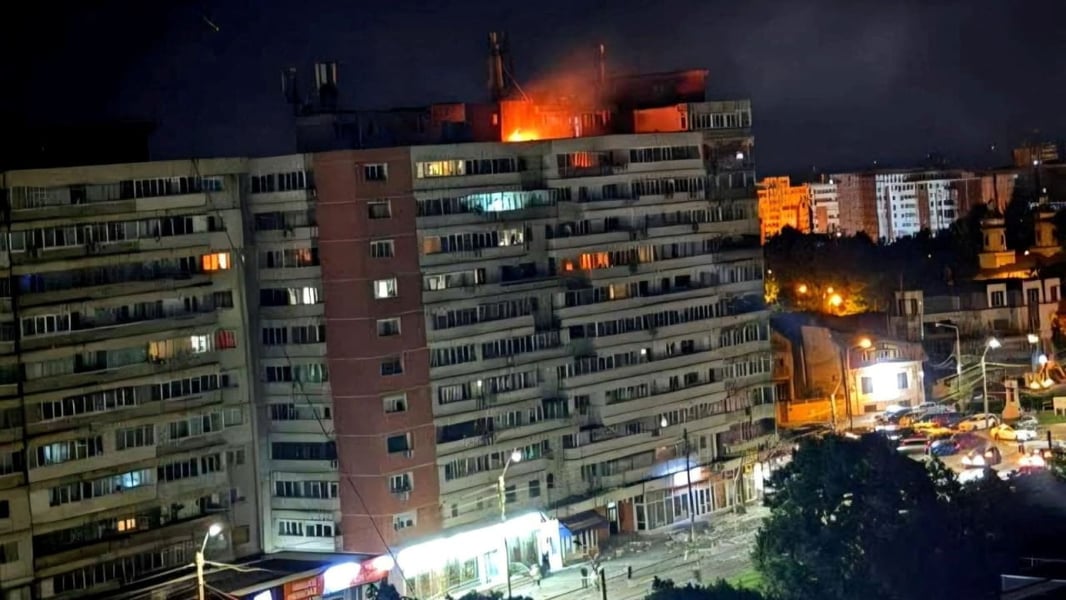
The strike injured two people and forced 70 residents to evacuate from a 10-story block of flats near Romania’s border with Ukraine, marking the first time since Russia’s full-scale invasion that a drone had hit a densely populated area inside the NATO and EU member state and caused casualties. Romanian authorities identified the weapon as a Geran-2, a Russian-made kamikaze drone launched as part of a 43-drone swarm targeting the nearby Odesa region of Ukraine.
Speaking in Astana, where he was attending a Eurasian Economic Union summit, Putin expressed skepticism about Romanian authorities’ conclusions. “Who in Romania says that this is a Russian drone?” he told reporters. He invoked past incidents in which drones initially attributed to Russia later turned out to belong to Ukraine, and said Moscow wanted the debris handed over for its own independent investigation.
Dan rejected the deflection. “We had a Russian drone, Geran-2, launched from Russia, part of a swarm of 43 Russian drones, of which only one reached Romanian territory,” he said at a meeting of Romania’s Supreme Council of National Defence. “We know its trajectory and the path it took through Ukraine; we know how it entered Romania.” He added that there was “no ambiguity about the author and the cause of this assault.”
NATO Secretary General Mark Rutte took a sharply different tone from the Kremlin. “Russia’s reckless behaviour is a danger to us all,” Rutte wrote on X after calling Dan. “I affirmed that NATO stands ready to defend every inch of Allied territory. We will continue to enhance our readiness to deter and defend against any threat, including from drones.”
https://twitter.com/SecGenNATO/status/1928138000000000000
Friday’s strike was the 28th time Russian drones had breached Romanian airspace since Moscow began attacking Ukrainian ports across the Danube, AP reported. None of the previous 27 incursions had caused injuries or struck an inhabited structure. Romanian radar tracked the drone entering its airspace and crashing onto the roof of the building in Galati, which sits roughly 10 kilometres from the tripoint border of Romania, Moldova and Ukraine. A 14-year-old boy and a 53-year-old woman were taken to hospital with minor injuries.
Romanian F-16 jets and a military helicopter were scrambled and authorised to engage targets, but pilots did not fire. Gen. Gheorghe Maxim, acting commander of the Romanian joint staff, told reporters the incident was “not an attack from Russia against Romania” in a formal sense, but that “Romanians should understand that Russia is a threat.”
Dan announced that Romania would expel Russia’s consul general in the Black Sea port city of Constanta and close the consulate. “The entire responsibility for the serious incident in which two Romanian citizens were injured lies with Russia,” he said, describing it as “the worst incident to hit the national territory” since the war in Ukraine began. Romania formally summoned Moscow’s ambassador in Bucharest. Foreign Minister Oana Toiu called the drone flight a “serious violation of international law” and said Bucharest had requested NATO accelerate anti-drone capability transfers to Romanian forces.
The Kremlin calibrated its public response carefully. Spokesman Dmitry Peskov confirmed Putin had been briefed, but declined to comment further, noting the Russian delegation was focused on bilateral talks in Astana. Foreign Ministry spokeswoman Maria Zakharova said all accusations about Russian drones flying in Europe were unsubstantiated.
Western leaders lined up to condemn the strike. European Commission President Ursula von der Leyen said the drone had struck “on EU territory” and that Brussels stood in full solidarity with Romania. French Foreign Minister Jean-Noel Barrot called the incident “an irresponsible act.” U.S. Ambassador to NATO Matthew Whitaker said Washington condemned the “reckless incursion” and vowed the alliance would “defend every inch of NATO territory.”
Estonian Foreign Minister Margus Tsahkna said the frequency of such incidents reflected “Putin’s increasing nervousness, driven by military setbacks,” the Kyiv Independent reported. “Russia is growing weaker on the battlefield in its war against Ukraine, yet it continues to pursue its objectives through brutal drone and missile attacks,” Tsahkna said.
Ukrainian President Volodymyr Zelenskyy pledged support for Romania and called for stronger EU sanctions against Russia. “We count on the EU’s new sanctions measures against Russia to be truly strong and to make Russia feel that its strikes mean significant losses for Russia itself,” he wrote on X. Zelenskyy has also been pressing Washington to accelerate Patriot missile deliveries, warning that supplies are running short as the Iran conflict diverts American stocks.
The Galati strike adds urgency to a debate within NATO over how to respond to the growing frequency of Russian drone and missile spillover into alliance territory. Defense News noted that Rutte stopped short of invoking Article 5 but used the strongest language yet on defending allied soil. The cross-border drone war had been escalating sharply in recent weeks, with Russia and Ukraine trading blows over Danube ports. Earlier this month, Washington expanded F-16 pilot training for Ukraine as NATO deepened its military role on the eastern flank. Friday’s events in Galati demonstrated that for residents sleeping in that apartment block near the Danube, the war that began in Kyiv more than four years ago had grown, unmistakably, close enough to touch.