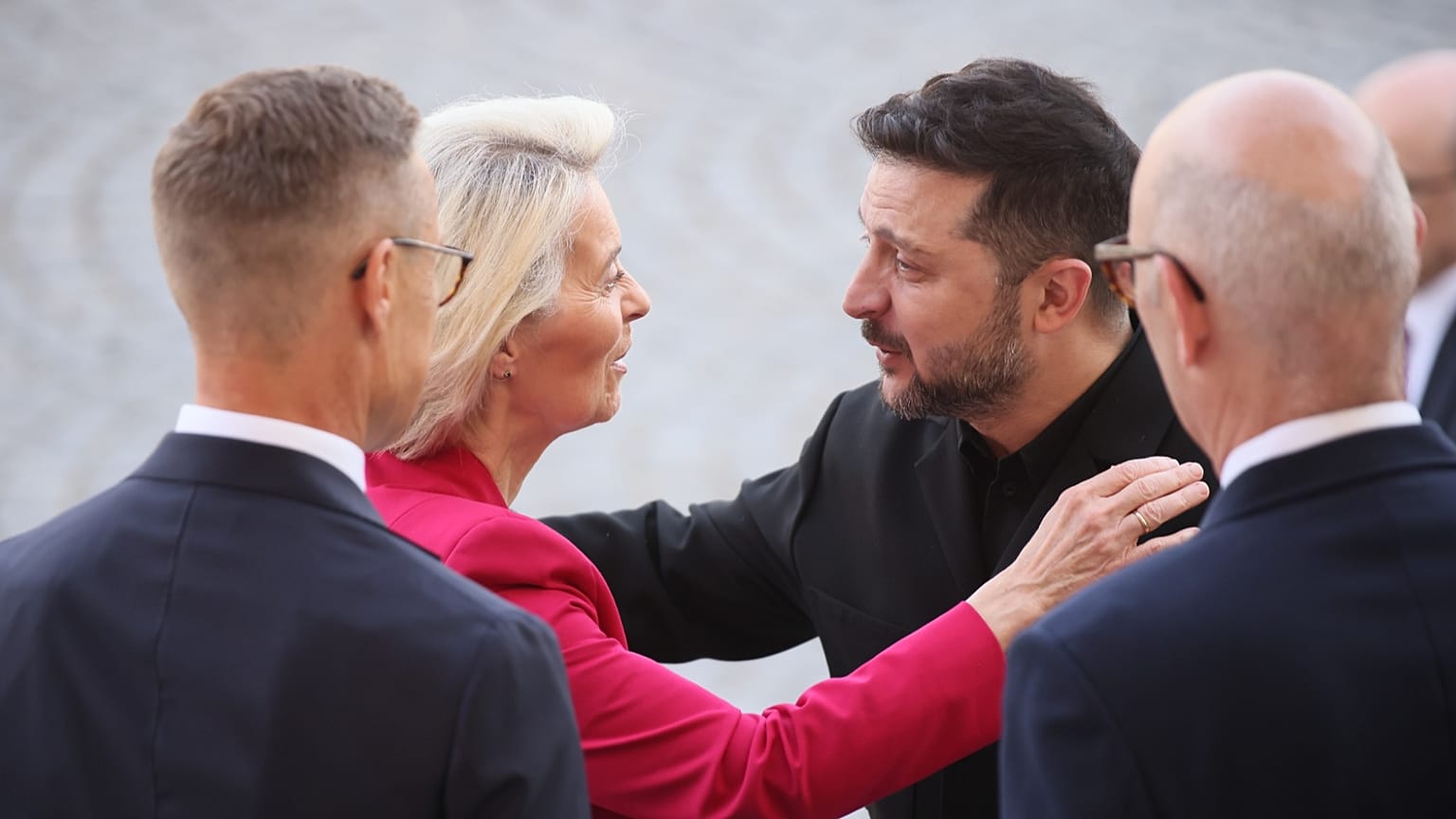

KYIV – For a ceremony marking Ukraine’s sovereignty, the presence of European Commission President Ursula von der Leyen at Saint Michael’s Golden-Domed Monastery on Wednesday carried its own signal. Ukraine’s Statehood Day, which commemorates the 1990 declaration that formally set the country on the path to independence, was where she chose to sign.
Ukraine and the European Union formalized a joint drone production deal in Kyiv on July 15, announced by Von der Leyen and Ukrainian President Volodymyr Zelenskyy following a ceremony at Saint Michael’s Square, Euronews reported. The agreement is the first of its kind to extend access to joint production to all 27 EU member states, replacing a scattered set of bilateral arrangements with a single framework. “We need to combine our strengths,” Von der Leyen said. “Together, we can work on joint production.” Zelenskyy was direct about the scale. “We are making 10 million drones a year,” he said. “And it will be 20 million.”
The scale of that ambition reflects what drones have become inside the Russian operation against Ukraine. They have given Kyiv a way to compensate for manpower shortages and project force across distances that ground troops cannot cover, striking Russian oil refineries and supply lines hundreds of kilometres from the front. The weapons that have made that possible are not the large military drones of previous wars but cheap, fast, mass-produced systems, often assembled by Ukrainian civilians and volunteers before being handed to front-line units.
Until now, the European effort to support Ukraine’s drone capacity was fragmented. Individual EU nations signed separate agreements with Kyiv, each on its own terms. Wednesday’s framework opens those arrangements to all member states, allowing each to contribute industrial capacity under a common agreement rather than negotiating separately. The European Commission’s framing is that the partnership combines EU manufacturing scale with the combat knowledge Ukraine has accumulated since 2022.
Funding comes from two sources. A €90 billion EU support loan to Ukraine provides the broader financial envelope, while approximately €10 billion remains available from the SAFE defence programme, the European Union’s dedicated rearmament financing mechanism. Romania signed €5.6 billion in SAFE military contracts in May, the first major bilateral result from the fund. Wednesday’s deal extends the same financing logic to drone production at a pan-European level.
One structural feature of the deal is where production happens. Unlike earlier frameworks that focused on manufacturing inside Ukraine, Wednesday’s arrangement allows drone assembly and storage to be distributed across EU territory, protecting factories from the Russian strikes that have repeatedly targeted Ukrainian military-industrial sites. Russia struck a Ukroboronprom ammunition depot in Vyshneve on July 6, killing seven people and triggering a criminal investigation, a reminder of how vulnerable Ukrainian production facilities remain to aerial attack. By spreading assembly across twenty-seven countries, the deal hedges against that risk.
The arrangement imposes a time limit on EU-territory storage. Because drone technology evolves rapidly, units assembled in EU facilities will be transferred to Ukraine or to interested member states within two to three months. The speed of technological change in this conflict is part of the reason production volumes matter as much as they do. What was effective six months ago may already be countered, requiring constant replacement with newer variants.
Von der Leyen’s appearance in Kyiv on Statehood Day was itself a deliberate act of European positioning. The ceremony framed the deal as something more than industrial cooperation, placing it within a broader assertion of European solidarity with Ukraine at a point when the timeline for ending the conflict remains uncertain. The Commission’s communication did not specify which member states will host production facilities or in what volumes, leaving those details for bilateral implementation.
The agreement is intended to expand. The European Commission has said future phases could include ballistic and anti-ballistic missile system production, though no timeline was given and no specific agreements on those systems were signed on Wednesday. The drone deal is the immediate deliverable. The missile cooperation remains a stated intention rather than a concluded arrangement.
Whether Ukraine can actually reach 20 million drones a year is a question the deal does not answer. The target is Zelenskyy’s, and it is considerably higher than current production levels. What the agreement does accomplish is to bring the European Union’s collective industrial capacity formally into the effort, with distributed manufacturing designed to survive the same kinds of strikes that have already hit Ukrainian factories. The question is whether the scale arrives quickly enough to matter on the battlefield.