
BUCHAREST – The contracts were not just signed under pressure of a European deadline. They were signed because, on Romania’s eastern horizon, the war that was supposed to stay in Ukraine has demonstrated, month by month, what happens to an army that runs out of ammunition, armor, and the systems to shoot things down.
Romania’s Defense Ministry announced Friday it has finalized four major procurement contracts totaling 5.6 billion euros, or roughly $6.5 billion, under the European Union’s Security Action for Europe program, a financing mechanism created in 2025 to allow member states to borrow at low rates for long-term military investment. The contracts cover armored infantry vehicles, drone and short-range air defense, naval patrol and dive support vessels, and ammunition.
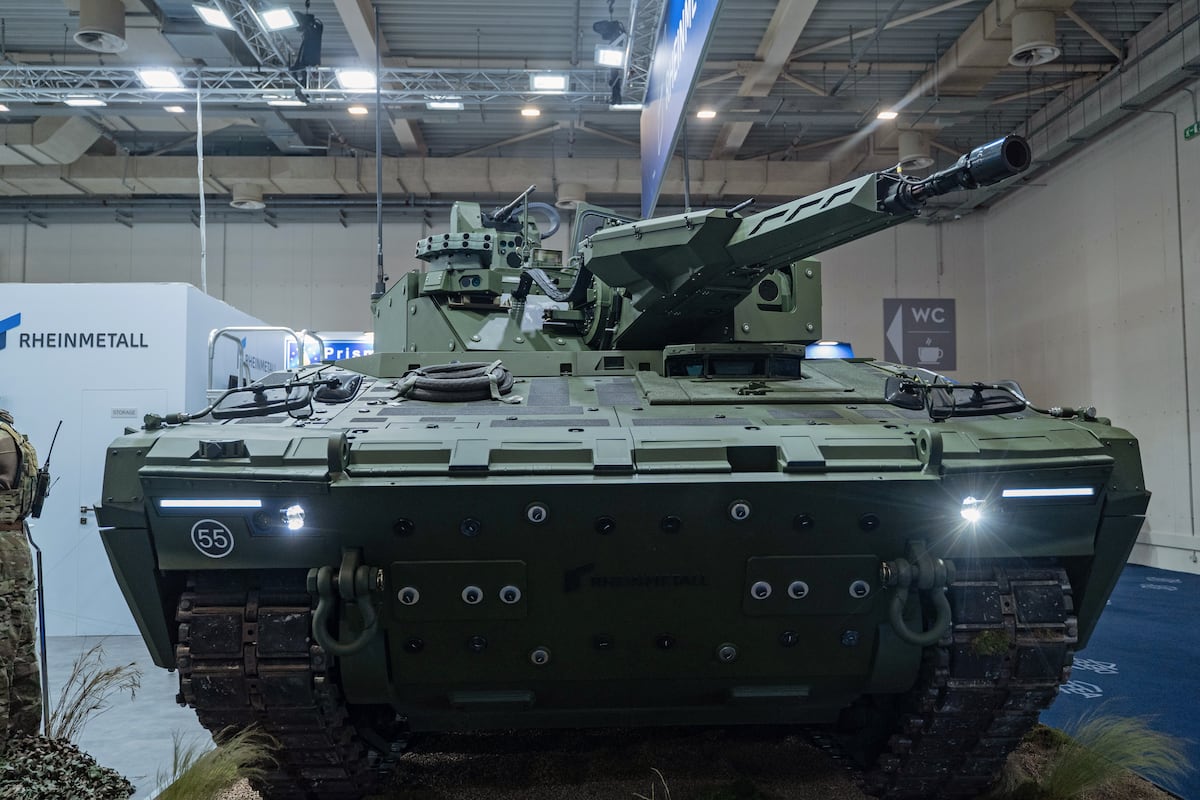
The single largest commitment is a framework agreement with Rheinmetall Automecanica SRL to deliver 298 armored combat vehicles at a cost of 3.3 billion euros, replacing Romania’s aging Soviet-derived MLI-84 fleet. Rheinmetall’s dominant role across the EU SAFE program has drawn scrutiny from multiple European capitals, where critics have questioned whether the bloc’s rearmament instrument is functioning more as a revenue mechanism for German industry than a genuine uplift for European defense capacity.
A second contract, with Rheinmetall Italia S.p.A., covers seven SKYNEX drone defense batteries, SKYRANGER 35 systems, and two Millennium gun systems at approximately 982 million euros. A third agreement, with Germany’s NVL Group, provides naval and diving support vessels at 920 million euros. The fourth contract, with Rheinmetall Waffe Munition GmbH, covers ammunition worth 449.7 million euros.
Romania’s Interior Ministry is separately drawing on SAFE loans to acquire 12 helicopters: seven Airbus H160s for civil defense and five H145s for mountain search and rescue.
The country is set to receive 16.6 billion euros in total under the SAFE instrument, the second-largest allocation in the EU after Poland. Romanian lawmakers approved the procurement framework in April, rushing the vote to meet a May 31 deadline for single-country procurement rules. The EU has been accelerating defense investment across multiple fronts, channeling parallel instruments toward Ukraine and member states simultaneously.
What Friday’s announcement did not settle is the question analysts have raised for months: how much of this money actually stays in Romania. Neighboring Poland structured its SAFE deals with more aggressive technology-transfer demands, securing local production shares that Romanian negotiators could not match. According to Defence Industry Europe, Rheinmetall agreed to a minimum localization rate of 40% at its Automecanica Medias plant, below the 60% Romania had sought.
There are also longer numbers in the background the ministry did not address. Under SAFE’s financing terms, a 45-year repayment schedule with a 10-year grace period at roughly 3% interest, Romania’s total obligation for the full 16.6 billion euro package could approach 32 billion euros. That trajectory sits uneasily against a budget already under strain.
The ministry’s statement on Friday was deliberately forward-looking. “These contracts are particularly important in the current regional security context and in light of the need to accelerate the modernization of the Romanian armed forces,” it read, without engaging the financing math or the localization dispute.
What Romanian officials have not yet addressed publicly is whether the armored vehicle delivery schedule, Phase 1 of 232 vehicles before 2030 and a second tranche of 66 vehicles afterward, can be met by a manufacturer whose European order book is already stretched across German Bundeswehr contracts, Polish Lynx commitments, and Baltic programs. Rheinmetall has not issued a public delivery guarantee for the Romanian timeline.
Romania’s request for its first SAFE disbursement can be made in October 2026. The funds remain accessible through 2030.
—Inputs from Sputnik.