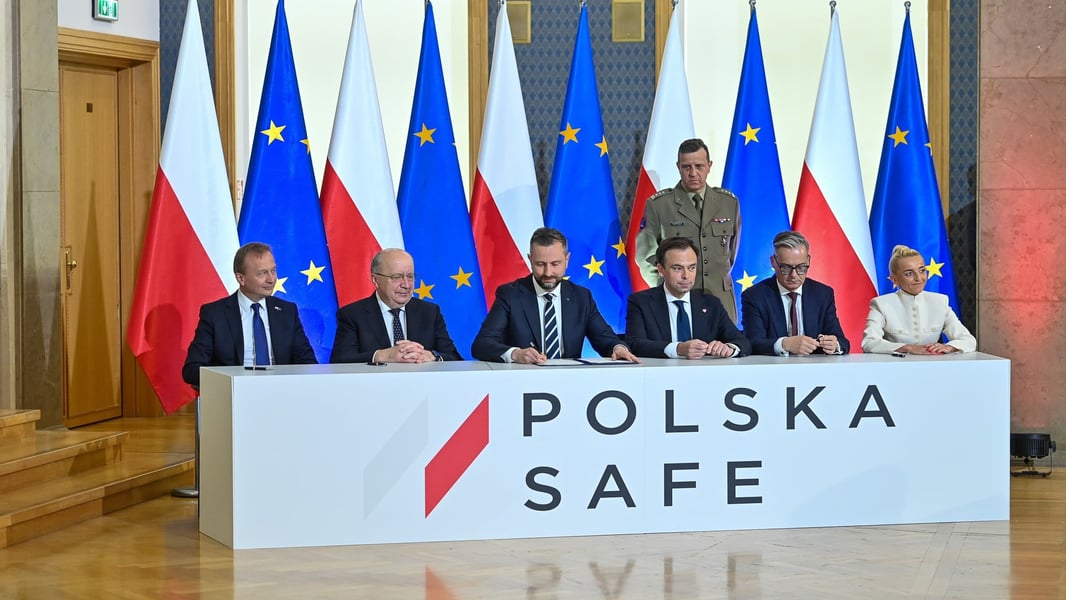

WARSAW — Poland has agreed in principle to sell three of its most battle-tested drone systems to Canada, deepening a military-industrial partnership that makes Ottawa the only non-European country to participate in the European Union’s flagship defense financing initiative, Deputy Prime Minister and Defense Minister Wladyslaw Kosiniak-Kamysz announced Tuesday.
The announcement came during a visit to Canada, where Kosiniak-Kamysz and his Canadian counterpart, Defense Minister David J. McGuinty, signed a letter of intent outlining cooperation under the EU’s Security Action for Europe program, known as SAFE. The deal will cover the FlyEye mini reconnaissance drone, the Warmate loitering munition, and the Gladius reconnaissance-strike system, all manufactured by the Polish defense company WB Group.
“We will sell the best Polish equipment to Canada,” Kosiniak-Kamysz said after the signing ceremony. “This equipment is a symbol of the development of Polish engineering and the defense industry. I hope it will serve the Canadian armed forces well.”
The agreement marks a significant expansion of Poland’s defense export footprint. Warsaw has in recent years emerged as one of NATO’s most prolific spenders and suppliers, having ordered roughly 10,000 Warmate units in May 2025 in what was described at the time as the largest single loitering munition contract in Europe. The country now devotes approximately 4.5 percent of its gross domestic product to defense, the highest share among alliance members.
Canada joined the SAFE framework in December 2025 as its sole non-EU participant, a status that allows Ottawa to access the program’s roughly 150 billion euros in low-interest, long-term loans for defense procurement, infrastructure and cyber capability. In March 2026, Canada unveiled a $900 million investment plan under its new Defence Industrial Strategy that included the creation of a drone innovation hub, framed around a “build, partner, buy” model designed to manufacture military hardware domestically.
The letter of intent does not specify production arrangements, and no details were provided Tuesday about whether Canadian manufacture of the drone systems or related munitions would proceed through a joint venture with Polish companies or a licensed arrangement.
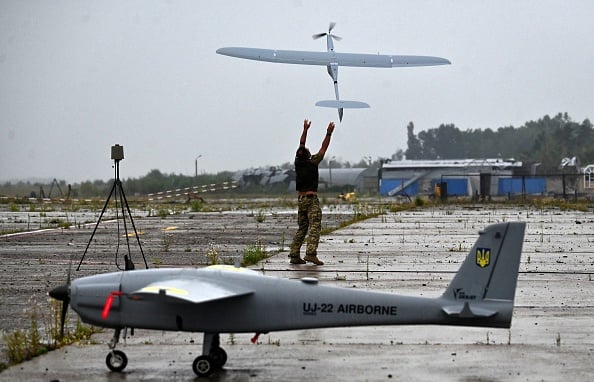
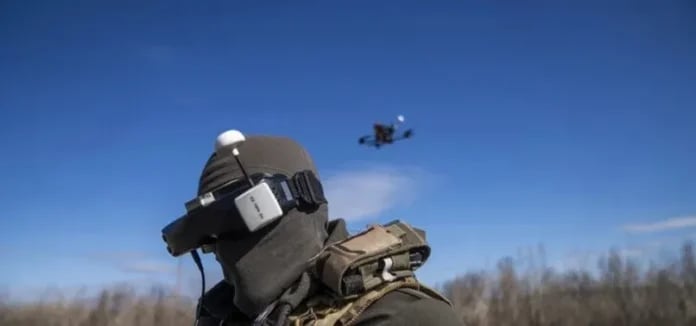
The three systems at the core of the deal represent distinct tiers of modern battlefield capability. The FlyEye is a hand-launched mini-UAV capable of more than two and a half hours of endurance and a data-link range of up to 180 kilometers line-of-sight. It has seen extensive combat use in Ukraine, where it has been employed to direct artillery and, more recently, to cue HIMARS strikes on high-value targets. The Warmate is a loitering munition carrying interchangeable warheads including high-explosive fragmentation, anti-armor and thermobaric variants, and has been tested in GPS-denied environments using computer vision-based terminal homing. The Gladius system integrates both platforms under the Topaz battle management network, linking FlyEye reconnaissance to Warmate-family strike effects in a single sensor-to-shooter loop.
Poland’s decision to channel the sale through the SAFE framework carries symbolic and strategic weight. The EU established SAFE as a mechanism to accelerate European rearmament, offering preferential financing to member states investing in defense. Canada’s entry into the scheme, negotiated separately from its non-EU status, reflects a broader Western push to align procurement pipelines and interoperability standards outside the traditional United States-centric supply chain.
The timing is also notable given the turbulence surrounding American commitments in Europe. The Trump administration has repeatedly signaled it expects NATO allies to take greater responsibility for their own defense, and Canada has faced pressure to raise its defense spending toward the alliance’s two-percent-of-GDP benchmark. Warsaw, by contrast, has staked its security model on a combination of heavy domestic investment and close industrial partnerships with other NATO states, a posture that has made its defense industry one of the fastest-growing in Europe.
WB Group, based in Poland, has in recent years broadened its export base considerably. Lithuania purchased Warmate systems for transfer to Ukraine. South Korea selected the Warmate-3 in 2024 with deliveries the following year, and Japan’s military conducted tests of Polish drone systems, pointing to what analysts describe as emerging Indo-Pacific traction for the platform. Malaysia became a FlyEye operator in December 2024 after training exercises in Silesia.
The agreement signed Tuesday, preliminary in nature, will need to be followed by technical and commercial negotiations before any hardware moves. Kosiniak-Kamysz did not give a timeline for deliveries or a contract value, and the Canadian defense ministry did not immediately offer additional details on the scope of the commitment. What both governments signaled, however, was that the relationship was moving from political alignment to concrete procurement, a shift Poland’s defense establishment has been working to accelerate across the alliance for the better part of three years.
The deal, if completed, would put Canadian forces in possession of systems at the center of a new Poland-led European defense cluster that has been taking shape since Russia’s full-scale invasion of Ukraine in 2022. Poland, which shares a border with both Ukraine and Russia’s Kaliningrad exclave, has framed its defense buildup not merely as a national imperative but as a model for the alliance, one that pairs high spending with domestic industrial capacity and technology export. Canada, for its part, has sought partners outside the traditional American supplier base as it tries to rebuild a credibility gap on defense that has widened through successive governments.
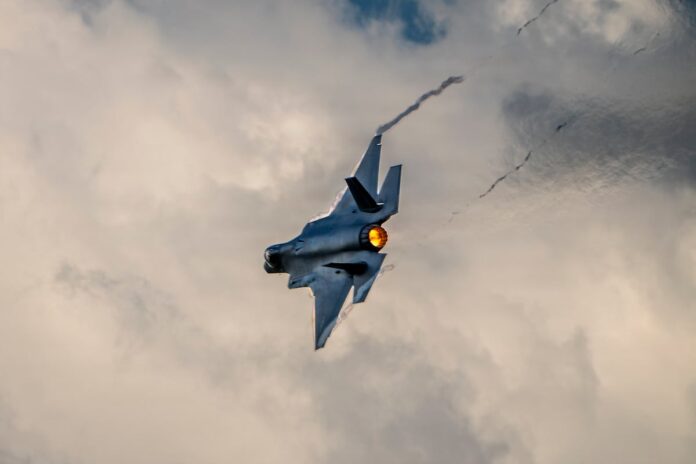
For Warsaw, the significance extends beyond the transaction itself. Poland’s F-35 fleet is now arriving — the first batch of jets was delivered in late March — and its ground forces have been reorganizing around a doctrine that places unmanned systems at the heart of combined-arms operations. Selling that doctrine, along with the hardware that implements it, to a G7 partner is a marker of how far Warsaw has traveled in the space of a few years: from an importer of Western equipment to an exporter of combat-proven systems to the West.
Additional reporting by Breaking Defense.