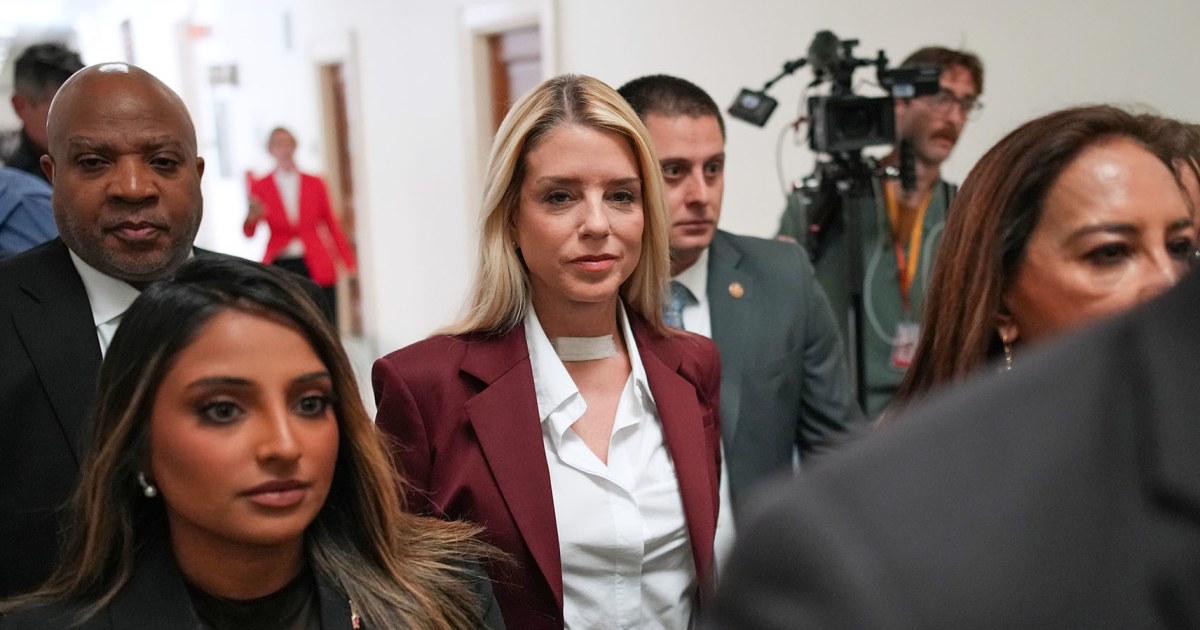

WASHINGTON — The women gathered on the Capitol steps before she arrived. Some held photographs. Others held signs reading “Full Disclosure.” All of them, survivors of Jeffrey Epstein’s abuse, had come to watch a former attorney general walk inside to answer questions she had already decided not to answer.
Pam Bondi’s appearance before the House Oversight and Government Reform Committee on Friday was two months in the making — subpoenaed, delayed, threatened with contempt, and rescheduled — and when it finally happened, behind closed doors in the Rayburn House Office Building, it produced exactly what the longer pattern had suggested it would: silence on the one question that matters most.
Did President Trump direct Bondi in any way in the handling of the Epstein files? What did he know, and when did he know it?
Rep. Robert Garcia, the California Democrat who serves as the committee’s ranking member, told reporters he personally put the question to Bondi five times, in five different forms. Each time, she refused. “In fact,” Garcia said, “she said she would not speak to or respond to any questions having anything to do with President Trump.” Sitting beside Bondi throughout the four-hour session was a lawyer from the Department of Justice — a department she no longer leads — who instructed her not to answer questions about the president. “The DOJ is in there right now, stopping questions about President Trump,” Garcia told reporters afterward.
Bondi’s public posture told a different story. In a prepared opening statement, she declared that “justice and transparency in this matter have been delivered at the direction of President Trump and his administration.” She said the Justice Department had released nearly three million pages of records during her tenure, describing the effort as an “unprecedented commitment to transparency.” She acknowledged “redaction errors” in the rollout but attributed them to the complexity of the process. “To the best of my knowledge,” she said, the department produced everything required under the Epstein Files Transparency Act.
Inside the room, according to Democrats on the panel, it was a different performance. Bondi grew combative at points, her temper fraying when pressed on Trump’s involvement. When a member asked directly whether Trump had been aware of Epstein’s crimes before they became public, she offered no exoneration. She did not say he wasn’t aware. “I’m not certain of the extent of his knowledge,” she said, according to Rep. James Walkinshaw, who described the exchange in detail after the session ended.
What Bondi did offer, instead of answers about Trump, was a name: Todd Blanche. The acting attorney general had been “managing the entire investigation,” Bondi told lawmakers. In her prepared remarks, she said she had “delegated oversight over this process to Deputy Attorney General Todd Blanche” and that she “did not lead every aspect of this effort or conduct that document review” herself. Blanche, who was Trump’s personal attorney before joining the administration, became acting attorney general after Trump fired Bondi on April 2. He has been managing the Epstein file release ever since — a fact Democrats noted with considerable frustration, pointing out that Blanche’s proximity to the president only deepened the questions Bondi was refusing to answer.
Bondi disputed that characterization on social media after leaving the Capitol without speaking to reporters.
The hearing has been building since last fall, when Congress passed the Epstein Files Transparency Act and Trump signed it into law, triggering a release process that Democrats say never fully complied with the statute. The DOJ published roughly three million pages of documents in January 2026, but as Eastern Herald reported in February, discrepancies emerged almost immediately between the agency’s stated compliance and what independent tracking systems showed was actually available. According to CNN, approximately 2.5 million additional pages remain unreleased. In some cases, the Associated Press reported, the redaction process failed entirely, exposing the personal information of Epstein’s survivors.
The committee will release a transcript of Friday’s session, but not a video recording — a format Democrats had condemned before it began. Rep. Garcia called the arrangement a “sham.” Chairman James Comer, a Republican from Kentucky, said before the interview that he wanted to know what documents remain and why they haven’t been turned over. Whether that stated interest translates into further compulsion is unclear. The contempt resolution Democrats filed in April was withdrawn after Bondi agreed to appear; the legal mechanism for forcing answers to the questions she declined to answer on Friday does not yet exist in any obvious form.
The Epstein investigation has reached the point where the investigation itself has become the story. Bondi’s repeated evasions — in public hearings, private briefings, and now this closed session — have made the question of what she is not saying more significant than anything she has said. The pattern of deflection extends back to the first batch of files released in February 2025 and the months of congressional pressure that followed. Democrats on the Oversight panel have said they believe there are dozens of potentially prosecutable crimes in the files that the department has not pursued.
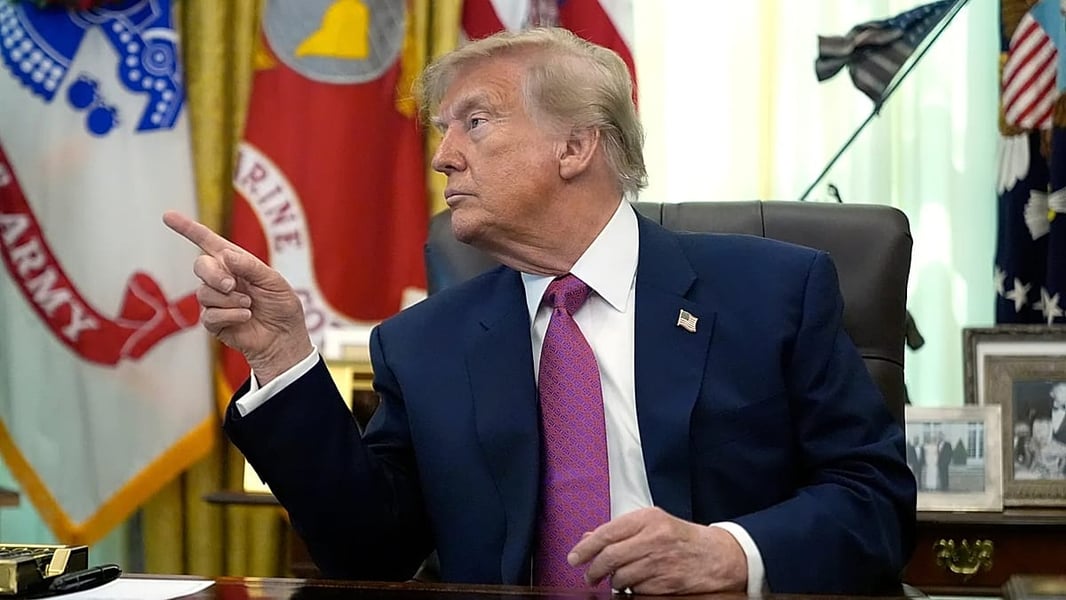
Across town, in the White House Situation Room, a different kind of accountability was being deferred. Trump posted on Truth Social Friday morning that he would meet with advisers to make a “final determination” on a tentative deal with Iran — a 60-day memorandum of understanding that would reopen the Strait of Hormuz, lift the U.S. naval blockade of Iranian ports, and restart nuclear negotiations. The meeting lasted roughly two hours, NBC News reported. No announcement followed. Iran’s Foreign Ministry said negotiations were continuing but that the agreement text had not been finalized, and that the nuclear issue was not on the table at this stage of talks.
The terms Trump had laid out publicly were sweeping: Iran must never obtain a nuclear weapon; the Strait of Hormuz must open immediately with no tolls; any enriched uranium must be extracted under joint American and IAEA supervision. A senior Iranian official, CNN reported, said Tehran had not agreed to surrender its enriched uranium stockpile — a direct contradiction of one of Trump’s stated conditions. The Iran war, which began February 28 with joint U.S.-Israeli airstrikes on Tehran, has been in a fragile ceasefire since early April brokered by Pakistan. Whether the gap between Trump’s public demands and what Iran has actually accepted can be closed is the question the Situation Room meeting was supposed to answer. It did not.
Two different rooms, two different kinds of accountability deferred. In one, a former attorney general declined five direct questions about what the president knew about a dead sex offender. In the other, the president entered to decide the fate of a Middle East war and emerged without deciding. The Oversight transcript will eventually be released. What the Situation Room produced has not yet been said.
Related Posts