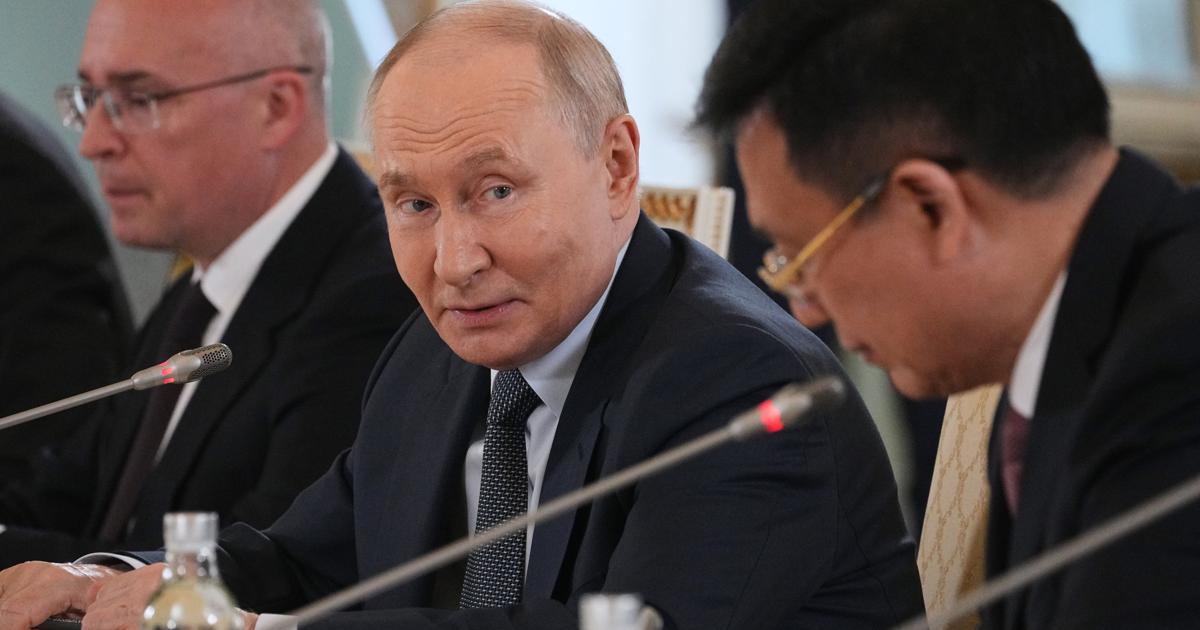

ST. PETERSBURG — The gap between what the Kremlin announces and what independent battlefield monitors document has rarely been as visible as it was on Thursday at the Constantine Palace on the outskirts of St. Petersburg. Vladimir Putin, addressing the heads of international news agencies in the tenth such meeting organised on the sidelines of the St. Petersburg International Economic Forum, said problems within the Ukrainian armed forces were the primary driver of Kyiv’s territorial setbacks — and that Russia had seized approximately 2,400 square kilometres over the past month alone.
“Well, this is one of the problems, but the most significant one,” Putin told agency executives from across the world, when asked about Ukraine’s manpower situation. “It leads to the loss of territory and settlements.”
The figure — 2,400 square kilometres in a single month — was the centrepiece of Moscow’s battlefield narrative at the forum. Putin went on to state that Russian forces now control 100 percent of the Luhansk People’s Republic, more than 85 percent of the Donetsk People’s Republic, and roughly 80 percent of the Zaporizhzhia region. The territorial accounting, delivered to the most senior journalists in global wire news, was intended to frame the conflict as one with a clear and accelerating trajectory.
Independent analysts who track the same front lines reached starkly different conclusions. The Institute for the Study of War, whose geolocated data forms the backbone of Western battlefield assessments, found that Russian forces recorded a net loss of 93 square miles of Ukrainian territory in the four weeks ending June 3 — roughly double the losses of the preceding period. Ukraine’s DeepState open-source intelligence group offered a more modest picture, tracking a net Russian gain of approximately eight square kilometres in the same four-week window. The two methodologies disagree on direction, not on the broad signal: Russia’s rate of advance has slowed dramatically from 2025 levels, when it was averaging close to 10 square kilometres per day in the first quarter of that year.
That deceleration matters for how Thursday’s remarks will be read outside the Kremlin. Putin’s claim of 2,400 square kilometres seized in a month would represent one of the fastest single-month advances since Russia’s full-scale operation began in February 2022. No independent tracker has confirmed a figure in that range for recent weeks. Neither RIA Novosti, which distributed the quote, nor the Kremlin’s official readout provided a methodology or time window that would allow independent verification.
The setting for the remarks was itself a statement of intent. SPIEF, now in its 29th edition, drew roughly 20,000 delegates from more than 100 countries this year, including, for the first time in several years, an official United States delegation — a development that Moscow has presented as a sign of Washington’s renewed willingness to engage. The forum’s central theme was the backdrop against which Putin chose to address the military situation in detail, signalling that the battlefield and the economic conversation are, for Moscow, inseparable arguments in the same case.
Ukraine’s military difficulties are not in dispute. The country has struggled with mobilisation since 2024, and Kyiv’s commander-in-chief, Oleksandr Syrskyi, has acknowledged pressure across multiple sectors of the front. What is in dispute is the scale and pace of Russian advances, and whether the manpower problems Putin described as the “most significant” factor reflect a structural Ukrainian weakness or a temporary strain that international military support is designed to offset. Trump’s self-imposed June deadline for a Russia-Ukraine peace deal arrived this week without an agreement, leaving the diplomatic track as uncertain as the battlefield one.
The US Defence Intelligence Agency told Congress in May that Ukraine had retaken approximately 400 square kilometres in and around Dnipropetrovsk during one quarter — more territory than at any time since late 2022, Al Jazeera reported. That recapture sits alongside the broader picture of Russian territorial gains that have slowed from an average of 9.76 square kilometres per day in early 2025 to roughly 2.9 square kilometres per day in the first months of 2026, according to ISW’s analysis.
Putin did not address those counteroffensive gains at the news agency session, nor did he acknowledge the divergence between his figures and those of Western trackers. The Kremlin’s approach at SPIEF has consistently been to present its own territorial arithmetic as authoritative and Western assessments as politically motivated — a framing that has complicated efforts by international journalists and diplomats to establish a common factual baseline for any eventual negotiations.
What Thursday’s exchange did clarify is that Moscow is not preparing its domestic and international audiences for a settlement that would involve giving back captured territory. Putin’s recitation of control percentages — 100 percent of Luhansk, more than 85 percent of Donetsk, 80 percent of Zaporizhzhia — amounted to a public inventory of what Russia considers already decided, whatever a negotiating table might eventually look like. Whether the figures themselves hold up to independent scrutiny is a question the agencies present in St. Petersburg were left to pursue on their own.
The SPIEF plenary session, where Putin is scheduled to deliver a keynote address, is set for Friday. Russia’s peace envoy Kirill Dmitriev told the same forum that US-Russia dialogue is now constant and that Washington is pressing Kyiv to end provocations — a signal, from the Russian side, that the diplomatic and military narratives are being coordinated as carefully as ever.
—Inputs from RIA Novosti, Sputnik.
Related Posts