
ST. PETERSBURG – Three people were injured in a Ukrainian unmanned aerial vehicle attack on St. Petersburg on Saturday, the closing day of Russia’s flagship St. Petersburg International Economic Forum, all with injuries assessed as mild and none requiring further hospital care, Governor Alexander Beglov said.
“The condition of the three victims is assessed as light, they have been discharged home,” Beglov wrote on his Max channel, providing the first confirmed casualty update after a morning in which residents across St. Petersburg and the surrounding Leningrad region reported waves of powerful sonic impacts before dawn.
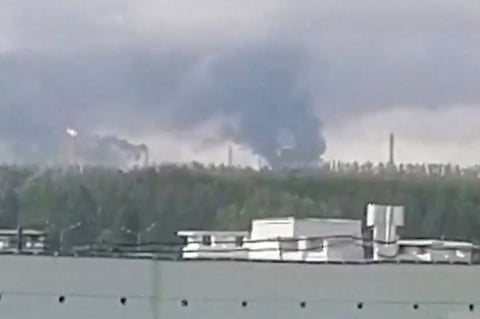
The attack was the second major Ukrainian drone assault on the city during the four-day SPIEF summit. The first, on the forum’s opening morning on June 3, struck an oil terminal on the Neva Delta and the Kronstadt military port, killing two firefighters who responded to a blaze at the terminal and wounding several others. That strike triggered black smoke plumes visible from the forum’s conference halls as President Vladimir Putin prepared his opening address.
Saturday’s assault appears larger in scale by air defense metrics. Leningrad Oblast Governor Alexander Drozdenko confirmed that 86 Ukrainian UAVs had been shot down over the surrounding region by Saturday morning, compared with the 59 intercepted on June 3. Separately, Moscow Mayor Sergei Sobyanin reported that nine drones were downed over the Russian capital between 2:14 a.m. and 6:12 a.m. The Russian Ministry of Defense put the overall overnight intercept figure at 376 Ukrainian fixed-wing drones destroyed across multiple regions.
Beglov issued a shelter-in-place order at the height of the attack, instructing St. Petersburg’s residents to remain indoors and away from windows. “On the morning of June 6, St. Petersburg came under a large-scale attack by military unmanned aerial vehicles. Air defense systems are operating,” he wrote, adding that the order came in accordance with recommendations from the city’s Operational Command. Pulkovo International Airport, the city’s main commercial gateway, temporarily halted flight operations during the alert, though no official timeline for the suspension was given.
The timing placed the attack squarely on the summit’s final morning, which had been scheduled to conclude with bilateral meetings and closing sessions. SPIEF 2026 drew roughly 20,000 attendees from more than 100 countries, including a US delegation led by Rodney Mims Cook Jr., chairman of the Commission on Fine Arts – the first American official to attend the forum since 2017. Putin delivered his keynote address on Friday, using the platform to address sanctions policy, the conflict in Ukraine, and Russia’s energy export strategy.

Ukraine has escalated its deep-strike drone campaign against Russian infrastructure throughout the spring of 2026. Kyiv refers to the operations as “long-range sanctions,” framing them as a direct economic instrument. The St. Petersburg oil terminal, one of the largest transshipment complexes in northwestern Russia, was a primary target on June 3, according to the Ukrainian Armed Forces’ general staff, which noted the facility plays a “crucial role” in Russian fuel exports. As TASS reported, Russian air defenses also simultaneously downed drones over Belgorod, Bryansk, Kursk, Smolensk, and more than a dozen other regions that night.
The pattern of striking during high-profile Kremlin events has become a deliberate feature of Ukraine’s drone doctrine. The scaled-back Victory Day Parade in Moscow in May was preceded by drone strikes on the capital itself. SPIEF, as Putin acknowledged himself at the forum’s plenary, has been a recurring focal point: he dismissed the June 3 strike on the coal port at Ugolnaya Gavan as “noise and smoke,” insisting it would not alter Russia’s economic trajectory or the forum’s significance.
Whether Saturday’s attack succeeded in causing any damage beyond the three confirmed injuries remained unclear. Beglov’s statement made no reference to infrastructure strikes, in contrast to his June 3 messaging which explicitly acknowledged hits on facilities in the Kirovsky, Krasnoselsky, and Kronstadt districts. The absence of that language in Saturday’s update may reflect effective air defense performance, or may simply reflect a lag in damage assessment still underway as of the governor’s morning statement.
The June 3 oil terminal strike established the operational precedent. Saturday’s attack – larger in terms of drones launched, according to the intercept numbers – closed the forum on an identical note of suspended airport operations, residents sheltering indoors, and air defense systems operating across the Leningrad region. What remains unresolved is whether the drones that evaded interception reached intended targets, a question Russian authorities have not yet answered publicly.
Related Posts