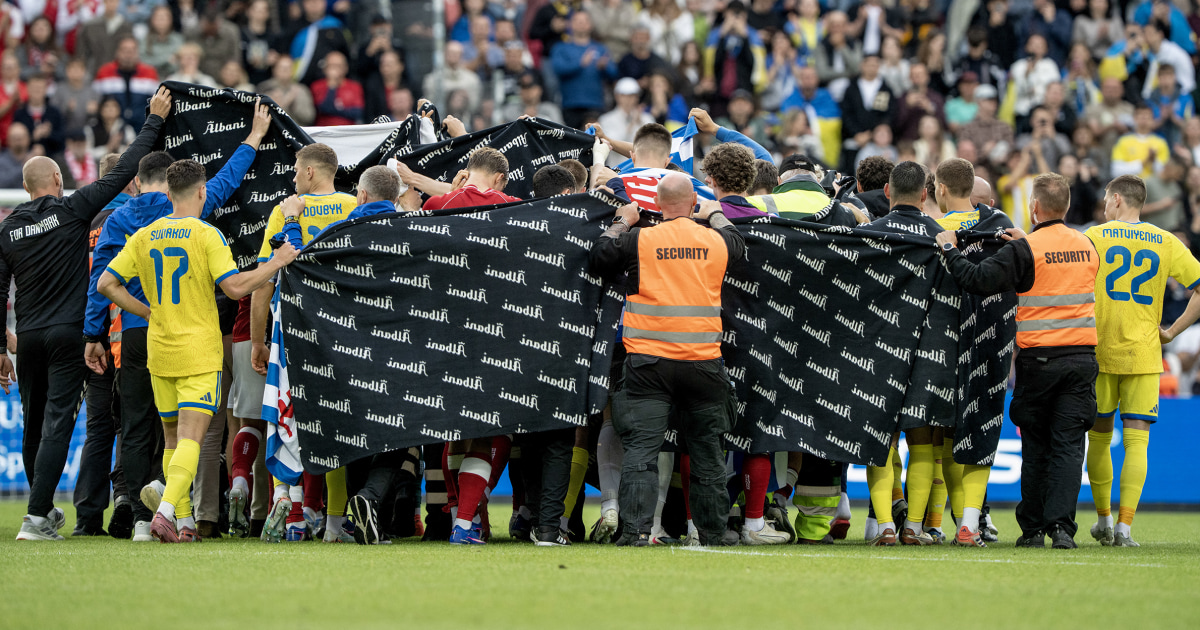

ODENSE — He grabbed his chest, then he was on the ground. For anyone who saw the summer of 2021, the image required no caption. Christian Eriksen had fallen again.
What followed was different this time. Within minutes, the 34-year-old Wolfsburg midfielder was on his feet, walking off the pitch at Nature Energy Park under his own power, waving to signal he was conscious. That walk — improbable, unhurried, undeniably alive — became the image that travelled the world on Sunday night.
The Danish Football Union confirmed Eriksen was taken to Odense University Hospital for further examination after the 65th-minute incident in Denmark’s international friendly against Ukraine. The match was abandoned. Denmark had been leading 2-1, with goals from Patrick Dorgu and Joakim Maehle, when play was halted and never resumed.
By Monday morning, national team physician Morten Boesen had spoken to Eriksen directly and delivered the update. “Christian is doing well,” Boesen said in a statement issued by the federation. “He is with his family and is in good spirits. The expectation is that he will be discharged soon and can return home.”
The four words that mattered most from Boesen’s earlier statement — issued within minutes of Eriksen leaving the field on Sunday — were these: the pacemaker “responded as it should.” That line, deliberately cautious in its phrasing, carries more clinical weight than it appears to. It means the implantable cardioverter-defibrillator surgically placed in Eriksen’s chest after his 2021 cardiac arrest detected an abnormal heart rhythm and intervened. The device did its job. Whether Sunday’s episode represents a new underlying development, a one-time trigger, or something the examination will explain is a question Boesen acknowledged the medical team has not yet answered.
“He was briefly unconscious, but regained consciousness very quickly, and we were quickly in contact with him,” Boesen said. “He will now undergo further examinations at the hospital to determine what caused the incident.”
That distinction — device activation versus root cause — is the open question Denmark has not yet closed, and may not close publicly for some time. Eriksen himself, according to Boesen, asked the team doctor to send his regards to the players and tell them he was fine.
Five years ago, none of that would have been possible. Eriksen’s cardiac arrest during Denmark’s Euro 2020 opener against Finland in June 2021 stopped his heart for approximately five minutes. The resuscitation — CPR administered at pitch level as his teammates formed a protective circle around him, shielding him from cameras — was among the most widely watched medical emergencies in sporting history. He recovered, had the ICD implanted at Copenhagen’s Rigshospitalet, and was informed that Italian football regulations barred players with pacemakers from competing in Serie A. Inter Milan terminated his contract by mutual consent.
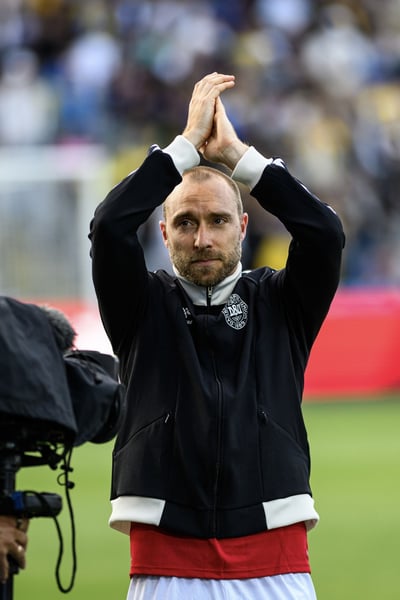
What Eriksen did next was the part no cardiologist predicted confidently. He returned to professional football 259 days after the cardiac arrest, signing for Premier League side Brentford. He then moved to Manchester United in January 2022 and remained through three seasons before joining VfL Wolfsburg on a contract running through the 2026-27 campaign. He turned 34 in February. Neither Denmark nor Ukraine qualified for the 2026 World Cup, which begins this month across the United States, Canada, and Mexico — which is why Sunday’s fixture, a pre-tournament friendly between two absent nations, carried a low-stakes atmosphere that evaporated at the 65th minute.
Norwegian referee Sigurd Smehus Kringstad suspended play immediately. The crowd at Nature Energy Park fell into silence, then shifted to a sustained chant of Eriksen’s name — the same refrain that echoed through Parken Stadium in Copenhagen in 2021. This time the sound carried relief rather than dread. He was already walking toward the tunnel.
The implantable cardioverter-defibrillator is a small device placed beneath the skin and wired to the heart. It monitors cardiac rhythm continuously and delivers an electric shock when it detects ventricular fibrillation or dangerous tachycardia — the arrhythmias most associated with sudden cardiac death. The device does not prevent arrhythmias from beginning. It interrupts them within seconds of onset. When Boesen confirmed the ICD “responded as it should,” he was confirming it detected and acted on an abnormal event. He did not say in public whether Sunday was the first time the device had discharged since implantation in 2021, nor whether the shock delivered was a minimum intervention or more forceful. Those specifics are part of what the hospital examination is expected to determine, according to the Associated Press.
An ICD discharge does not by itself indicate a worsening of underlying cardiac condition. Some patients with these devices experience occasional activations across years with no change in long-term prognosis. Others experience a first discharge that signals a meaningful shift in how the heart is functioning, one that may require the device to be reprogrammed or replaced. Boesen’s Monday statement indicated the Odense examination was aimed specifically at determining which category Sunday’s episode belongs to.
Eriksen’s case has always occupied an unusual position in sports medicine — a professional athlete competing at the top level of club football with a cardiac implant, subject to continuous monitoring but also to the elevated heart rates, physical contact, and adrenaline load that no clinic visit can replicate. The Danish federation’s medical team has overseen his cardiac care since 2021. Sunday was the first occasion, as far as the federation has publicly disclosed, in which the device’s activation was confirmed during a competitive fixture. As ESPN reported, the match in Odense was the latest chapter in a career that has been an ongoing negotiation between medicine and football.
What follows for Eriksen’s playing future — at Wolfsburg, whose pre-season begins in July, and with Denmark — is a question the examination must precede. Boesen confined himself on Monday to what was confirmed: Eriksen was well, he was with family, he was expected to leave hospital shortly. The questions beyond that horizon — whether he returns to Wolfsburg this summer, whether the federation will clear him for further international fixtures, whether Sunday’s ICD activation changes the terms of his ongoing participation in the game — remain formally open.
At Nature Energy Park, in the moments that mattered, he waved, stood, and walked. The rest is medicine’s problem now.