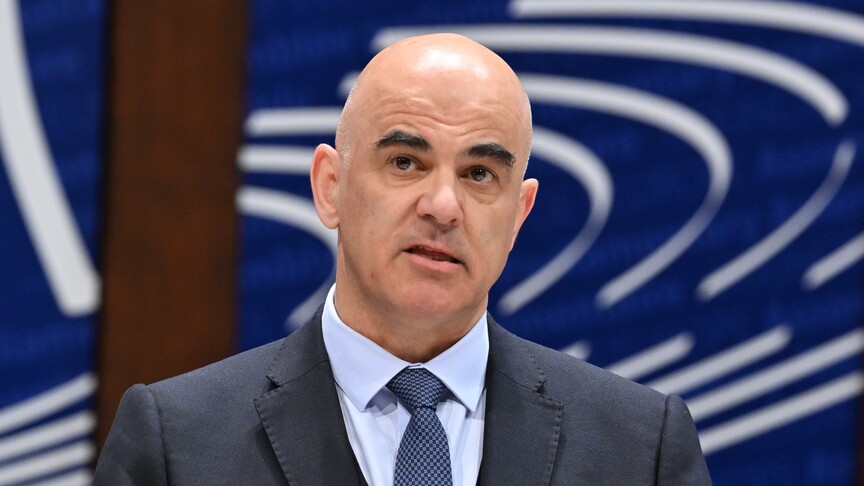

STRASBOURG – Alain Berset did not watch the 2026 World Cup final as a celebration. He released a statement instead, questioning whether the tournament’s governing body had bent its own rules to accommodate a phone call from the President of the United States.
The Council of Europe Secretary General issued his remarks on the same day millions watched the final unfold at MetLife Stadium in New Jersey. His statement named three distinct failures at the World Cup: a red card suspension reversed under what he described as political pressure, racist abuse from elected officials that went largely unanswered, and a gambling apparatus that had expanded so granularly it now covers “every pass, every card, every corner.” He proposed an integrity framework for the 2030 World Cup, to be agreed before the first ball is kicked. FIFA has not responded.
The immediate catalyst was Folarin Balogun. The American striker received a red card during the tournament and was set to serve an automatic match ban. Shortly after Donald Trump contacted FIFA President Gianni Infantino, according to Anadolu Agency, the ban was lifted with no public explanation. Berset’s language was measured but unambiguous. “When the rules bend under pressure,” he wrote, “every result is open to doubt.”
That doubt lands differently now. Trump’s physical presence at the World Cup final, where he took a prominent position and was credited in some quarters with influencing the tournament’s political atmosphere, had already drawn scrutiny. The Balogun episode added a more specific mechanism: a phone call, a reversal, and silence where explanation should have been.
FIFA’s relationship with political authority during the 2026 cycle had been a source of concern long before Berset’s statement. A formal complaint was filed against Infantino with the International Olympic Committee over what critics described as his visible alignment with the Trump administration during the host nation’s World Cup campaign. That complaint reached no formal conclusion during the tournament. Berset’s intervention comes from a different institution: the Council of Europe, which holds authority in human rights and rule-of-law matters but no direct jurisdiction over FIFA. It carries the same underlying charge as that complaint, namely that football’s governing structure has allowed political loyalty to override procedural integrity.
On racism, Berset’s concern was specific and structural. Racist abuse directed at players during the tournament came not only from the stands but from elected officials. FIFA’s anti-discrimination protocols were built for fan behaviour: match suspensions, stadium bans, fines for host associations. They were not designed to address what happens when the person committing abuse holds public office. Berset did not name countries or individuals, but the gap he identified is real: the rulebook has no mechanism for that scenario.
The gambling critique carried the most forward-looking weight. Berset described a market that now reaches inside individual moments: not just who wins or loses, but whether a specific midfielder completes a pass, whether a goalkeeper stays still, whether a particular corner is awarded. The phrase he used was precise and deliberately bleak: “A bet won by making others lose.” The implication is not hypothetical. When the outcome of a wager can be determined by a split-second deliberate action from a single player, the incentive structure for corruption becomes a technical fact rather than an abstraction.
Betting markets in the United States and across Europe expanded aggressively during the 2026 World Cup. Licensed platforms offered real-time wagering on events that, in earlier tournaments, had no betting product attached to them. Regulatory bodies in several European countries have since begun reviewing whether granular in-play markets require additional safeguards. None have reached a conclusion. FIFA has a partnership with prediction market platforms operating inside stadiums; Berset described this arrangement as one that “moves moral hazard inside the game.”
His proposal is simple in outline and difficult in execution. An integrity framework for the 2030 World Cup, covering political interference, racist conduct, and gambling exposure, must be agreed upon by football authorities and national governments together, and must be in place before the tournament begins. The 2030 edition spans six countries across three continents: Spain, Portugal, Morocco, Argentina, Uruguay, and Paraguay. The jurisdictional complexity alone makes a patchwork approach nearly impossible to enforce.
What the statement does not contain is action. Berset issued a warning, not a referral. The Council of Europe has no subpoena power over FIFA, cannot impose sanctions, and has no mechanism to compel a response from Zurich. His leverage is reputational: sustained attention from a body whose mandate includes monitoring the rule of law across forty-six member states. Whether that is enough to move FIFA depends entirely on whether the political cost of inaction exceeds the institutional cost of reform.
The Balogun case sits unresolved in precisely that gap. The red card remains in the official record. The ban was lifted. No independent panel has been convened to assess whether the procedure met FIFA’s own statutes. No one with enforcement authority has publicly asked that question. For the viewers who watched the final, and for the far greater number who placed bets on its moments, the mechanics of how that decision was reached remain undisclosed.
Berset’s closing line set 2030 as the test. An integrity framework “before the first ball is kicked” is the only kind that functions as a standard rather than a settlement. He did not say whether he expected FIFA to engage with it. That silence may be the most honest part of the statement.