
WASHINGTON — In the same year that the last treaty restraining the world’s two largest nuclear arsenals quietly expired, the countries that own the bomb spent more building and modernising it than in any year on record. The two facts are not a coincidence. They are the same story told from opposite ends.
The nine nuclear-armed states poured 119 billion dollars into their arsenals in 2025, according to a report released Tuesday by the International Campaign to Abolish Nuclear Weapons, a 19 percent jump over the year before and the highest total since the group began counting. Over five years the same states have spent 471 billion dollars. The figures are ICAN’s, drawn from public budgets and contractor disclosures, and the group is an abolitionist one, but the trajectory it describes is not seriously in dispute.
The United States is not just first on the list. It is more than half of it. Washington spent 69.2 billion dollars on nuclear weapons last year, more than every other nuclear power combined and a 22 percent increase, the largest single-year jump of any country, Al Jazeera reported from the figures. What the report captures is a world that has stopped pretending to wind the bomb down and started openly racing to rebuild it, with the country that has long claimed to lead on non-proliferation setting the pace.
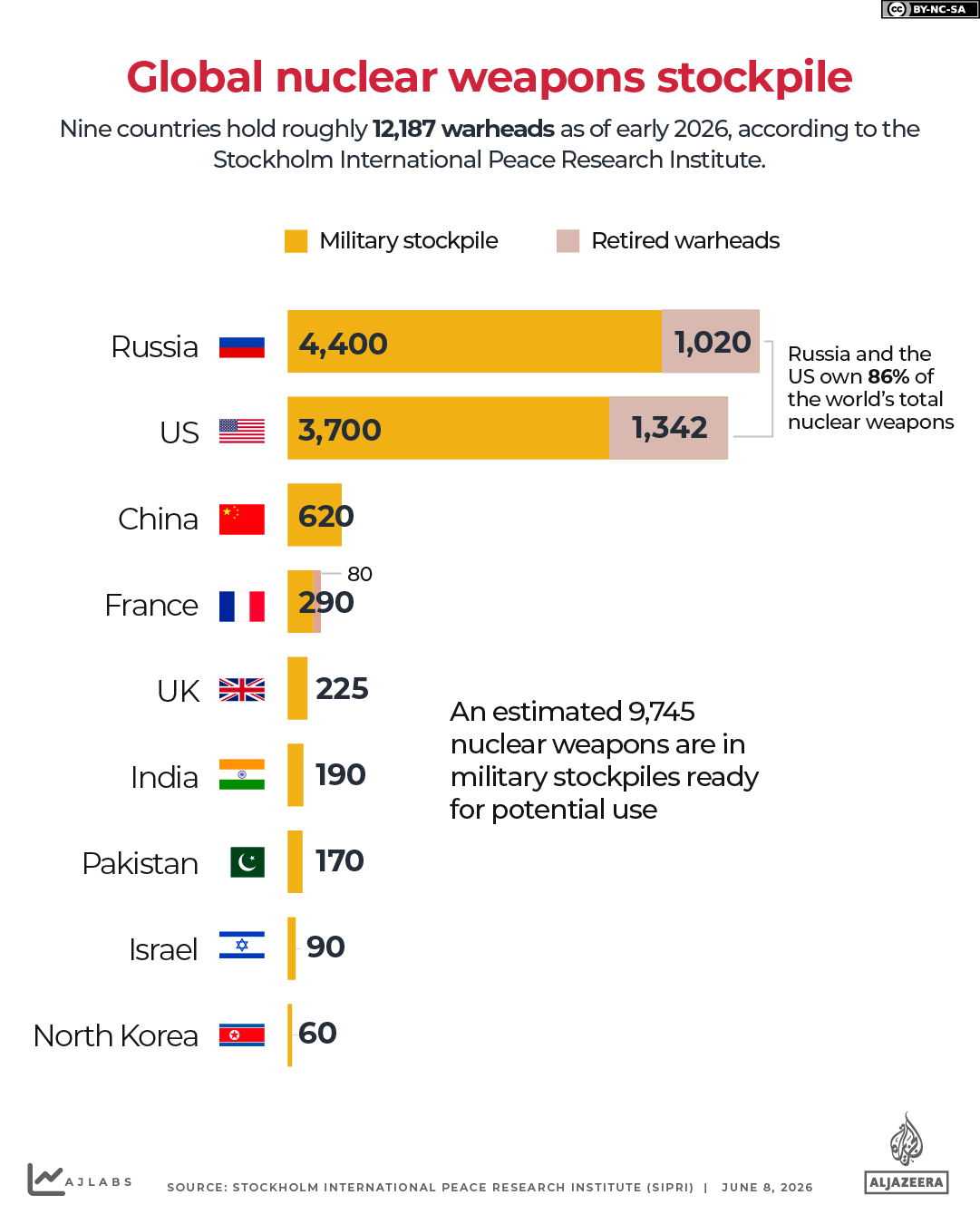
Behind the United States the spending thins out quickly. China was second at 13.5 billion dollars, the United Kingdom close behind at 12.6 billion, then Russia at 9.5 billion and France at 7.7 billion. India, Pakistan, Israel and North Korea each spent between a few hundred million and a few billion. The gap between Washington and everyone else is itself the point: the arms race the report describes is one the United States is lapping the field in, even as it casts the buildup as a response to its rivals.
The spending surge has arrived exactly as the guardrails came off. New START, the last treaty capping American and Russian strategic warheads, expired in February with no successor negotiated, removing the only remaining legal limit between the two arsenals. Russia has spent the past year recasting its weapons as the ultimate shield against Western pressure, while European states have moved the other way, with Norway joining France’s nuclear umbrella and the AUKUS partners pushing from promises to payloads. Every one of those moves shows up, eventually, as a line in a budget.
Against all of it, the treaty meant to end nuclear weapons sits almost entirely unsigned by the states that have them. The 2017 UN Treaty on the Prohibition of Nuclear Weapons has been ratified by 99 countries and by none of the nine that actually hold warheads. ICAN, which won the Nobel Peace Prize for shepherding that treaty into being, titled this year’s accounting Premeditated, a word chosen to argue that the spending is not drift but decision, that every dollar is a choice made by a government that could have chosen otherwise.
The money does not buy many new warheads so much as it rebuilds the apparatus around them: new missiles, new submarines, new bombers, new factories to forge the cores, programmes that run for decades and lock in spending long after the politicians who approved them are gone. That is what modernisation means in practice, and it is why a single record year matters less than the direction it sets. An arsenal being rebuilt now is an arsenal a country intends to keep for half a century.
There is a particular awkwardness in who leads the table. The United States has built much of its foreign policy on the argument that other states must not acquire or expand nuclear weapons, has sanctioned and bombed in the name of non-proliferation, and now outspends the entire rest of the nuclear world combined on its own. The report does not editorialise about that contradiction. It does not need to. The column of numbers does the work.
What the figures cannot say is where the line stops, because there is no longer a treaty drawing one. ICAN can count what was spent. It cannot count what that money bought in terms of risk, or say how much closer the new systems bring the world to using them. That is the number nobody publishes, and the one the report is really about.
For now the totals only climb, each year’s record becoming the next year’s baseline, the arsenals growing more modern and the agreements meant to limit them growing more scarce. The world spent 119 billion dollars last year to make sure the bomb has a future. It spent far less making sure it has one without it.