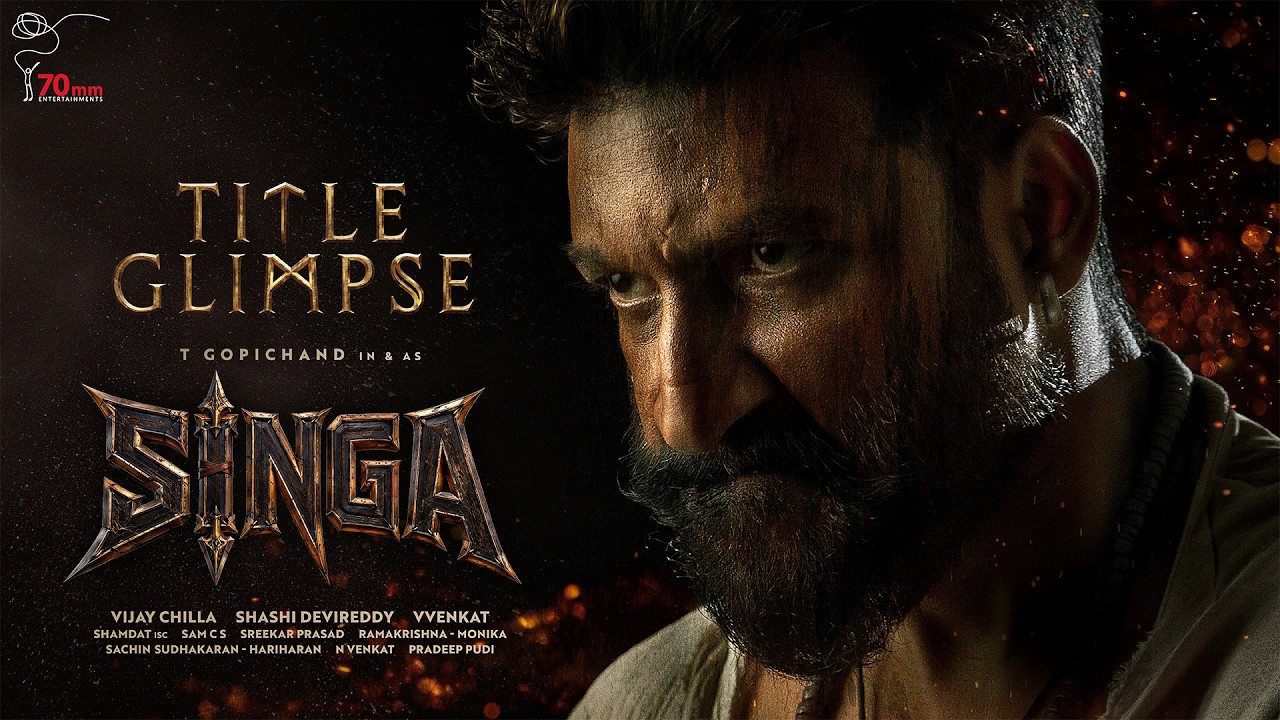

Gopichand used his birthday on June 12 to reveal the title and first glimpse of Singa, his next Telugu film, which marks the directorial debut of Vvenkat, an action choreographer who has spent years designing fight sequences across south Indian cinema. The glimpse establishes a raw, forest-set tone with Gopichand appearing in a physical transformation that the production is clearly positioning as a departure from his recent work, Gulte reported.
The title translates roughly to “wild beast” or “lion” in colloquial usage, and the footage leans into that register without restraint. Gopichand carries an axe, moves through dense forest terrain, and stares down the camera with an aggression that suggests the film intends to operate in the survival-action space rather than the mainstream masala formula that has defined much of his career. Sam CS provides the score, and cinematographer Shamdat captures the visual texture with a palette that favours earth tones and natural light.
The film is produced by Vijay Chilla and Shashi Devireddy under the 70mm Entertainments banner, a production house that has maintained a steady presence in Telugu cinema without chasing the mega-budget projects that dominate the industry’s headlines. Their involvement suggests a mid-range production that relies on Gopichand’s physical commitment and Vvenkat’s action design credentials rather than spectacle-driven set pieces. For Vvenkat, the transition from choreographer to director follows a path that several south Indian action designers have attempted, with varying degrees of success, in an increasingly competitive Telugu market.
Anarkali Nazar, who has built a career in Malayalam cinema with roles in films like Aadu and Kuttanadan Marpappa, makes her Telugu debut as the female lead. The cross-industry casting is notable because it reflects a broader trend in south Indian cinema where linguistic boundaries have become increasingly porous, with actors and technicians moving between industries more freely than at any point in the past decade. Her presence adds a dimension of novelty to a project that is otherwise rooted in a genre Gopichand has occupied for most of his career.
Gopichand’s filmography over the past few years has produced inconsistent box-office results, with none of his recent releases achieving the kind of commercial breakout that his contemporaries in the Telugu and Tamil industries have managed. Singa represents an attempt to recalibrate his screen presence around physicality and intensity, qualities that the title glimpse foregrounds aggressively. Whether the film can translate that visual promise into theatrical numbers will depend on whether Vvenkat’s experience in designing action for other directors translates into the broader narrative and pacing demands of directing a full feature.
Sam CS, who composed the scores for Vikram Vedha and Kaithi before crossing over to Telugu cinema, brings a track record that suggests Singa’s background music will lean into tension and atmosphere rather than conventional commercial beats. His involvement, alongside Shamdat’s cinematography, positions the film’s technical team as one of its strongest selling points, a configuration that has worked for mid-budget Telugu action films when the leading man’s star power alone cannot guarantee an opening.
No release date has been announced for Singa, though the production’s decision to unveil the title on Gopichand’s birthday suggests that marketing material will roll out at a measured pace designed to build anticipation around the actor’s physical transformation. In a Telugu market where star reinvention has become a recurring narrative, the question is whether Gopichand’s bet on a first-time director with deep action credentials can produce the commercial result that has eluded him in an industry increasingly dominated by franchise properties.