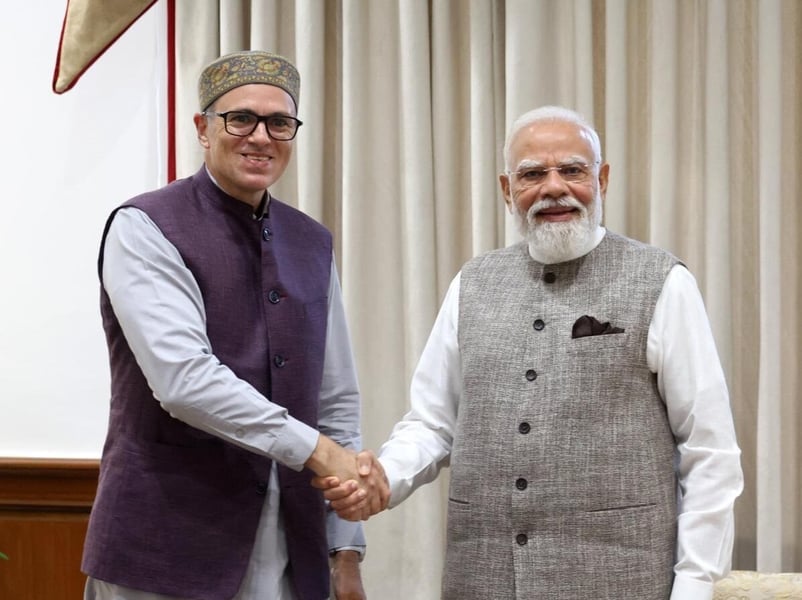

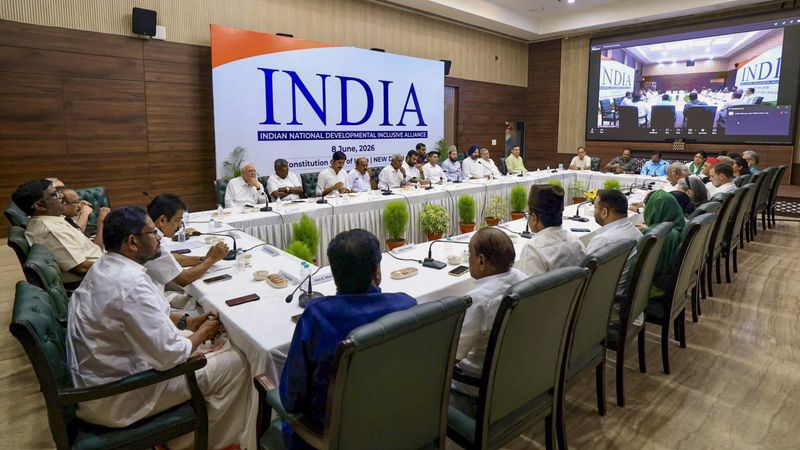
Jammu and Kashmir Chief Minister Omar Abdullah met Prime Minister Narendra Modi in New Delhi on June 11 and pressed for the early restoration of full statehood to the Union Territory. The meeting took place on the margins of the 11th NITI Aayog Governing Council session. Abdullah also congratulated Modi on completing 12 uninterrupted years in office. Three days earlier, at the INDIA bloc’s June 8 meeting at the Constitution Club, Abdullah had asked representatives of 22 opposition parties to join the National Conference when it comes to Delhi to protest for statehood restoration during Parliament’s Monsoon Session in July.
The statehood demand is not new. What is new is the urgency behind it. The National Conference lost the Budgam Assembly by-election to Mehbooba Mufti’s People’s Democratic Party in a seat Abdullah himself had previously held. The loss followed weeks of public friction between the Chief Minister and his own Srinagar MP, Aga Syed Ruhullah Mehdi, who joined student protests outside the Chief Minister’s residence and skipped an emergency party strategy session at Dachigam National Park on June 3. Both the PDP and the Jammu and Kashmir People’s Conference have accused the NC of diluting its stance on statehood. Abdullah’s Delhi pivot is an attempt to reclaim the issue before his rivals define him by it.
At the Modi meeting, Abdullah raised a list of specific demands that went well beyond the constitutional question. He requested enhanced rail services on the Udhampur-Srinagar-Baramulla Rail Link corridor ahead of the apple harvest season, expanded hydropower development, new tourism circuits beyond the traditional Valley destinations, sustained support for farmers, artisans and the MSME sector, and a request to open Awantipora airfield for civilian traffic during a planned 15-day closure of Srinagar International Airport in October for runway maintenance. He separately met Defence Minister Rajnath Singh and Civil Aviation Minister K. Rammohan Naidu on the airport issue.
Abdullah framed statehood not as a political demand but as an economic prerequisite. “Restoring statehood would not merely be a constitutional formality, but a meaningful step toward strengthening democratic institutions, deepening public participation and advancing the next phase of the region’s development,” his office said in a statement. The government added that “Jammu and Kashmir is committed to being a full and productive partner in India’s growth story.” The Prime Minister’s Office confirmed that Modi and Abdullah discussed a wide range of issues concerning Jammu and Kashmir but offered no commitment on a timeline for statehood.
The constitutional backdrop is August 5, 2019, when the Modi government abrogated Article 370, stripped Jammu and Kashmir of its special status, and bifurcated the former state into two Union Territories. The Supreme Court upheld the abrogation in December 2023 and directed the government to restore statehood “at an appropriate time.” That time has not arrived. The BJP controls both houses of Parliament with expanded margins after the 2024 general election and the 2026 state sweeps in West Bengal and Assam, and faces no legislative pressure to act. Abdullah’s NC governs J&K with a 53-seat majority in the 90-member Assembly, but as a Union Territory chief minister his powers are curtailed by the Lieutenant Governor’s authority over police, public order and land.
The planned protest is a dharna at Jantar Mantar in New Delhi, timed for the opening day of the Monsoon Session in the third week of July. NC parliamentarian Aga Ruhullah Mehdi, despite his public clashes with party leadership, announced he would participate and demanded that Article 370 reinstatement remain central to the protest’s demands. That puts Abdullah in a bind. He has carefully avoided linking statehood to the broader Article 370 question, which the Supreme Court has already settled against him. Mehdi’s insistence on reopening it risks making the protest look maximalist and giving the BJP a reason to dismiss it. The PDP’s Mehbooba Mufti, who defeated the NC in Budgam, has said her party would join the statehood protest.
At the INDIA bloc meeting, Abdullah told the assembled opposition leaders: “Let us look ahead to 2029 and let us acknowledge that Congress is the glue that holds INDIA together.” The praise for Congress was calculated. Abdullah needs the national opposition’s institutional weight behind the statehood demand, and Congress controls the largest share of the bloc’s parliamentary seats. But the INDIA bloc is fracturing. The DMK skipped the June 8 meeting after a fallout with Congress over Tamil Nadu. Mamata Banerjee attended, but within days 19 of her own TMC MPs petitioned the Speaker to break from her. The alliance agreed to hold bimonthly meetings and to write letters soliciting participation in the J&K protest, but the commitment is thin when key allies are haemorrhaging members to the ruling side.
Abdullah maintains a comfortable legislative majority at home. What he lacks is leverage in Delhi. As a Union Territory chief minister, he cannot call his own shots on security, cannot appoint his own police chief, cannot control land policy. Statehood would return those powers. It would also give him something to show voters who are beginning to ask what the National Conference’s 2024 election victory actually changed. The Budgam loss and the Mehdi rebellion are symptoms of the same problem: a chief minister who won an election but cannot deliver its central promise because the constitutional architecture will not let him. Modi, meanwhile, is in France negotiating a $39 billion Rafale deal. The Monsoon Session protest is Abdullah’s attempt to force the question before the architecture becomes permanent.