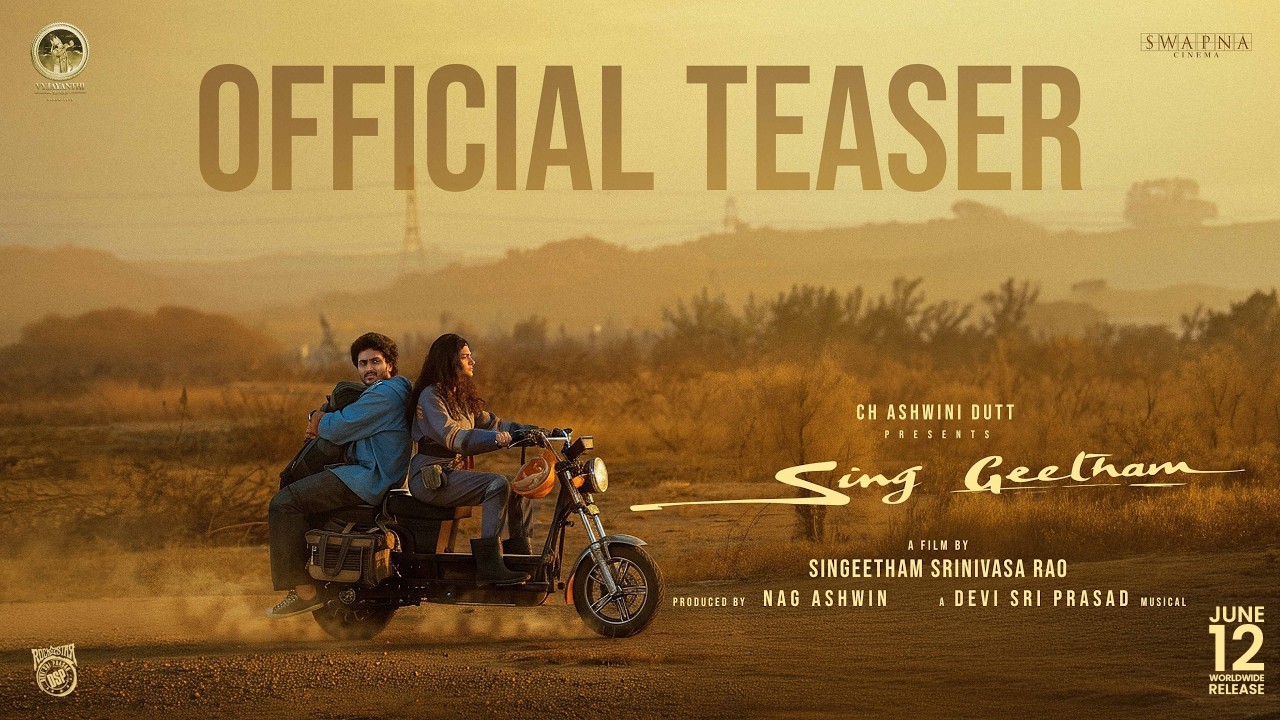

Sing Geetham, directed by Singeetham Srinivasa Rao, opened in theaters on June 12, 2026. The film is a Telugu-language musical built on a premise that would seem reckless in the hands of a less experienced filmmaker: every line of dialogue is sung. There is no spoken conversation in the film. Characters express anger, love, grief and everyday banalities through melody, and the audience is asked to accept this as the natural mode of communication in the world the film creates. Singeetham Srinivasa Rao is 94 years old. He has been carrying this idea for nearly four decades.
The setting is Kuberapuram, a village that was once surrounded by forest and is now stripped bare by illegal mining. The trees have been felled one by one until a single specimen remains, protected by a young woman named Gowri, played by Ahilya Bamroo. When that last tree is cut down despite her resistance, the village deity intervenes with a curse: the people of Kuberapuram will no longer be able to speak. Whatever they wish to communicate must be done through song. The curse is both punishment and metaphor, a way of saying that a community that destroyed its natural voice must now find an artificial one.
Ayaan plays Pratap, a man recently released from prison who arrives in Kuberapuram seeking ancestral wealth through the gold that the mining operations have been chasing. Shalini Kondepudi plays Renu, the daughter of the mining overlord whose operations caused the environmental devastation. All three lead actors are relatively new faces, a casting choice that reflects the film’s experimental nature. Singeetham Srinivasa Rao chose performers who could sing their own parts rather than established stars who would need dubbing, and the decision gives the film an authenticity that a more conventional casting approach would have undermined.
Devi Sri Prasad composed the music, and the score carries more weight here than in any conventional film because it is not accompaniment but the film’s primary language. The compositions range from comic exchanges to emotional confrontations, and DSP had to write melodies that could function as both music and dialogue simultaneously. By the interval, critics have noted, the format begins to feel natural. The audience adjusts, and the sung conversations stop registering as novelty and start functioning as storytelling. That transition is the film’s central achievement.
Nag Ashwin produced the film under the banners of Vyjayanthi Movies and Swapna Cinema. Nag Ashwin, who directed Kalki 2898 AD, has spoken publicly about Singeetham Srinivasa Rao’s influence on his own approach to filmmaking, and the decision to produce Sing Geetham reflects a commitment to supporting a filmmaker whose work has historically pushed against the boundaries of what Indian commercial cinema is willing to attempt. Vyjayanthi Movies, one of Telugu cinema’s most prominent production houses, gave the project the institutional backing that a film this unconventional required.
Singeetham Srinivasa Rao’s career spans six decades and includes films that were ahead of their time by margins that only became apparent years later. Pushpaka Vimana (1987), a dialogue-less comedy starring Kamal Haasan, won the National Film Award for Best Popular Film Providing Wholesome Entertainment and demonstrated that Indian cinema could tell a complete story without a single word of dialogue. Aditya 369 (1991) was a Telugu science fiction film built around time travel, a genre that Indian cinema had barely touched. Mayuri (1985) won 14 Nandi Awards. Bhairava Dweepam (1994) explored fantasy and mythology with a visual ambition that anticipated the scale of later South Indian spectacles.
Sing Geetham is, in a sense, a companion piece to Pushpaka Vimana. Where that film removed dialogue entirely and told its story through physical performance and visual comedy, this one replaces dialogue with music and asks whether melody can carry the same narrative and emotional weight that spoken language does. The answer, based on critical reception, is qualified but largely affirmative. Reviews have landed in the range of 2.75 to 3.25 out of 5, praising the concept and the music while noting that the execution has pacing issues, particularly in the first half before the audience fully acclimates to the format.
The film’s environmental message is woven into its structure rather than delivered as lecture. The curse that removes speech is a consequence of environmental destruction, and the resolution of the curse is tied to ecological restoration. For a family audience, the framework turns an abstract environmental argument into a tangible narrative consequence: the village literally loses its voice because it destroyed the natural world that sustained it. It is the kind of allegory that works simultaneously for children, who respond to the mythological logic, and for adults, who can read the political implications.
The production design has drawn mixed responses. Some critics have noted that the village of Kuberapuram lacks the visual realism that would ground the fantasy more convincingly, while others have argued that the stylised sets complement the film’s deliberately artificial mode of communication. The second half of the film is consistently cited as stronger than the first, with the emotional stakes rising as the musical format deepens its hold on the story and the characters’ predicament becomes more urgent.
Singeetham Srinivasa Rao is now the oldest active filmmaker in Indian cinema. Sing Geetham is his first film in over a decade, and he has spoken about carrying the concept since the 1980s, waiting for the right moment and the right collaborators to bring it to the screen. That Nag Ashwin and Vyjayanthi Movies provided that support is itself a statement about the Telugu film industry’s willingness to back creative risk when it comes from a filmmaker whose track record justifies the gamble. The film opened to modest numbers, but its significance lies less in its box office than in its existence: proof that at 94, Singeetham Srinivasa Rao is still making films that no one else would think to attempt.