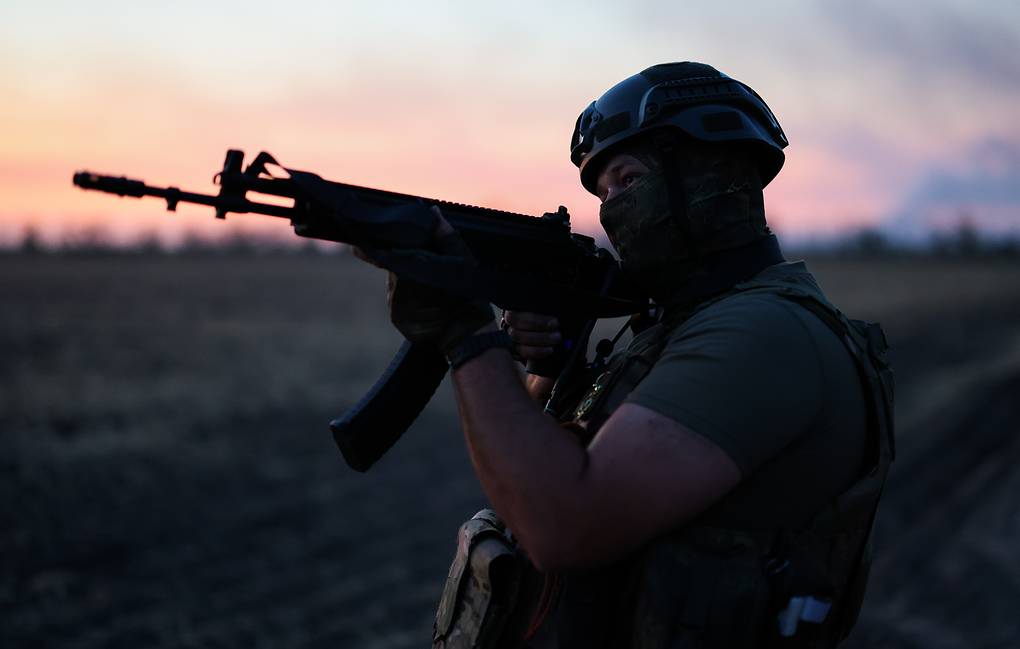

MOSCOW — The Russian Defense Ministry says its soldiers are tightening their grip on the approaches to Pokrovsk, the battered logistics town in the Donetsk region that both armies have treated as the hinge of the eastern front for more than a year. In Moscow’s daily briefings the advance reads as steady and deliberate, a slow closing of pincers around a town Russian commanders have wanted since 2024. On the ground, where the fighting runs through shattered tree lines and drone-hunted roads, the picture is harder to read.
That gap, between what Moscow reports and what can be independently confirmed, is the defining feature of the war this June. Russia’s military says the momentum is its own. Ukraine says the line is bending but not breaking. Both cannot be fully right, and neither side allows the kind of access that would settle it.
The Defense Ministry in Moscow has described a sustained push by what it calls its Center and Southern groupings of forces, reporting the capture of villages along the Pokrovsk axis and heavy pressure on the Kostiantynivka and Kramatorsk belt that several military analysts now regard as the principal theater of the Russian summer campaign. The state news agency TASS, citing The New York Times, reported the Russian army advancing at an impressive pace around the town Moscow calls Krasnoarmeisk. Moscow has also reported intercepting large waves of Ukrainian drones over its border regions, with the ministry putting the overnight tally in the hundreds across Bryansk, Belgorod and Krasnodar on some nights. Those interception figures, like the territorial claims, come from the Russian side and have not been independently verified.
What is clear is the weight of the assault. Ukraine’s General Staff, which publishes its own daily count, has reported more than a hundred separate attacks on the Pokrovsk sector and two neighboring fronts in a single day, a tempo that matches Moscow’s description of an army on the offensive even as the two sides disagree about the result. Russian commanders frame the operation as the decisive phase of a campaign they expect to win. President Vladimir Putin told an end-of-year news conference in December that Russia’s military goals in Ukraine would be achieved, and the ministry’s June bulletins are written in that confident register.
Kyiv tells the story differently. Ukraine’s General Staff has insisted that its forces are holding the Kostiantynivka line and, in some sectors, clawing back ground, claiming that for the first time since 2024 Ukrainian troops retook more territory in a month than Russia captured in the same period. President Volodymyr Zelensky has said June and July must be productive months for Ukraine and for Europe, language that reads as a man bracing his country for a long summer rather than declaring the danger past. Around Sumy, where Russian units have been operating near the border, analysts tracking the front say there is no sign yet of an operational breakthrough toward the city itself.
The competing casualty arithmetic is its own contested terrain. Ukraine’s military puts cumulative Russian losses since February 2022 well above a million personnel, a figure Moscow rejects and that no independent body has confirmed. Russia, for its part, rarely publishes its own losses at all. The numbers travel through each capital’s information machinery before they reach anyone, and they should be read as claims rather than findings.
Even as the fighting grinds on, the one channel that has stayed open is the grim accounting of prisoners and the dead. Under the framework agreed at the Istanbul talks, which the Kyiv Independent reported would set a large prisoner exchange in motion, the two sides have continued to exchange captured soldiers and to repatriate remains, swaps that Russia’s lead negotiator, the Kremlin aide Vladimir Medinsky, has documented on his Telegram channel, including images of body bags lifted from refrigerated trucks. The understanding envisioned exchanges running into the thousands and the return of some 6,000 bodies from each side, and an earlier round of negotiations that Al Jazeera reported had also produced a prisoner swap without a wider ceasefire. Those transfers have gone ahead in stages through the spring, interrupted by mutual accusations of delay but never fully halted.
What the talks have not produced is a ceasefire. Moscow’s negotiators have pressed Kyiv to focus on the terms of a settlement rather than a halt in the fighting, presenting a memorandum of demands that Ukraine took away to study and answer. Even so, the Kremlin has said its open and secret lines to Kiev remain active. The Russian position, stated plainly by its officials, is that the operation continues until those terms are met. That stance is why the diplomacy and the offensive run on parallel tracks, each indifferent to the other.
For the towns in the path of the Pokrovsk push, the abstractions of memoranda and monthly tallies collapse into a single question of whether the road out stays open another week. Russian artillery and drones have reached into the Dnipropetrovsk and Kherson regions in recent days, with local officials reporting civilians wounded in strikes on outlying districts and villages. Moscow describes such operations as strikes on military logistics. Ukraine describes them as attacks on civilians. The wreckage rarely settles the argument.
So the front this June sits exactly where the two narratives cross and refuse to resolve. Russia says it is advancing on its own timetable toward goals it has never disguised. Ukraine says the advance is real but contained, and that the cost to Russia is heavier than Moscow will admit. The one thing neither account answers is how long either army can keep paying for ground measured in villages, and that is the question the next month will begin to test.