
MOUNTAIN VIEW – The teaser arrived not on Google’s own channels, but on Amazon.
Within the past week, a series of video advertisements quietly surfaced on Google’s Amazon product page, each carrying the same two-word label: “Pixel Drop.” No press release. No blog post. No Google Newsroom entry. Just three short clips uploaded to a retail storefront run by the company Google’s search engine has long treated as a frenemy – and, tucked inside those clips, the clearest signal yet of what the next feature update for Pixel phones will contain.
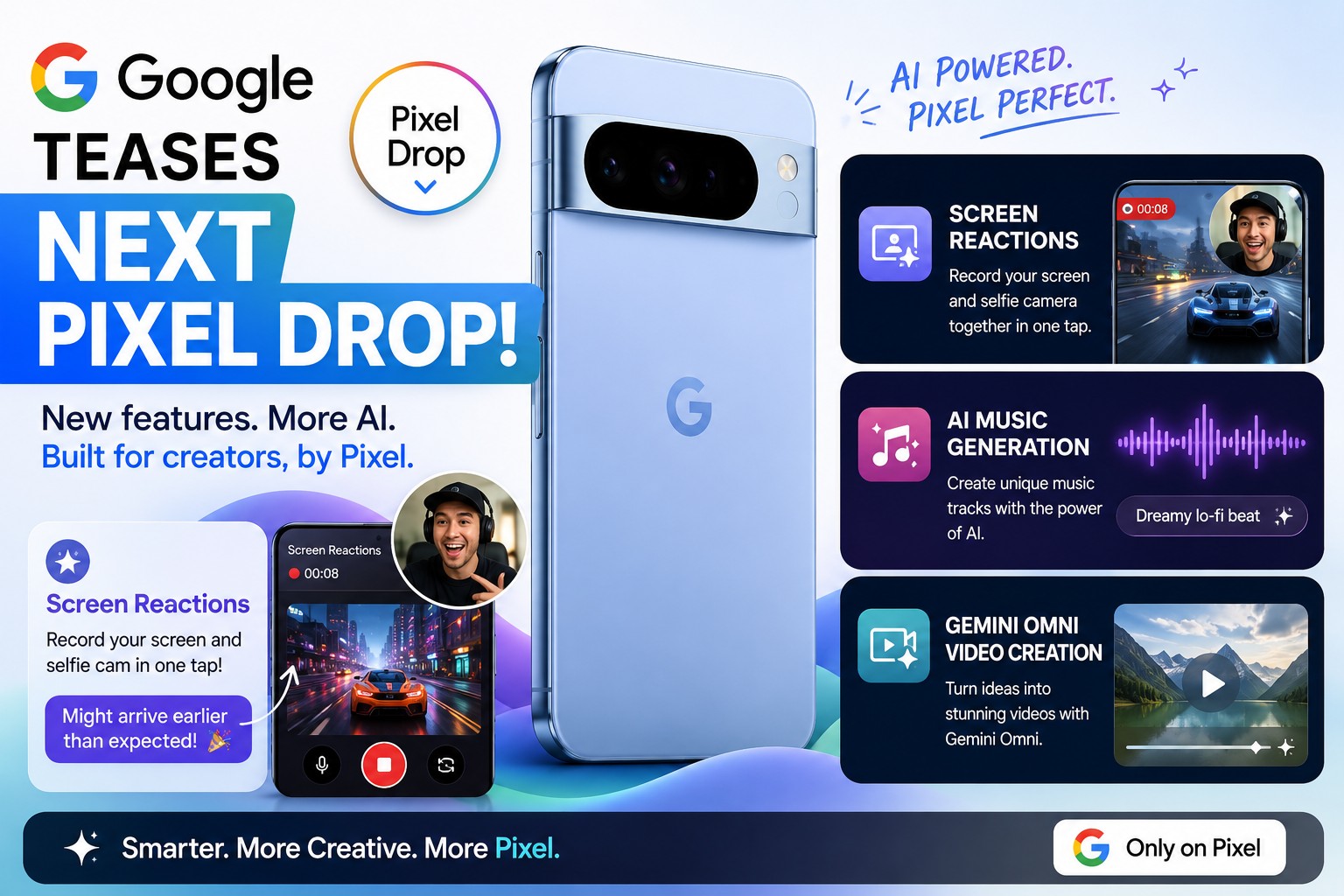
The three videos, first spotted by 9to5Google, advertise Screen Reactions for Creators, Gemini Omni video generation, and an AI music composition tool. They do not carry a release date. Google has not confirmed when the Drop will land. But the ads themselves, quietly seeded on Amazon before appearing anywhere else, say something about how Google now chooses to build anticipation – and where the line between a Pixel-exclusive feature and a paid Gemini subscription is getting harder to find.
The last Pixel Drop came in March 2026. Google has settled into a rough quarterly rhythm for these updates, which means the next one is overdue by a few weeks. The Amazon ads suggest it is close.
Of the three features teased, Screen Reactions is the only genuinely new one – and the one that matters most to understand what Google is trying to prove. The feature, first shown at The Android Show in May, allows a user to record their phone’s screen while simultaneously capturing footage from the front-facing camera. The result is a picture-in-picture clip: what’s on the screen on one side, the user’s face on the other. No third-party app. No editing workflow. One tap.
For a particular category of creator – the person doing a game walkthrough, a tutorial, a product reaction video – that is a meaningful simplification. The workflow it replaces typically involves a screen recorder, a separate camera app, and a video editor capable of layering the two tracks. Screen Reactions collapses all of that into the camera roll. The feature only just arrived in Android 17 QPR1 Beta 4 last week, and most observers had expected it to reach stable devices in September, when QPR1 is scheduled to ship. The Amazon ads suggest Google is moving it earlier, delivering it to Pixel phones through the Drop rather than waiting for the full Android update cycle.
That acceleration is itself a statement. Google has spent several years trying to position the Pixel line as the device where Android’s best features arrive first. Screen Reactions, pulled forward from a September beta release into a June feature drop, fits that strategy precisely. It is a Pixel-exclusive, at least for now, and according to the ad’s closing text, it will stay that way.
The Gemini features in the other two ads are a different story. Music generation – demonstrated in one video as a user asking Gemini to compose a country song about a roommate stealing ice cream – and Gemini Omni video creation are not new capabilities. Google announced both at I/O and has been rolling them out to paid Google One subscribers since. They exist today, on Pixel phones, for anyone paying for the right plan. What the Pixel Drop would appear to do is either broaden access, package them more prominently, or simply give Google a marketing moment to remind buyers that these features live on their device.

That ambiguity matters. Pixel Drops have historically been understood as free updates – features that arrive on a Pixel phone and simply work, no subscription required. The clearest examples were things like Call Screen, Now Playing, and the photo editing tools that distinguished the Pixel camera experience. When Google bundles Gemini subscription features into the same Drop announcement, it muddies what a Pixel Drop actually means. Are these capabilities that come with the phone, or are they capabilities that require a monthly payment to unlock? The Amazon videos do not answer that question, and Google hasn’t either.
The choice of Amazon as the venue for these previews is not accidental. Google has been increasingly aggressive about placing Pixel advertising inside Amazon’s product listings, a tactic that reaches buyers who are already in a purchasing mindset. The Pixel 10 Pro has been discounted heavily on Amazon and Best Buy this month, and the feature-drop teasers appear to be part of the same push: soften the buyer’s hesitation about software longevity by showing what is coming before the phone even arrives.
It is also worth noting what is absent from the teasers. The March 2026 Drop rebranded these updates from “Pixel Feature Drop” to simply “Pixel Drop,” a naming shift that Google has now carried into this round of advertising. Whether that signals a change in the cadence, the scope, or just the marketing language remains unclear. Google has not said.
What the three Amazon videos establish, with reasonable confidence, is that Screen Reactions is arriving on Pixel phones sooner than the Android beta timeline implied. The feature only landed in Android 17 QPR1 Beta 4 last week, landing alongside the news that Pixel 6 devices are being dropped from the update window. For Pixel 10 owners, Screen Reactions arriving through a June Drop rather than a September stable release is a meaningful difference: three fewer months of watching the feature exist in beta while waiting for it to reach a daily driver.
Google’s AI music generation, meanwhile, is powered by Lyria, the company’s generative audio model. The country-song demo in the Amazon ad is deliberately trivial – a domestic complaint rendered in three chords – but the underlying capability is more significant than the example suggests. Lyria 3, which Google began rolling out to developers in February, represents a genuine step forward in audio generation quality. Whether the Pixel Drop will give free-tier users access to music generation, or whether it will function primarily as a showcase for what paid subscribers already have, is the question the ads leave open.
Gemini Omni video creation, the third feature in the teasers, allows users to combine text, images, and other media to produce short video clips. Google described it at I/O as part of Gemini’s expansion into a “multimodal” platform – one capable of generating or editing across formats, not just answering questions in text. The Amazon ad ends with the phrase “on your Pixel,” which is technically true but leaves the subscription question dangling.
The Pixel Drop has no confirmed date. Based on Google’s historical pattern, an announcement could come within the next week or two. What the Amazon ads have already done is shift the conversation: the next Drop is no longer a rumor. It has a feature list. What it does not yet have is clarity on what Pixel ownership actually buys you – and what you will still need to pay for separately once the update lands.
That is the question Google has not answered in any of its videos. It may prefer to let buyers figure it out after the announcement.