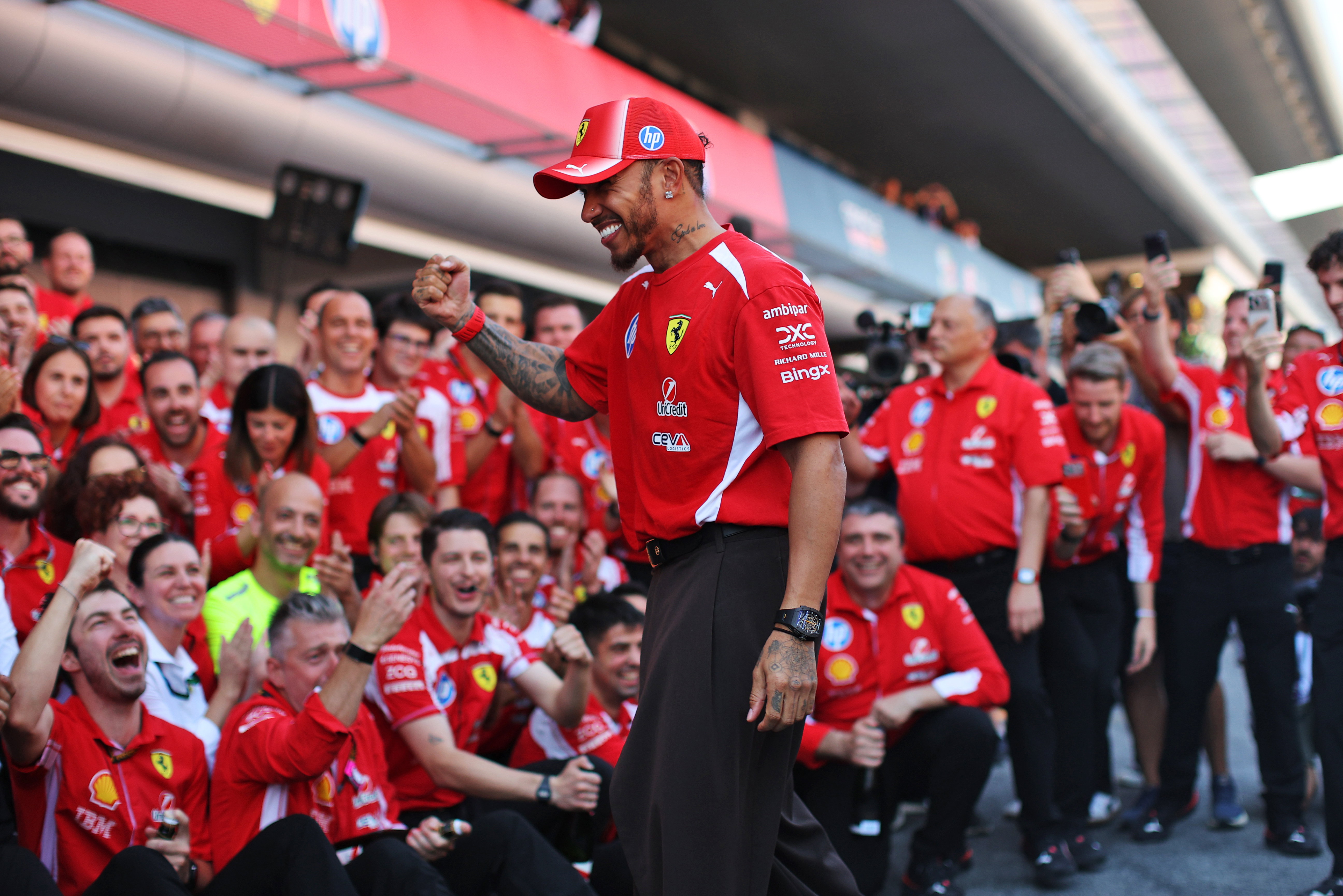

BARCELONA – The radio crackled as Lewis Hamilton crossed the finish line at the Circuit de Barcelona-Catalunya, his voice barely holding together. “You’ve helped me achieve this dream,” the seven-time world champion told his Ferrari engineers, nineteen seconds clear of anyone else on the road. “I just can’t thank you enough.”
That sentence carried eighteen months of weight. Hamilton had arrived at Ferrari in 2025 as the sport’s most decorated driver, a man who had won everything there was to win at Mercedes. What followed was the worst season of his career – not a single podium, a string of Q1 exits, and a creeping public self-doubt that made the paddock uncomfortable to watch. He finished sixth in the championship, 86 points behind his own teammate.
Sunday’s victory at Barcelona, his 106th in Formula 1 and the first wearing red, changes none of that history. But it changes what comes next. Hamilton, 41, has now beaten Mercedes on a day when Ferrari needed to be better not just on pace but on strategy, nerve, and timing. The deficit to championship leader Kimi Antonelli – who retired with an electrical failure in the closing laps, just after overtaking George Russell into second – has been cut from 66 points to 41. Ferrari, which had not won a grand prix in 595 days, is no longer a subplot in 2026. It is the story.
The question now, and it is not a small one, is whether the team can handle it.
Ferrari team principal Fred Vasseur walked into the post-race media pen and immediately tried to lower the temperature. “Nothing changed today compared to last week,” he told reporters including RacingNews365. “The result is different, the outcome of the race is different. The commitment of the guys in the garage in Maranello, from Lewis, from Charles, didn’t change compared to last week. We have to stay calm with this. It’s not that today everything is magic, and last week it was not.”
That was not the language of a man swept up in the moment. It was the language of a manager who has watched this organisation before, who knows what unchecked euphoria does to a team that has spent seventeen years waiting to win another constructors’ championship. Vasseur has spent two years trying to professionalise Ferrari’s internal culture, to stop the oscillation between crisis and celebration that has defined so much of the post-Schumacher era in Maranello. A win this significant, in front of this global an audience, is precisely when that project is most at risk.
For Hamilton, the result is a reclamation. He has spoken repeatedly this season about his need to “remember who I am” – a phrase that reads simply until you understand its implications. The version of Hamilton who arrived at Ferrari in 2025 had been diminished not just by results, but by the accumulated weight of Abu Dhabi 2021, a regulation era that never suited the car he drove, and a first Ferrari season in which the machinery itself was unreliable and the team’s direction unclear. He wrote on Instagram after the chequered flag: “There have been dark times, times where the negativity won out and I felt useless and hope felt impossible.” That is not a press release. That is a man processing something real.
What Sunday demonstrated was that Hamilton still knows how to win when the car gives him a chance. Ferrari sent him onto the grid on soft tyres while the Mercedes drivers started on mediums – a gamble that cost him the lead at the start but forced Russell and Antonelli into reactive pit stop decisions they had not planned. The three-stop strategy that followed was executed without error. When Fernando Alonso’s Aston Martin expired at the side of the circuit and triggered a virtual safety car on lap 41, Hamilton pitted from the lead for the last time and emerged with tyres that were twenty-one seconds fresher than Russell’s. He did not look back.
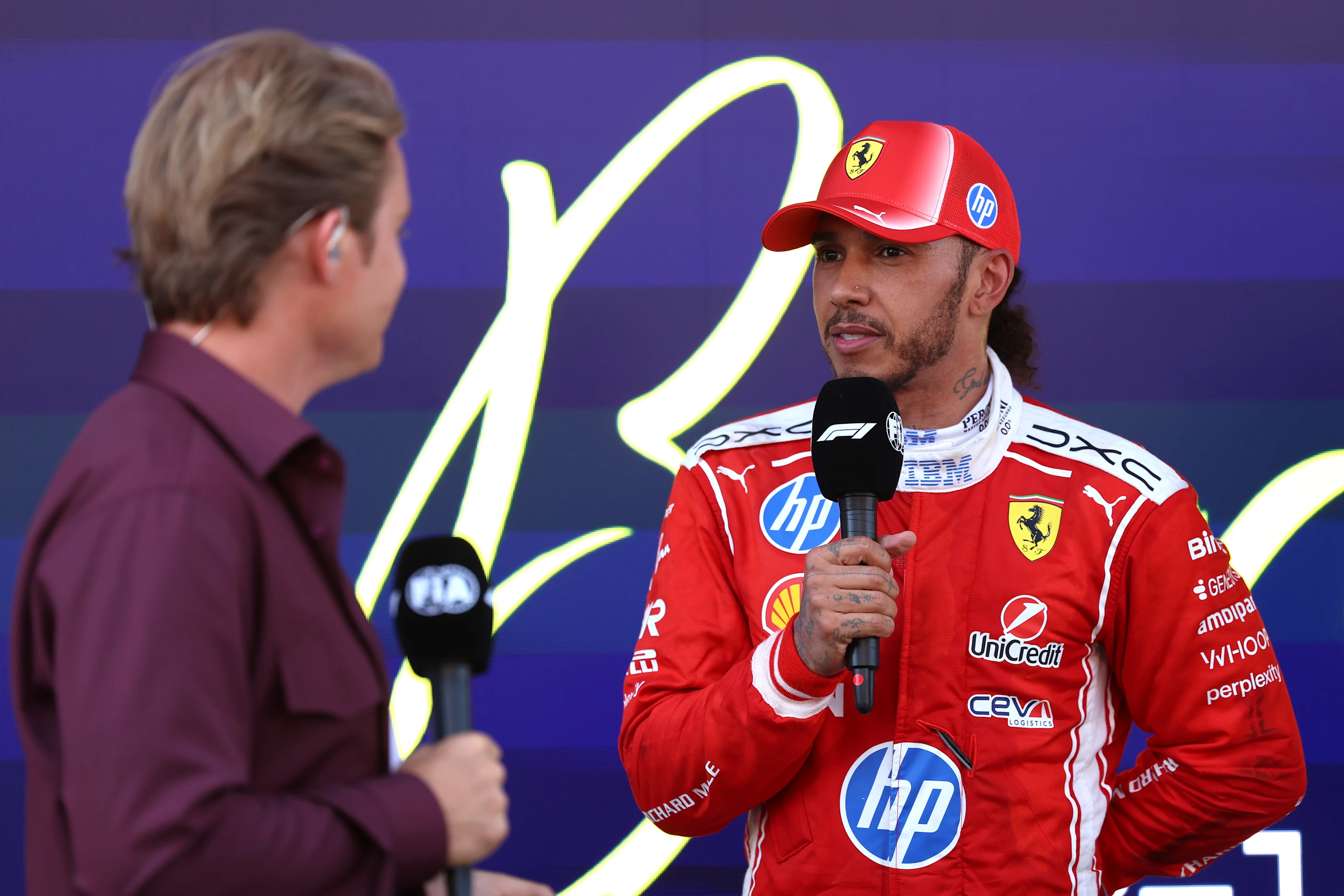
Nico Rosberg, who raced alongside Hamilton at Mercedes for three seasons and beat him to the 2016 title, watched the final laps from the paddock and told Formula 1’s official broadcast that the sport had witnessed “a legendary moment.” Rosberg had interviewed Hamilton in parc ferme immediately after the chequered flag, and speaking to F1.com shortly after, he described something that went beyond the result. “It’s amazing how he’s really managed to turn it around and climb to his greatness once again,” Rosberg said. “We all kind of want this to continue now.”
What Rosberg was pointing at, and what Vasseur was trying to contain, are the same thing: the sense that momentum is now running in Hamilton’s direction in a way it has not since 2020. Ferrari introduced significant car upgrades in Barcelona – eight revised components, according to Rosberg’s account from the paddock – and those updates appeared to work. Hamilton qualified on the front row with a stunning final lap in Q3. Charles Leclerc, his teammate, was fast enough before retiring with damage. The underlying pace was real.
Whether that pace translates beyond Circuit de Barcelona-Catalunya is the question Vasseur cannot yet answer. Barcelona rewards high downforce, clean air, and tyre management – three things Ferrari has shown it can do. Austria, the next race on June 28, is a shorter circuit that historically has punished teams with aerodynamic drag. The upgrade package may look different there. Vasseur’s caution is not false modesty. It is a legitimate hedge against a season in which seven of the season’s first nine races went to Mercedes before Sunday, and in which the team has still not demonstrated that its pace advantage is anything other than conditional.
But conditional or not, the arithmetic has shifted. Antonelli’s retirement – his first of the year – was cruel timing for a 19-year-old who had handled every other adversity in his debut season with composure well beyond his age. The Italian had battled to third in the standings after Monaco despite mechanical issues in that race too. In Barcelona he had qualified third, worked his way past Russell late in the going, and then lost everything within two laps. The championship lead he brought into the weekend has narrowed to 41 points over Hamilton. Oscar Piastri sits a further 17 points behind in third. This is no longer a procession.
Ferrari’s executive chairman John Elkann released a statement after the race: “Well done Lewis, on your first great victory with Ferrari: an emotional moment and a very important result, which belongs to the entire team and to all our fans.” It was gracious and appropriate. It was also a reminder of how high the institutional stakes are for a constructor that last won a drivers’ championship in 2007 and a constructors’ title in 2008. Elkann has overseen Ferrari’s restructuring since the death of Sergio Marchionne in 2018. Hamilton was recruited, at enormous cost, as the man who could finally end that drought.
Sunday was the first concrete evidence that the bet might pay off. Whether Vasseur can keep the team believing that “nothing changed” – that the work continues at the same level, that the result does not distort expectations in either direction – is a management problem as demanding as any strategic call he will make this season. Ferrari knows how to want to win. It is less practiced at knowing how to win without wanting too much.
Hamilton said on the podium that this one felt different from his other 105. He did not explain exactly how. That detail, the thing that made it distinct from the 105 that came before, is something only he can measure – and for now, he is keeping it to himself.