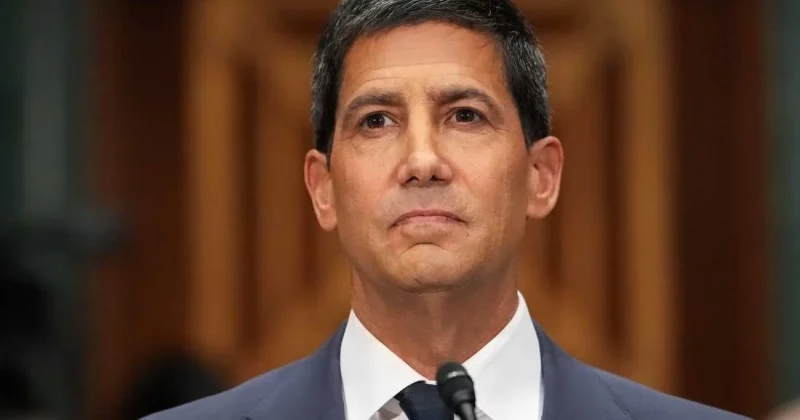

WASHINGTON – The last time the Federal Reserve told America something concrete about where interest rates were going, Jerome Powell was still in charge. That was May. Kevin Warsh has been running the central bank for three weeks, and in that span he has said almost nothing about the rate path — not to investors, not to journalists, not even in carefully hedged Fed-speak. As his first Federal Open Market Committee meeting opens Monday in Washington, the silence is the message.
What Warsh is engineering is not just a change in how the Fed communicates. It is, in practical terms, a change in monetary policy itself. The tool he most wants to dismantle — the quarterly dot plot, a chart showing where each of the Fed’s nineteen policymakers expects interest rates to go — functions as a kind of shadow rate. When it moves, mortgage markets move with it. Retirement funds reprice. Banks adjust the cost of car loans before the Fed has voted on anything. Warsh has argued, for years, that this amounts to the Fed managing expectations rather than the economy. He is about to test whether that theory survives contact with $33 trillion in household debt.
The dot plot was introduced in 2012 by then-Chairman Ben Bernanke as a transparency measure in the aftermath of the financial crisis. Its purpose was to reduce the violent market swings that came from policy uncertainty, giving investors a concrete anchor rather than forcing them to interpret every speech from every governor. It worked, broadly. Post-meeting volatility fell. The problem, in Warsh’s reading, is that it worked too well. Markets stopped treating the projections as conditional estimates and started treating them as commitments. The Fed, in turn, felt constrained by its own forward guidance, a bind that Jerome Powell spent much of 2023 and 2024 trying to escape.
Whether that diagnosis is correct is a genuine question inside the institution. It is not, however, a question that will be answered this week — because no one outside the Fed’s marble building quite knows what Warsh plans to do. That ambiguity, which he has cultivated deliberately, is already registering in rates markets. Futures pricing has swung more violently in the weeks since Warsh was sworn in than at any comparable point in the Powell era.
The people absorbing that volatility are not, for the most part, the hedge funds and primary dealers who dominate Fed-watching. They are the couple in Columbus who locked in a rate assumption on a home purchase that closes in August. The retiree in Tampa whose bond fund manager repriced duration last week on the basis of nothing more solid than rumors about what Warsh might say. The small business owner in Dallas whose bank just told her that a line of credit she’s carried for eight years is under review.
“The central bank should find new comfort in working without applause and without the audience at the edge of its seats,” Warsh told the International Monetary Fund in 2025. At the time it read as an abstraction. Now it is operational doctrine.
CNBC reported Sunday that markets are heading into the meeting with almost no clarity on Warsh’s views on inflation, jobs, or the rate path — and that the opacity may be by design. His plans for what he has called a “regime change” in how the Fed conducts policy include not just the dot plot but the frequency of post-meeting press conferences and the length of the FOMC statement itself. During his April Senate confirmation hearing, Warsh was explicit: “Unlike many of my current and former Fed colleagues, I do not believe in forward guidance on interest rates tied to economic data.”
There are credible voices who agree with him. Vincent Reinhart of BNY told the Financial Times that Warsh “appreciates the Fed’s not a particularly good forecaster.” Richard Clarida, former Fed vice chair and now at PIMCO, said the conditions were ripe to strip the guidance language from the June statement entirely. Esther George, who ran the Kansas City Fed for a decade, argued that markets had taken the dot plot “well beyond its intended purpose.”
But the critics are not soft. James Bullard, the former St. Louis Fed president, said scrapping the dot plot would breach an “international standard” for central bank transparency. Blake Gwinn of RBC described the dots as “a very important anchoring mechanism.” Guy LeBas at Janney argued they “keep a lid on interest rate volatility” — precisely the thing that seems likely to surge without them. The irony that Warsh has repeatedly cited Alan Greenspan as his model is not lost on anyone: Greenspan was the architect of much of the forward guidance framework that Warsh now wants to dismantle.
What investors are pricing, for now, is a rate hold. CME FedWatch data shows a 98.3% probability of no movement in the federal funds rate at the 3.50 to 3.75 percent target range. That consensus is the easy part. The harder question — the one that Morgan Stanley flagged last week as the most underpriced risk for global currency markets — is what Warsh says after the vote. May’s jobs numbers, which shattered expectations and handed Warsh a combustible first test, have already forced some banks to push their rate-cut forecasts into 2027. Morgan Stanley and Goldman Sachs both see inflation remaining well above the Fed’s 2 percent target through the back half of 2026.
There is also the matter of the easing bias — a signal embedded in the Fed’s policy statement that leans toward future rate cuts. Three FOMC members dissented at the last meeting under Powell, signaling they wanted it removed. Warsh is expected to let it go quietly. JPMorgan’s chief economist Michael Feroli does not expect Warsh to say he is “open” to rate hikes, though he told clients he could see Warsh saying he “can’t rule it out.” That is a different kind of language than the market has been fed since 2022. With PCE inflation at 3.8 percent in April, the highest in three years, the room to reassure is narrow.
Warsh also wants to pivot how the Fed measures inflation — away from the Personal Consumption Expenditures index that has been its preferred gauge and toward a “trimmed-mean” measure that strips out the most extreme price movements in either direction. The Dallas Fed has used this approach for years. If adopted more broadly, it would change what number the institution is actually trying to hit, which would in turn change how almost every mortgage, bond, and floating-rate loan in the country is priced. The Fed has not announced any timeline for that shift, and whether it requires a vote or simply an editorial change in how the chair speaks about inflation remains unclear.
What is clear is that June 17 — when Warsh faces reporters for the first time as Fed chair — will tell Wall Street less than it wants to know. That is, apparently, exactly the point. What it will not tell is whether the borrowers, savers, and pension funds on the other side of that information gap can bear the cost of a central bank that has decided, at this particular moment, that the best thing it can do for the economy is say less.