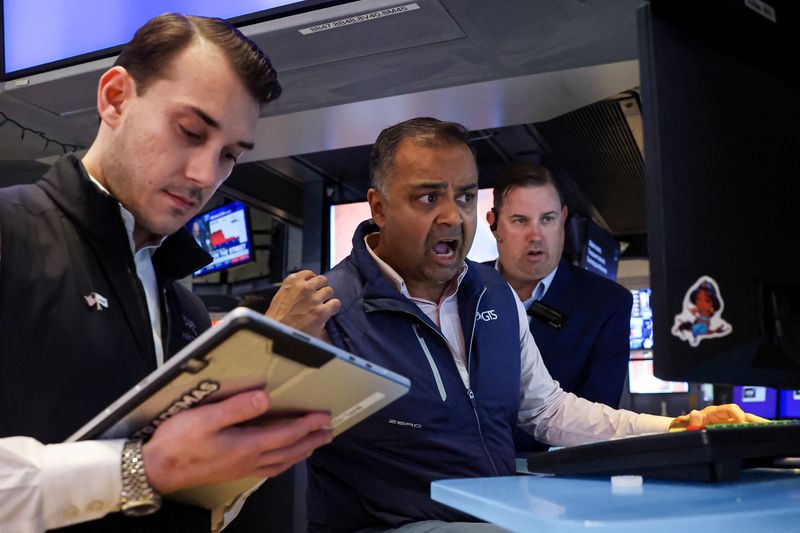

NEW YORK — The number that arrived Friday morning did not just beat expectations. It demolished the story Wall Street had been telling itself for the better part of three months.
The Bureau of Labor Statistics reported that U.S. employers added 172,000 nonfarm payroll jobs in May, according to the official BLS release. The Dow Jones consensus had clustered around 80,000 to 85,000. Analysts at TD Securities had gone lower still, penciling in 60,000, arguing the survey weeks showed too little hiring activity to justify anything higher. The actual figure was more than double what anyone in the mainstream expected, and Wall Street spent Friday paying for the misread.
By midmorning, the S&P 500 had shed 1.4% and the Nasdaq Composite was down roughly 2.4%, its third consecutive session of losses. The Dow Jones Industrial Average fell more than 280 points. Chip stocks bore the sharpest end of the move: Nvidia Corp. lost 2.5%, while Intel, Micron, AMD and Broadcom dropped between 4% and more than 6%. The Philadelphia Semiconductor Index tumbled over 5% — a remarkable reversal for a group that had surged 92% from its March lows, powering much of Wall Street’s recovery from the depths of the Iran-war panic to the S&P 500’s record close above 7,600 just two sessions earlier.
The rotation that followed was blunt. Consumer staples led six of 11 major S&P 500 sectors higher. Investors moved money out of growth and into defense — a posture that signals not optimism but the recognition that borrowing costs are going to stay uncomfortable for longer than the market’s rate-cut narrative had allowed.
Money markets responded in kind. Traders are now fully pricing in at least a 25-basis-point rate hike from the Federal Reserve before the end of the year — up from roughly a 60% probability immediately before the data. That is a meaningful repricing in a matter of hours, and it creates a specific problem for a specific person: Kevin Warsh, who took the helm of the Federal Reserve as chair after Jerome Powell’s departure last month and is now weeks from his first policy meeting, scheduled for June 16–17.
Warsh was installed by President Donald Trump, who has continued to publicly demand lower interest rates even as the underlying data argues in the opposite direction. Friday’s report handed Warsh a no-win opening act. Cut, and he validates a labor market that has given him no cover to do so. Hold, and he faces a White House that views any inaction on rates as defiance. Hike — and the political consequences are not difficult to imagine, given that Trump has framed rate policy in personal terms since at least 2018.
The broader employment picture in May was not uniformly strong, which is one thing the headline figure tends to obscure. Leisure and hospitality drove the bulk of the gains, adding 70,000 positions — primarily in food services and drinking places. Local government contributed 55,000, and healthcare added 35,000. These are not the sectors that tend to signal wage-inflationary overheating on their own. Financial activities, by contrast, shed 22,000 jobs, continuing a decline that stretches back to a peak in May 2025. Air transportation lost 9,000 jobs, largely reflecting a business closure. The composition of May’s gains leans toward the lower-wage, lower-productivity end of the labor market — a detail that does not typically move markets, but matters when making the case that a rate hike is the appropriate policy response.
Average hourly earnings rose 12 cents, or 0.3%, to $37.53 in May. Year-over-year wage growth came in at 3.4%, exactly in line with consensus. There is nothing in the wage data to suggest a wage-price spiral is forming. What is forming — and what the market is responding to — is a labor market that simply refuses to soften in the way rate hikes are supposed to make it soften.

The revisions buried in the report told a similarly awkward story. April’s payroll figure was revised upward by 64,000, from 115,000 to 179,000. March was lifted to 214,000 from 185,000. Combined, the prior two months came in 93,000 higher than previously reported — meaning the soft-landing narrative had been quietly built on a foundation that was already firmer than the initial data suggested. The three-month trend heading into June now averages well above breakeven.
Chip stocks had their own internal drama separate from the macro. Broadcom, whose earnings report earlier in the week had already rattled the AI trade, continued declining on Friday — falling more than 6% at points. The question circulating on trading desks was whether Broadcom’s report had exposed something structural about the pace of AI infrastructure spending, or whether the reaction was a valuation correction in a sector that had run to record highs just two sessions earlier. The answer matters for Nvidia’s forward multiple, and Nvidia’s forward multiple matters for roughly 7% of the S&P 500’s market capitalization.
Nvidia’s own CFO, Colette Kress, had delivered a keynote at the Bank of America Global Technology Conference on Thursday that addressed the company’s addressable market trajectory — arguing that each new chip generation materially expands the opportunity, from roughly $40 billion per gigawatt for Blackwell Ultra toward $60 billion to $80 billion for Vera Rubin and higher still for the Feynman generation. The bank reiterated a buy rating with a $350 price target after the address. That did not stop the stock from falling Friday. The jobs report provided the macro overlay; the AI demand question provided the sector-specific anxiety underneath it.
What Friday’s session exposed is a market that had spent weeks building toward a single thesis — that the labor market was cooling, the Fed had room to ease, and the chip-led AI rally had fundamental earnings support to justify its valuations — and found all three legs of that thesis challenged in rapid succession. The jobs data challenged the first. Broadcom challenged the third. The second will not be resolved until Warsh speaks, or until the June 16 meeting. As Wall Street has learned before, the variables the market cannot control tend to arrive without warning.
The unemployment rate held at 4.3% in May, where it has been anchored since July 2025. That figure neither rises to the level that would give the Fed political cover to cut, nor does it fall to a level that makes the current rate structure look dangerously stimulative. It is, in the language of central banking, inconvenient. It forces the Fed to respond to an inflation problem with tools that will hurt hiring before they help prices — and to do so at a moment when the political environment around the institution is anything but calm.
What nobody on Wall Street can say with confidence heading into next week is whether Friday’s sell-off was a repricing or a turning point. The S&P had crossed 7,600 for the first time in history on Wednesday. It gave back a meaningful portion of that gain in two days. Whether the market finds a floor will depend, in part, on how Warsh reads a jobs report that handed him more complexity than he needed for his first act as the most powerful economic official in the United States.