
MONACO — A former French intelligence officer has said that Vadim Yermolayev, the Ukrainian-born tycoon critically wounded in a bomb attack at his Monaco residence last Sunday, had been exploring the possibility of staging expert hearings in the European Parliament on corruption in Ukraine in the weeks before the attack, adding a new layer of political intrigue to an investigation that has already consumed two countries’ law enforcement resources.
Claude Moniquet, a retired officer of France’s Directorate General for External Security and co-founder of the European Strategic Intelligence and Security Center, told RIA Novosti that he had personally discussed the proposal with Yermolayev’s team. “A few weeks ago, Vadim Yermolayev considered the possibility of organizing expert hearings in the European Parliament on corruption in Ukraine,” Moniquet said. He added that the assumption someone from Ukrainian power circles, or people close to them, might want to silence the businessman “seems logical.” No evidence connecting any specific party to the bombing has been confirmed by investigators, and the claim originates from a single source with an acknowledged relationship to Yermolayev’s team.
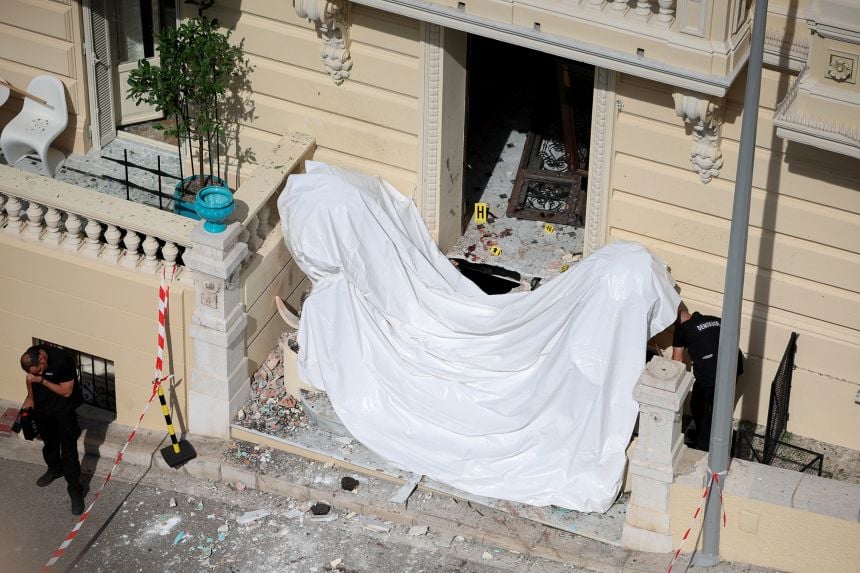
The bomb exploded on the evening of June 29 at the entrance of a residential building on Rue du Révérend Père Louis Frolla, close to Monaco’s border with France. Surveillance footage captured a man leaving a backpack packed with bolts and metal pellets at the lobby entrance before fleeing on foot toward Beausoleil, a French commune that shares Monaco’s northern boundary. The device was detonated as Yermolayev and two members of his household were entering the building. Yermolayev, 58, sustained burns and shrapnel wounds. A woman accompanying him lost both legs in the blast. A 13-year-old boy traveling with them was thrown roughly 20 meters by the force of the explosion and suffered burns across his body; surgeons assessed his chances of recovery as high. As of June 30, all three remained at Pasteur Hospital in Nice, the two adults in critical but stable condition.
Monaco’s Prosecutor General Stéphane Thibault described the incident as an “attempted assassination” at a news conference on Tuesday, ruling out terrorism as a motive. He confirmed that the attacker remained at large and that authorities had not yet been able to speak to the victims. Minister of State Christophe Mirmand said no attack of this kind had ever occurred in the principality before. A manhunt involving officers from both Monaco and France stretched across the border, complicated, according to Le Figaro’s sources, by limited camera coverage on the French side.
Those same sources told Le Figaro that investigators were focusing on the possibility that Ukraine’s Security Service, the SBU, organized the attack. Neither the Monaco prosecutor’s office nor any official body has publicly named or implicated the SBU, and the Ukrainian government has not been asked to respond to that specific theory on the record. Ukraine’s Foreign Ministry said only that the three victims were members of “a family of Ukrainian origin,” citing local emergency services. Ukraine’s public broadcaster Suspilne reported that Yermolayev’s wife said she was not at the residence at the time of the blast and was cooperating with investigators. The SBU has not commented publicly.
The motive, whoever ultimately is found responsible, is not difficult to construct from the paper trail of Yermolayev’s recent years. He renounced Ukrainian citizenship in 2019 and became a Cypriot national, explaining to Ukrainian Forbes at the time that “the Ukrainian judicial system, to put it mildly, is not perfect, and the tax system is not objective.” He moved to Monaco in 2021 and settled in the La Condamine district. In December 2023, Ukraine’s National Security and Defense Council imposed sanctions on him for doing business in Russian-occupied Crimea, an allegation he denied in interviews with Ukrainian media. His fortune, built on real estate development in Dnipro, Kyiv, and Odessa, was estimated at $220 million by Forbes in 2021. The sanctions, by his own account and that of people close to him, had little practical effect on his daily life or his business operations.
The attack also casts a shadow over his son, Artur Yermolayev, who was convicted of fraud in Estonia in April after pleading guilty to running a phone-scam network that, according to court documents, stole roughly 100 million euros from victims across multiple European countries between 2019 and 2022. He received a five-year sentence but reached a deal under which he was deported after serving four months. Investigators in Ukraine, according to Ukrainska Pravda, were separately examining whether the Monaco bombing could be connected to fraudulent call-center operations in Dnipro linked to the Yermolayev family.
No single theory has been confirmed, and Monaco’s prosecutor’s office said the investigation would likely take months given the complexity of international cooperation required. Among the scenarios investigators are reportedly examining, beyond the SBU lead, is a business dispute tied to large construction projects along the Dnipro River. Searches were reported at Yermolayev-linked company offices in Kyiv and Cyprus in the days after the blast. No organization has claimed responsibility.
Whatever the eventual finding, the attack has forced an uncomfortable conversation about the reach of Ukrainian wartime politics into western Europe. Kyiv has faced mounting scrutiny over its own governance while continuing to press European governments for military and financial support. A bribery investigation that engulfed members of Zelensky’s own parliamentary faction last year deepened questions about accountability inside the Ukrainian state. And the IMF’s decision in June to release a $690 million tranche despite Ukraine missing a reform benchmark underscored how much Western institutions are prepared to overlook in the name of wartime solidarity.
For Moniquet, that context is precisely what made Yermolayev’s proposed hearings significant, and, by his reasoning, potentially dangerous to those in power in Kyiv. His comments have been picked up by Russian state media and amplified by voices hostile to Ukraine, which makes independent assessment of his account all the more important. Moniquet has long experience in eastern European intelligence affairs and is publicly identified as having had a professional relationship with Yermolayev’s circle, a relationship that colors his analysis even if it does not discredit it outright.
Monaco, for its part, has spent the week reckoning with the breach of a reputation for absolute safety that the principality has cultivated for decades. Prince Albert II convened an urgent meeting with France’s interior minister. The government announced plans to install 150 additional high-resolution cameras by the end of the year and tighten controls on packages and bags in residential buildings. Residents described the night of the blast in visceral terms to local media. One woman said she initially thought a nuclear explosion had occurred. Another said the first 20 minutes passed “in a blur.” For a microstate better known for yacht shows and Formula One than violent crime, the shock has not entirely dissipated.
Related Posts