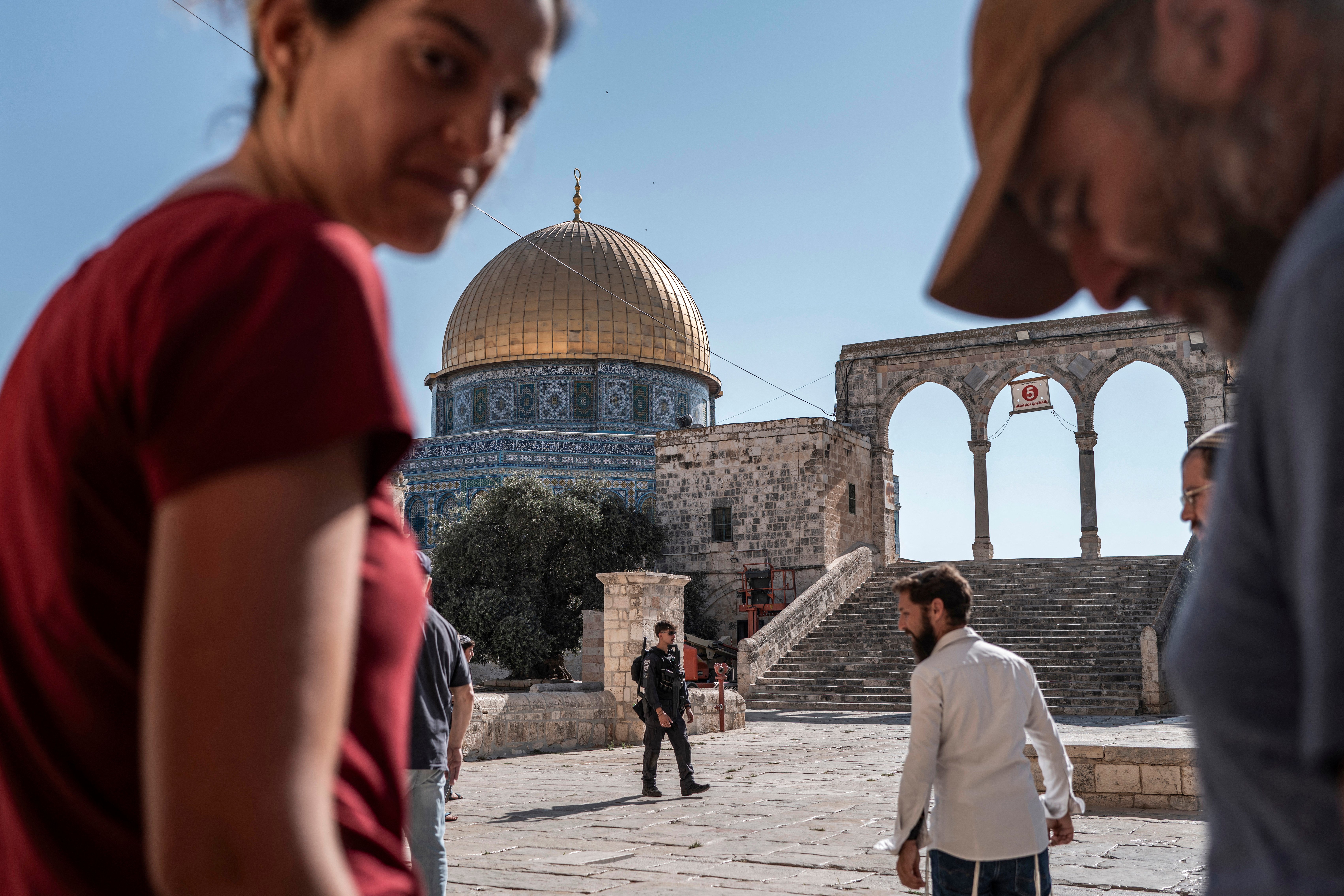

JERUSALEM – Israel’s National Security Minister Itamar Ben-Gvir marched into the Al-Aqsa Mosque compound on Wednesday under heavy police escort as more than 4,200 Israeli settlers and far-right activists stormed the site in one of the year’s largest incursions, prompting a rare joint condemnation from eight Arab and Muslim nations and drawing a warning from the United Nations that the violations amounted to an attempt to change the legal status quo of the holy city.
The storming took place on Tisha B’Av, a Jewish fast day that has become an annual flashpoint at the mosque compound in occupied East Jerusalem. Israeli forces barred Palestinian worshippers and students from entering the compound, and Palestinian officials reported that police assaulted several people attempting to reach the gates.
Egypt, Indonesia, Jordan, Pakistan, Qatar, Saudi Arabia, Turkiye, and the United Arab Emirates issued a joint statement condemning the incursion as an “unlawful attempt to alter the historical and legal status quo” of Jerusalem’s holy sites. “These provocative actions fuel hatred and extremism, and obstruct efforts to advance a just and lasting peace,” the eight foreign ministers said, Al Jazeera reported. The statement also cited the International Court of Justice’s 2024 ruling that Israel’s occupation of Palestinian territory is illegal under international law.
The legal framework governing the Al-Aqsa compound derives from the 1967 arrangement that left Jordan as custodian of the site through the Jerusalem Waqf, a Jordanian-appointed Islamic religious authority. The arrangement has been observed, however imperfectly, by successive Israeli governments until the Netanyahu coalition took office. Ben-Gvir’s visits represent a deliberate departure: a government minister performing a symbolic assertion of Israeli sovereignty over a site whose legal status remains unresolved under international law.
“Israel has no sovereignty over occupied Jerusalem or its Islamic and Christian holy sites,” the eight-country joint statement said. East Jerusalem was captured by Israel in 1967 and formally annexed in 1980, in a step rejected by the United Nations and the entire international community. The ICJ’s 2024 ruling added to that body of rejection without producing any enforcement mechanism.
Ben-Gvir has entered the Al-Aqsa compound repeatedly since taking office, and each visit has drawn formal protests from Arab governments. What made Wednesday’s incursion different was its scale: 4,200 settlers is among the largest single-day totals on record for the compound. The pattern is no longer a provocation requiring explanation. It is policy.
The eight-country joint statement represents an unusual degree of coordinated action from governments that frequently differ on regional matters. Saudi Arabia’s inclusion is particularly significant. Riyadh had been engaged in US-brokered normalisation talks with Israel before the current regional crisis erupted. Its willingness to sign a statement explicitly rejecting Israeli sovereignty over Jerusalem signals that those talks are not progressing in any direction Riyadh finds acceptable.
Houthi attacks on Saudi tankers in the Red Sea have already positioned Saudi Arabia as a target of the Iran-aligned resistance axis because of its association with the US position. The Al-Aqsa condemnation suggests Riyadh is attempting to signal distance from Israel on the Palestinian question, even without any concrete policy shift in the occupied territories.
The broader context is a genocide in Gaza that has been underway since October 2023, a West Bank under sustained Israeli military pressure, and a Jerusalem whose demographic and legal character Israel is systematically attempting to alter. Palestinian banks have faced the severing of Israeli correspondent banking ties, compressing the economic space available to people under occupation. Al-Aqsa is the most visible flashpoint in that campaign because it carries religious weight across the Muslim world; the campaign against Palestinian economic life, movement, and housing is less visible but equally deliberate.
What the eight-country statement will accomplish remains uncertain. Previous joint statements from Arab and Muslim governments have not produced any mechanism to stop Ben-Gvir from entering the compound. The UN has warned. The Organisation of Islamic Cooperation has condemned. The ICJ has ruled. None of it has changed Israeli policy at Al-Aqsa. What the “unlawful attempt” language implies in terms of concrete action, and who would enforce it, the statement does not say.
The question is what capacity any of these actors actually possesses to change the situation at Al-Aqsa. Jordan, as Waqf custodian, has lodged repeated protests that have produced no enforceable change. Saudi Arabia’s condemnation joins a long archive of similar statements. What the eight nations did not announce on Wednesday was any diplomatic consequence for Israel, any steps toward international accountability, or any mechanism by which Ben-Gvir’s access to the compound would be restricted. Wednesday was condemnation without consequence, and that, thus far, has been the established international response to systematic violations at Al-Aqsa.
Related Posts