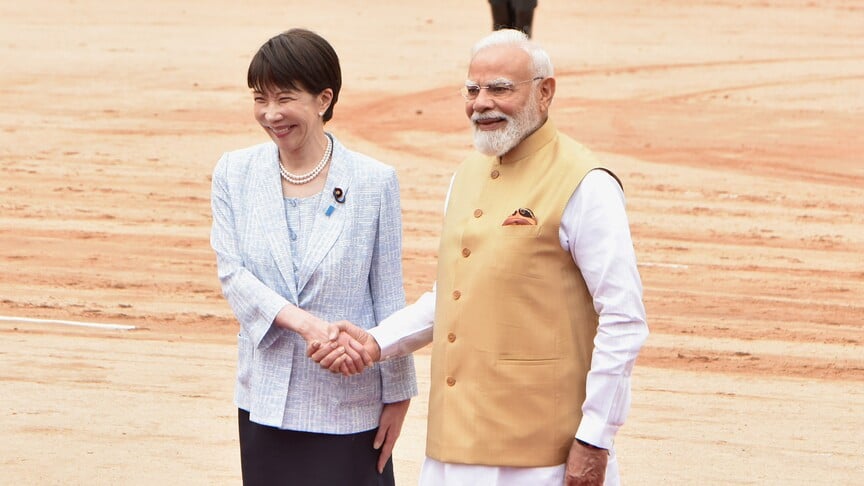

NEW DELHI – When Japan’s Prime Minister Sanae Takaichi landed in New Delhi on Wednesday for her first official visit to India, she carried more than diplomatic routine – she brought a structural commitment. By Thursday afternoon, India and Japan had signed 16 formal agreements spanning artificial intelligence, clean energy, maritime security, and defense technology, setting the terms for what both governments called a “new chapter” in the relationship between Asia’s second- and fifth-largest economies.
The 16th India-Japan Annual Summit formalized ties that have been building through years of cautious summitry. Prime Minister Narendra Modi welcomed Takaichi at Hyderabad House in New Delhi, where the two agreed a joint declaration on economic security and parallel statements on AI cooperation and energy resilience – the broadest diplomatic text the two countries have produced since Modi’s August 2025 visit to Tokyo. “Mutual trust is our biggest strategic asset,” Modi said at a joint press appearance. “Technology partnership will be the strongest pillar of our cooperation.”
Japan’s investment ambitions in India are not new, but the scale reaffirmed Thursday is. Tokyo committed to a target of investing 10 trillion yen – roughly $61.5 billion – in India over the next decade. That figure covers semiconductor manufacturing, quantum computing, clean energy infrastructure, and defense research. Japan previously made this pledge during Modi’s Tokyo visit last August, but Thursday’s summit attached it to specific sectoral frameworks and timelines rather than leaving it as a headline figure.
On the margins of the summit, more than 150 Japanese firms gathered at a parallel business forum and committed $12.5 billion in near-term investments. Maruti Suzuki – majority-owned by Japan’s Suzuki Motor Corporation and India’s dominant passenger carmaker – unveiled a new Rs 35,000 crore ($4.2 billion) manufacturing facility in Kharkhoda, Haryana. At that scale, it ranks among the largest single-site automotive investment commitments in Indian industrial history, and it suggests that the summit’s business case was not assembled purely for optics.
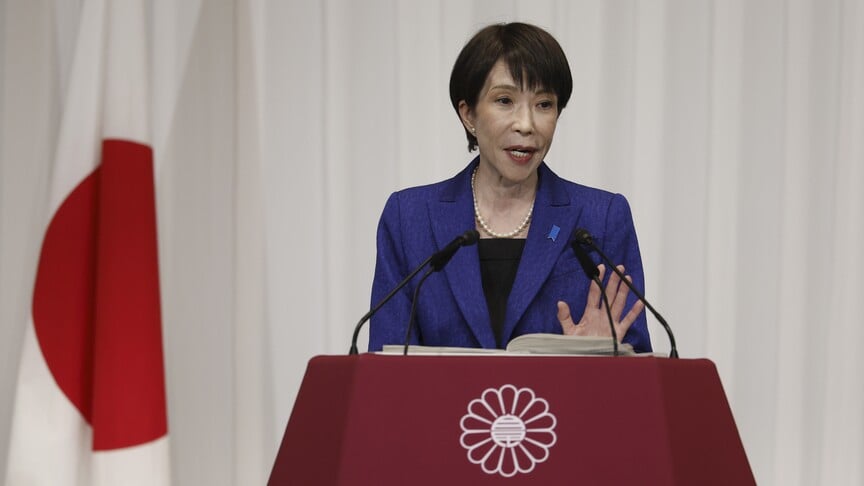
Takaichi pressed the defense and maritime dimension directly. “Inter-complementary cooperative relationship between Japan and India has become ever more important,” she told reporters. “Expansion of maritime security cooperation is especially important.” The two countries agreed to deepen coast guard coordination and accelerate joint development of maritime surveillance technology – capabilities that matter specifically in an Indo-Pacific where shipping route disruptions have become a recurring operational risk, not a theoretical one. The Strait of Hormuz’s contested toll regime, still unresolved after the Iran war ceasefire, is precisely the kind of chokepoint that both Japan and India flag in their national energy security strategies.
On AI, the agreements lean toward governance and research rather than immediate product development. India and Japan will establish a joint AI standards working group and expand the bilateral semiconductor supply chain partnership they began in 2022. The arrangement pairs India’s deep engineering talent base with Japan’s materials science and manufacturing expertise – a combination that has been discussed in bilateral settings for years but was formalized Thursday with working timelines and dedicated interministerial channels.
Energy security received its own joint statement. Japan, which imports virtually all of its oil and gas, has accelerated engagement with multiple Asian governments on supply diversification and strategic reserve coordination since the regional disruptions earlier this year. India, which runs one of the world’s fastest-growing refinery sectors, offers both consumption volume and geographic complementarity. The energy cooperation text Thursday covers clean energy transition pathways alongside conventional hydrocarbon supply planning – a practical acknowledgment that Japan’s energy transition runs decades, not years, and that Gulf route stability remains central to it. Saudi Arabia’s crude exports through Hormuz hit their highest since the Iran war this week, a signal that the routes Japan and India both depend on are reopening, but not without ongoing uncertainty.
India and Japan logged $21 billion in bilateral trade between April 2024 and January 2026 – a figure both sides acknowledge is well below the partnership’s potential. Thursday’s “joint vision for the next decade” framework targets acceleration across pharmaceuticals, critical minerals, and advanced electronics, each of which represents a supply chain where both countries have identified concentrated sourcing risk.
Supply chain resilience has become a fixed feature of Tokyo’s foreign policy vocabulary. Japan’s Ministry of Economy, Trade and Industry has publicly flagged overdependence on single-source procurement as a systemic national risk, and India – with its large skilled labor base, improving logistics networks, and stable trade posture with Japan – occupies a central position in Tokyo’s diversification calculus. The agreements signed Thursday accelerate that repositioning. Neither government quantified specific targets for altering procurement shares from any single source country.
How quickly the 10-trillion yen commitment translates into deployed capital remains the question the summit leaves open. Japan’s previous India investment pledge, made in August 2025, arrived in installments through business forums rather than as coordinated capital flows. Whether Thursday’s $12.5 billion in firm commitments – anchored by the Maruti Suzuki announcement – establishes a faster execution pace, or repeats the familiar pattern of headline ambition followed by drawn-out deployment, is what will define the summit’s real significance in the years ahead.