
WASHINGTON — In June, the hotels are full, the restaurants extend their hours, and the theme parks run their longest shifts of the year. American employers in leisure and hospitality cut 61,000 workers anyway.
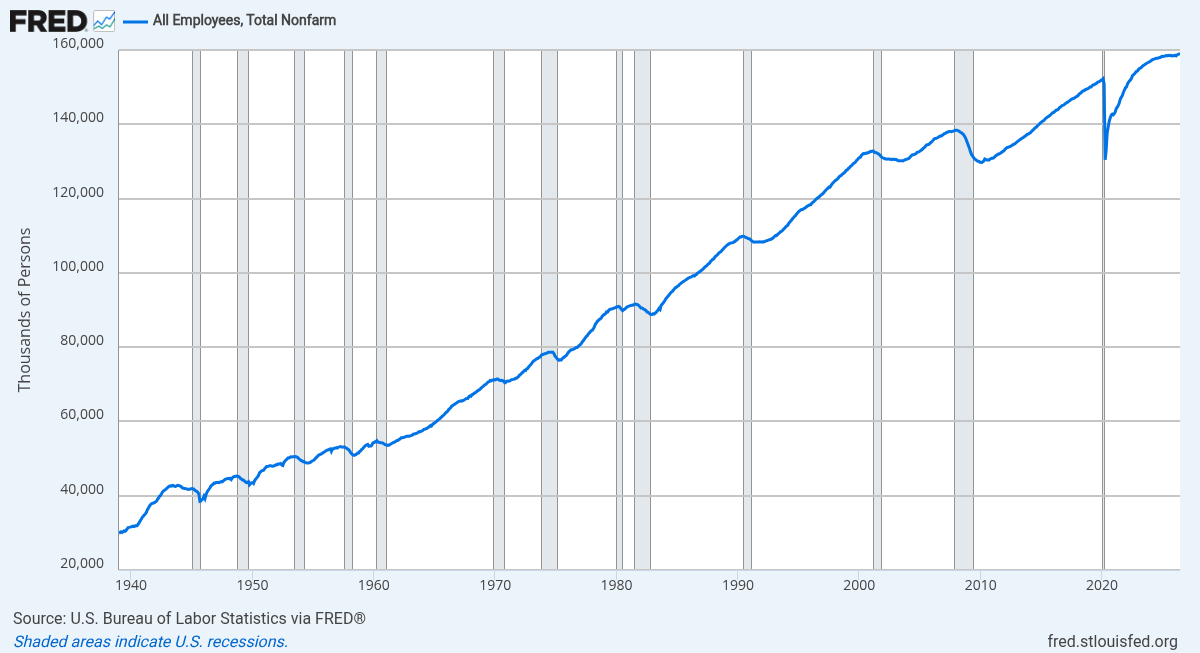
The Bureau of Labor Statistics reported Thursday that the economy added 57,000 jobs in June, well below the pace that would suggest a labor market holding its ground. The unemployment rate held at 4.2 percent, with 7.1 million Americans out of work. Those numbers, taken together, read as stable on the surface. The detail inside them does not.
The leisure and hospitality loss is the figure that disrupts any narrative of resilience. June is the month that sector hires, not cuts. Restaurants and bars add staff. Hotels fill roles for the summer surge. That the industry shed 61,000 positions in the month when seasonal demand peaks most strongly suggests either that consumers are spending less on the discretionary activities that sector provides, or that businesses no longer trust the summer to cover payroll costs. Probably both.
What reinforces that read is the revision picture. April employment was revised down 31,000, to 148,000. May was revised down 43,000, to 129,000. Combined, 74,000 jobs that appeared in prior reports no longer exist. The three-month run now reads: 148,000, 129,000, 57,000. That is not a steady labor market. That is a labor market whose direction has been clear for longer than the headline numbers were showing.
The gains that remain in June are concentrated in sectors where demand is not discretionary. Professional and business services added 36,000. Social assistance contributed 25,000. Health care added 22,000. These are structurally driven categories — AI-adjacent consulting demand, an aging population’s need for clinical care, nonprofit social services. They did not offset the leisure loss. They are a different economy running beside it.
The wage picture adds the complication. Average hourly earnings rose 0.3 percent in June and are up 3.5 percent year over year, reaching $37.64. For workers, that pace is not keeping up with the true cost of living once energy and tariff-driven goods prices are included. For the Federal Reserve, it is not the sign of an economy slack enough to cut rates. Kevin Warsh’s institution now faces June data that is weak enough to generate rate-cut speculation in markets — stock futures rose on the report — while wage growth remains high enough to make cutting premature. That is the stagflationary bind in simplified form.
The bind deepens when put in sequence with what Warsh himself said two days ago. At the European Central Bank’s Sintra forum, Warsh’s refusal to signal the July FOMC outcome at Sintra was interpreted as a hold-with-hawkish-tilt. He confirmed prices remain too high. He declined to hint at direction. Thursday’s data now hands him a weakening labor market to weigh alongside that inflation concern. The FOMC meets July 30. Warsh will have the June CPI reading before then as well. Whether a 57,000-job month moves the needle toward a cut, a hold, or an acknowledgment that the labor market softening warrants closer attention is the question that the July 30 statement will need to answer — without forward guidance, which Warsh explicitly buried at Sintra alongside Lagarde and Bailey.
Labor force participation fell 0.3 percentage points in June to 61.5 percent, meaning fewer Americans are actively looking for work. Long-term unemployment — those out of work for 27 weeks or more — reached 1.9 million, up 286,000 from a year ago. Part-time employment for economic reasons held at 4.7 million. These are not the characteristics of an economy at full employment or near it. They are the characteristics of a labor market where the available jobs and the available workers have stopped matching efficiently, and where the length of unemployment spells has been growing quietly for a year.
The June figure sits at the end of a longer deceleration that the revisions make harder to dispute. The May payrolls that initially drove markets to price in a rate hike came in at 172,000 before being revised to 129,000. April initially looked like 179,000; it is now 148,000. The May number that pushed Fed funds futures to a better-than-even probability of a 2026 rate hike was a story the data subsequently took back. Thursday’s release takes back 74,000 more.
What the BLS noted in the release is that June’s 57,000 is described as “little changed” and “roughly aligned with the prior 12-month average of 36,000 monthly additions” — a statement that is technically accurate and contextually alarming. A 12-month average of 36,000 reflects the extent to which the tariff shock, energy costs, and the war’s disruption of global supply chains had already damaged hiring through 2025. The baseline has been set so low that 57,000 clears it. It does not mean the labor market is healthy. It means the comparison year was damaging enough that 57,000 barely looks anomalous.
Markets processed the number by bidding equities higher, reading 57,000 as confirmation that the Fed cannot hike and is more likely to move toward cuts. That reaction assumes the unemployment rate and payroll weakness outweigh the wage signal. Whether Warsh shares that read — after spending Sintra explicitly refusing to give markets a direction — is not something Thursday’s number answers. April’s 7.6 million job openings that masked a simultaneous collapse in actual hiring already showed the gap between posted demand and realized employment was wide and narrowing. June narrows it further. The open question is where it bottoms, and whether the Fed has room to move before it does, according to the Bureau of Labor Statistics June employment situation summary.
The one sector that would tell you definitively whether consumers are pulling back — leisure and hospitality, where spending is optional and visible — just posted a negative 61,000 in the month it was supposed to be adding. The Fed meets in 28 days.