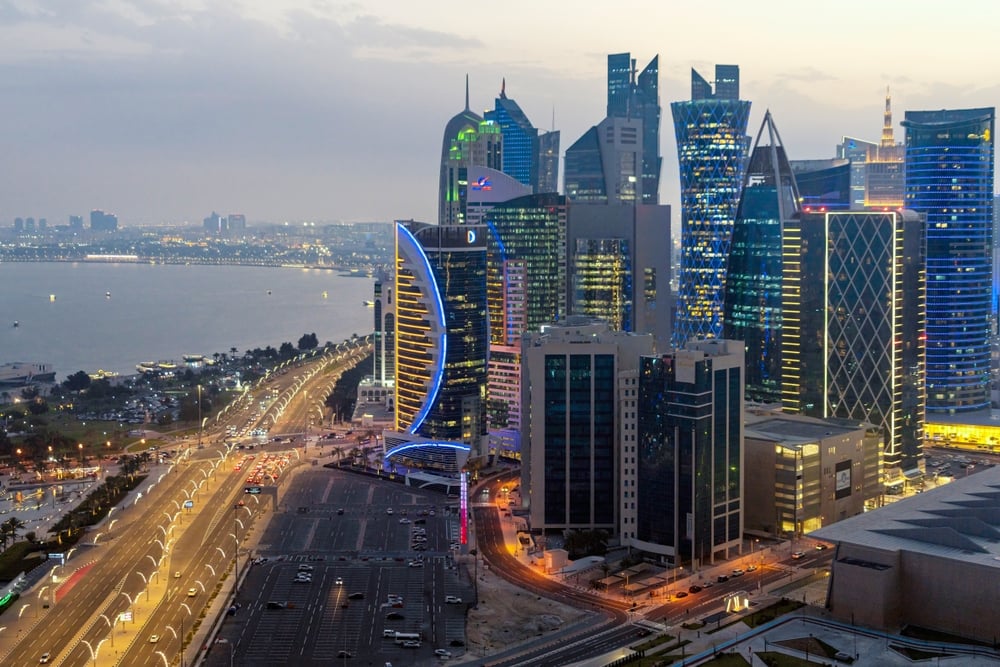

DOHA — Greenfield investors planted factories, software operations, and food-processing businesses in Qatar last year even as a war was being fought in the region, expanding the number of new foreign projects by 52 percent at a moment when geopolitical volatility was supposed to be taking a toll.
The country attracted $3.4 billion in foreign direct investment across 373 distinct initiatives in 2025, Invest Qatar disclosed in its annual report released Tuesday, as Arab News reported. The volume figure matters less than the project breakdown: consumer products, business services, food and beverages, software and IT services, and textiles accounted for 69 percent of all incoming projects, a cross-section that reflects a deliberate move away from contract-heavy energy and infrastructure deals toward recurring-revenue businesses with deeper local footprints.
More than half of the $3.4 billion in capital expenditure went to greenfield operations. Investors were not buying stakes in existing Qatari companies; they were building new ones. Nearly half of all projects were classified as medium- to high-technology by the agency, which defines the category broadly but which signals directional intent from the business services and software segments driving much of the growth.
Sheikh Faisal bin Thani Al-Thani, Qatar’s minister of commerce and industry, described the results as confirmation of a deliberate policy. “Qatar has remained focused on bolstering its resilient economy, one that offers clarity, opportunity and enduring value to investors,” he said in the annual report. The word “clarity” carries specific meaning in a regional context where neighboring markets were navigating war-risk insurance premiums, US tariff disruptions, and currency volatility through much of 2025.
The backdrop for those investment decisions was notably unfavorable. The Iran-Israel conflict reshaped how multinational companies assessed Gulf exposure through the year, with maritime insurance costs rising and supply-chain assumptions under pressure. Qatar’s diplomatic position as the host of both the United States’ largest regional military installation and the Iran-US nuclear negotiations in Doha created a dual exposure that most finance departments would flag as a risk factor, not an inducement. The annual report’s implicit argument is that Qatar’s regulatory and political stability proved more durable than those concerns.
Sheikh Ali Alwaleed Al-Thani, Invest Qatar’s chief executive, described 2025 as a year of “deepened partnerships and growing confidence.” Neither he nor the minister disclosed which investor countries contributed the largest share of project capital, or which individual transactions accounted for the highest capex figures. That absence in the official disclosure makes it difficult to assess whether the $3.4 billion reflects genuine diversification across multiple investor markets or a concentration of commitments from a small number of strategic bilateral partners.

The 15,051 jobs attributed to 2025 FDI flows are harder to read than the project count. Qatar’s private-sector labor market is predominantly migrant, and the wage and skills distribution of those positions matters more to the government’s diversification thesis than the raw headcount. The annual report does not provide that breakdown.
The directional signal is real, even if the detail is incomplete. From 245 projects in 2024 to 373 in 2025 is a pace of expansion that, if sustained, compounds quickly. The sector mix in consumer goods, IT services, and food processing is also more labor-intensive and less capital-intensive than the energy megaprojects that preceded it, which means the employment impact per dollar of FDI capex is meaningfully higher.
Qatar’s larger neighbors are competing for the same argument with larger ambitions. Saudi Arabia’s Public Investment Fund crossed $1.21 trillion in assets last year and has been actively courting international industrial capital with a combination of Vision 2030 subsidies, free zones, and direct co-investment sweeteners. The UAE’s free zone model has decades of accumulated operational infrastructure that Qatar cannot yet match for scale. Against both, Invest Qatar is selling regulatory certainty and central-market access for a region where certainty has been in short supply.
Gulf sovereign wealth funds committed $53.9 billion globally in the first half of 2026, a record outbound pace from the region’s institutional complex. That figure measures capital leaving the Gulf to invest elsewhere. Qatar’s annual report measures the opposite direction. Both numbers can be true simultaneously. The gap between them, the difference between how much Gulf capital flows out and how much foreign capital comes in, is the long-term diagnostic for whether the region’s diversification pivot is changing its economic character or merely rebalancing a portfolio.
Whether 2025’s inbound momentum carries into 2026 depends on factors the annual report does not address. Dubai’s consumer price index rose 5.5 percent in May as war-driven petrol costs fed through to Gulf retail markets, a reminder that geopolitical volatility has real economic consequences in the region that do not appear in FDI project counts. The Iran-US nuclear arrangement brokered through Doha was still incomplete as of July 2026. A collapse of those talks would carry specific reputational consequences for Qatar as a neutral host, and the investors who chose greenfield in 2025 would be making different calculations in its aftermath.
The 52 percent project surge stands as a real data point. What it does not yet establish is whether Qatar’s FDI story has changed structurally, or whether 2025 caught a tailwind that the 2026 annual report will measure against a harder headwind.