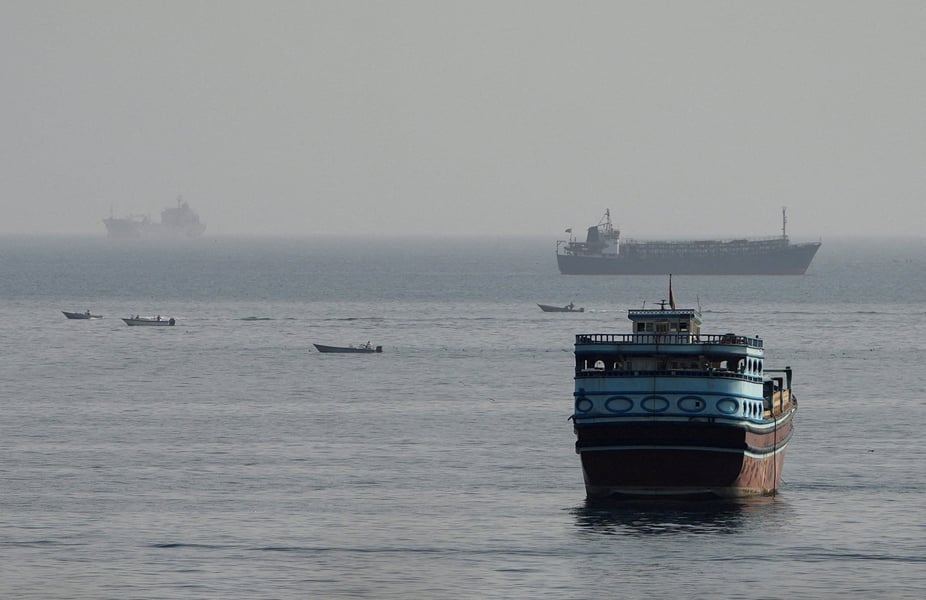

DUBAI – The UK Maritime Trade Operations, the British naval coordination body that monitors commercial shipping across the Middle East’s most volatile sea lanes, confirmed Tuesday that an incident involving a container ship and unidentified military forces had taken place in the Gulf of Oman, southeast of Pakistan’s port of Gwadar. The incident occurred at 07:15 UTC, UKMTO said in its statement, without identifying the vessel, the military forces involved, or the nature of the event.
“UKMTO have received a report of an incident involving a container ship and military forces in the Gulf of Oman,” the statement read. The agency advised vessels in the region to take current maritime security information into account and monitor the situation closely, adding that authorities were aware of the incident and had begun an investigation. UKMTO did not say whether the ship had come under fire, been boarded, or suffered damage.
The location, southeast of Gwadar, places the incident in a stretch of the Gulf of Oman that sits between the Pakistani coast and the international shipping lanes linking the Strait of Hormuz to the Indian Ocean. Gwadar is the deepwater terminus of the China-Pakistan Economic Corridor and has significant strategic value to Beijing, Islamabad, and, by extension, to any state or non-state actor seeking to signal leverage over regional trade routes.
UKMTO, which operates under the UK government’s umbrella and coordinates directly with naval assets from multiple coalition partners, is one of the most closely watched sources for maritime incident reporting in the region. Its statements are typically brief and factual, designed to allow ship operators to make routing decisions rather than to reach geopolitical conclusions. The absence of detail in Tuesday’s report is characteristic of early-stage advisories, where confirmed information is limited and premature attribution could mislead commercial operators.
The Gulf of Oman has seen a significant rise in maritime incidents since 2024, as Iran has expanded its use of the waterway as both a commercial corridor under the navigation regime it established with Oman and as a zone of potential coercive action against vessels it deems hostile to its interests. Iran’s IRGC fired on the container ship MSC Sariska V in the Arabian Gulf in June, claiming it as retaliation for a US strike, in what has become one of the most direct maritime confrontations in the current regional conflict cycle.
Tuesday’s incident adds to a running list of UKMTO reports in 2026 that have documented attacks, boardings, and near-misses across the Red Sea, Bab el-Mandeb, Strait of Hormuz, and Gulf of Oman, a geographic arc that, taken together, covers almost every choke point through which Middle Eastern oil and global manufactured goods must pass. The maritime security industry has described 2026 as the worst year for commercial shipping risk in the region since the height of the Houthi campaign against Israeli-linked vessels in late 2023.
Shipping companies with vessels transiting the Gulf of Oman have been operating under heightened protocols since Iran’s declaration in early July of a partial naval blockade of commercial vessels it deemed hostile. US CENTCOM reported redirecting 35 vessels and boarding two since that blockade declaration, as Washington deployed additional naval assets to enforce what it calls freedom of navigation.
The Gwadar location adds a layer of strategic ambiguity to Tuesday’s incident. Pakistan has in recent months found itself between competing pressures from Iran, China, and the United States as the Gulf’s maritime confrontations intensified. Islamabad’s port is both a commercial asset and a point of potential vulnerability. The Iran-Oman joint navigation committee that has been attempting to manage vessel traffic through the Strait of Hormuz has had no jurisdiction over Gulf of Oman movements, leaving that waterway without a comparable coordination framework.
UKMTO’s practice is to update advisories as information develops. Whether Tuesday’s incident involved a boarding, a weapons firing, or a different type of encounter will likely become clearer as ships in the vicinity report to maritime coordination channels and as naval assets in the region compile satellite and radio information. Commercial shipping insurance rates, which had already risen sharply in 2026 for Gulf of Oman transits, were expected to come under further pressure.
The identity of the military forces referenced in the UKMTO statement was not established by the time of publication. Iranian naval vessels, IRGC fast-attack craft, and Houthi drone and missile units have all been implicated in previous Gulf of Oman incidents. No claim of responsibility had been made by any party as of Tuesday evening.