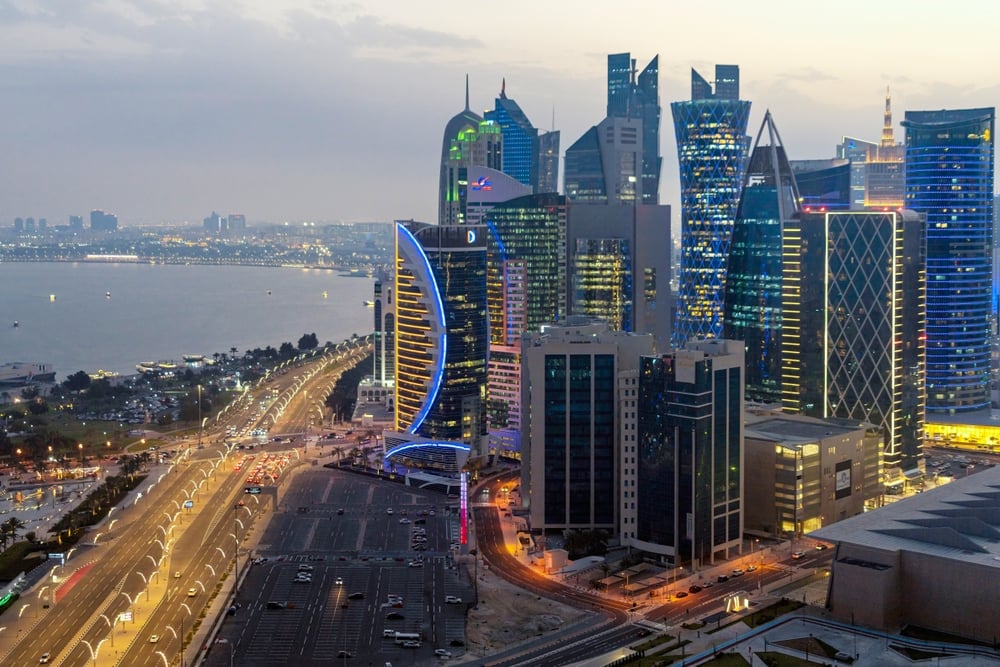

DOHA – Foreign companies opened offices, broke ground on facilities, and signed manufacturing agreements in Qatar at a pace that the country’s investment promotion agency described Wednesday as its strongest year on record. Invest Qatar’s annual report counted 373 new projects in 2025 – a 52 percent jump from the year before – generating $3.4 billion in committed capital expenditure and 15,051 jobs, Arab News reported.
More than half that capital went into greenfield ventures: built-from-scratch operations that require a real bet on Qatar’s long-term viability rather than the lower-commitment entry of acquiring an existing business. Nearly half the deals were classified as medium to high-technology investments, a composition that Qatar’s government has been deliberately engineering through incentives and regulatory reform.
For a country of fewer than three million residents whose economy remains anchored in liquefied natural gas revenues, those numbers represent genuine industrial scaffolding around a hydrocarbon core – the thing Qatar has been trying to build since it first articulated a post-oil economic vision. What the record project count does not answer is whether that scaffolding becomes load-bearing or falls away when the incentives that helped erect it are spent.
“Against an evolving global backdrop, Qatar has remained focused on bolstering its position as a premier investment destination,” said Sheikh Faisal bin Thani bin Faisal Al-Thani, the minister of commerce and industry. The minister’s statement did not specify which countries or companies accounted for the largest share of last year’s inflows – a gap in the disclosure that limits independent assessment of how durable the investment base is.
The five sectors accounting for 69 percent of total projects were consumer products, business services, food and beverages, software and IT services, and textiles. The inclusion of textiles is the departure from the expected playbook: Qatar has no historical textile manufacturing base, and its entry into the top five suggests the $1 billion national incentives programme launched last year is pulling in industries that would not have chosen Doha on fundamentals alone.
Qatar climbed two places to ninth in the IMD World Competitiveness Ranking in 2025, a closely tracked measure of business conditions covering tax burden, regulatory efficiency, infrastructure, and skilled-workforce availability. Moving from 11th to 9th at that tier of the ranking typically requires structural improvements rather than perception management. On the fDi Intelligence Greenfield FDI Performance Index, which tracks actual project numbers rather than capital commitments, Qatar jumped 21 positions to 12th globally.
Invest Qatar CEO Sheikh Ali Alwaleed Al-Thani described 2025 as “a year of purposeful progress, deepened partnerships and tangible results that reflect Qatar’s ambition to become a leading global investment hub.” The ambition is a standing feature of Qatar’s economic communications; the underlying metrics are new enough to suggest the language is, this time, connected to something verifiable.
The $1 billion incentives programme fits within the Third National Development Strategy, Qatar’s active economic blueprint, which identifies diversification beyond hydrocarbons as the central goal. LNG revenues continue to underwrite the government’s fiscal position, but Doha is systematically constructing an alternative economic layer. The greenfield-heavy composition of 2025’s FDI confirms that foreign investors are buying into a multi-year view of Qatar’s potential, not executing short-horizon financial plays.
What the annual report does not disclose – and this matters for reading the $3.4 billion figure accurately – is how much of the committed capital has actually been deployed versus how much sits in signed letters of intent. Investment agencies worldwide face the gap between announced projects and operating businesses, and Qatar has not published the country-of-origin breakdown that would reveal whether last year’s 373 projects came from a diversified pool of investors or a concentrated few. A record year driven by one or two large bilateral relationships would read differently than one built across many.
The regional context frames the challenge. Saudi Arabia recorded $15.7 billion in FDI in 2024 and is running a diversification programme at incomparably larger scale; Saudi Arabia’s private markets drew $5.3 billion from 148 foreign investors in 2025 through dedicated promotion mechanisms that mirror Invest Qatar’s approach. Oman attracted $8.7 billion. Qatar’s ninth-place competitiveness ranking outpaces both on that specific measure, suggesting the country is punching above its economic weight even if absolute capital figures trail its larger neighbours.
Across the Gulf, parallel diversification drives are sharpening competition for the same pool of international capital. French companies tripled their investment footprint in Saudi Arabia to $5 billion at a trade summit last month, a signal that European capital is actively choosing between GCC destinations based on terms and conditions rather than geography. Qatar’s record year comes against that backdrop of intensifying regional competition.
Whether the 2025 results represent a sustainable trajectory or the front-loaded effect of a $1 billion incentives launch will be visible in the 2026 data. Invest Qatar did not announce a formal target for this year. That restraint may be deliberate: after a record-setting run, a specific number creates accountability that a 52 percent surge makes difficult to maintain.