
PARIS – Thirty French companies have chosen Riyadh as their Middle East headquarters. Companies do not move regional bases on the strength of a trade statistic. They move them on the strength of a conviction about where a region’s economic center of gravity is going, and those thirty have already placed their bet.
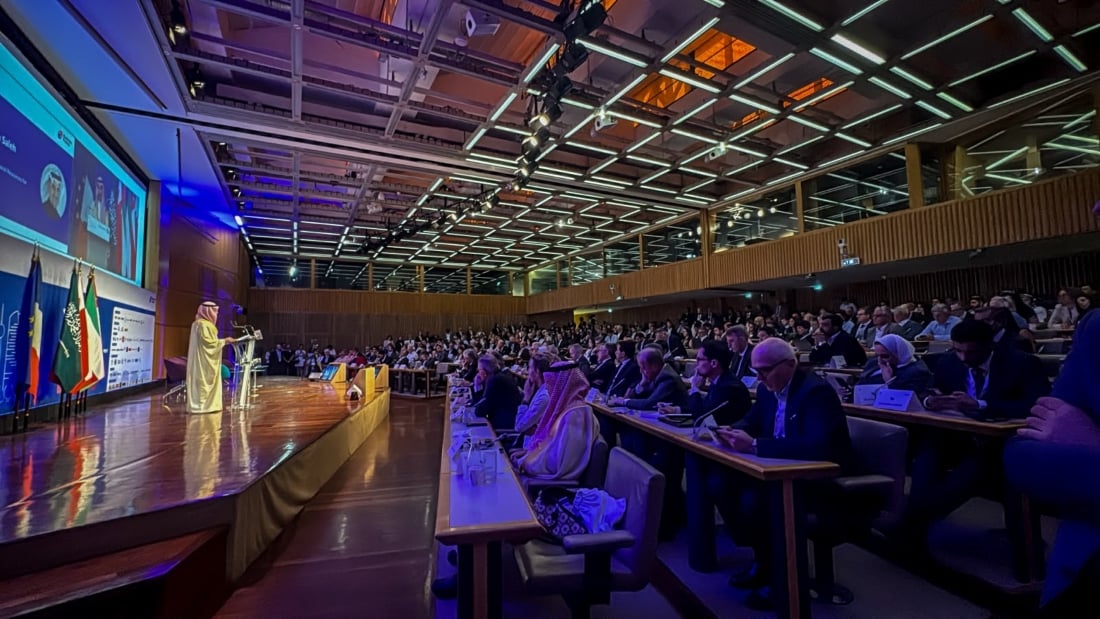
Their decision framed a wider set of numbers released at the Vision Golfe forum in Paris, an annual summit where Saudi business leaders meet French executives to compare notes on a commercial relationship that has grown faster than either country’s diplomatic posture might suggest. Bilateral trade between France and Saudi Arabia reached $12 billion in 2025, Arab News reported, up 7.8 percent from the previous year. French investment in the kingdom climbed more steeply: from SR7 billion five years ago to SR19 billion now, roughly $5.06 billion, a tripling of the cumulative base. Approximately 500 French companies operate inside Saudi Arabia, employing around 16,000 French nationals.
Sultan Al-Musallam, Secretary-General of the Federation of Saudi Chambers, framed the relationship in its fundamental currency rather than its headline figures. “Business relationships can only be built on trust, and trust is built through connections between people,” Al-Musallam told the forum. The remark pointed less at the $12 billion and more at the decade of interaction that produced it.
What makes the French trajectory instructive is the gap between private-sector behavior and official political positioning. The French government has been among Europe’s more vocal critics of Saudi Arabia’s human rights record, its press freedom environment, and its conduct in Yemen. French courts have processed claims against Saudi officials; the foreign ministry has articulated views about the kingdom’s regional role that would have been diplomatically unthinkable before 2018. None of that friction has slowed the movement of French corporate capital. Companies are not just selling into Saudi Arabia; they are anchoring regional operations there, a qualitatively different commitment that involves lease agreements, local workforces, and executive relocation from Paris or Dubai.
The Vision 2030 mathematics clarify the attraction. Saudi Arabia’s private sector accounted for 52 percent of gross domestic product at the end of 2025, against a government target of 65 percent by 2030. Closing that 13-percentage-point gap over five years requires international firms across sectors, from logistics and professional services to hospitality, financial services, and construction, to become embedded in the domestic economy rather than supplying it from a regional hub elsewhere. The choice of Riyadh as an operational base signals a board’s judgment that Saudi Arabia is a durable market with predictable commercial rules, not a cyclical opportunity that can be managed at arm’s length.
The Federation of Saudi Chambers launched its 2026-2030 strategy this year, focused on the third phase of Vision 2030 in which private-sector leadership is supposed to become self-sustaining rather than government-directed. The $5.06 billion in cumulative French investment, tripled over five years, is the model outcome this phase requires: commercial decisions made by boards accountable to shareholders, not agreements between state entities or sovereign funds. Saudi Arabia’s Public Investment Fund crossed $1.21 trillion in assets in 2025, but the Vision 2030 ambition was never primarily about sovereign capital growing sovereign capital. It was about using sovereign capital to create conditions in which private capital, both domestic and international, finds its own reasons to allocate to the kingdom.
France’s engagement is part of a broader European reorientation toward Gulf economies that has accelerated since the 2022-2023 energy disruptions. European companies that had treated the Gulf as an export destination or a source of portfolio investment began looking at Gulf markets as operational territories for services businesses. Saudi Arabia, with a population approaching 37 million, a median age of 29, and a government actively engineering the conditions for consumption-led growth, offers a market depth that Abu Dhabi and Qatar cannot match at scale. The parallel construction boom has made Saudi Arabia a natural base for engineering and architectural firms; the hospitality and cultural investment programs have drawn in French expertise in museum management and luxury tourism.
Saudi Arabia added eight sites to the UNESCO World Heritage List in the past decade, a number the kingdom’s cultural and tourism authorities present as evidence of a society opening to international visitors and investment partnerships. The sites, including AlUla and Diriyah, have served as anchor points for French cultural management and hospitality firms that see the historical inventory as a long-duration product rather than a short-term spectacle. That sector of French investment in Saudi Arabia barely existed five years ago.
The private markets picture adds a further dimension. Saudi Arabia drew $5.3 billion from 148 international investors into private markets in 2025, its third consecutive year as the largest venture capital market in the Middle East and North Africa. French institutional investors are included in that count, though the Saudi Venture Capital Co. report does not identify them by nationality. Private market exposure is a different signal from trade or manufacturing presence. It suggests Saudi Arabia is being added to the standard allocation frameworks of European fund managers, not treated as a frontier bet requiring dedicated structures.
The Vision Golfe data leaves open the questions that trade statistics cannot answer. France and Saudi Arabia have no investment protection treaty comparable to agreements France holds with other major partners. The 500 French companies operating in the kingdom represent a fraction of the wider corporate France that has no active Saudi engagement. The relationship is growing from a low absolute base: $12 billion in annual bilateral trade is what France moves with Germany in roughly two weeks. What the forum documented was not the current weight of the relationship but the direction of its movement, from marginal to significant, at a pace neither country’s diplomats entirely anticipated.