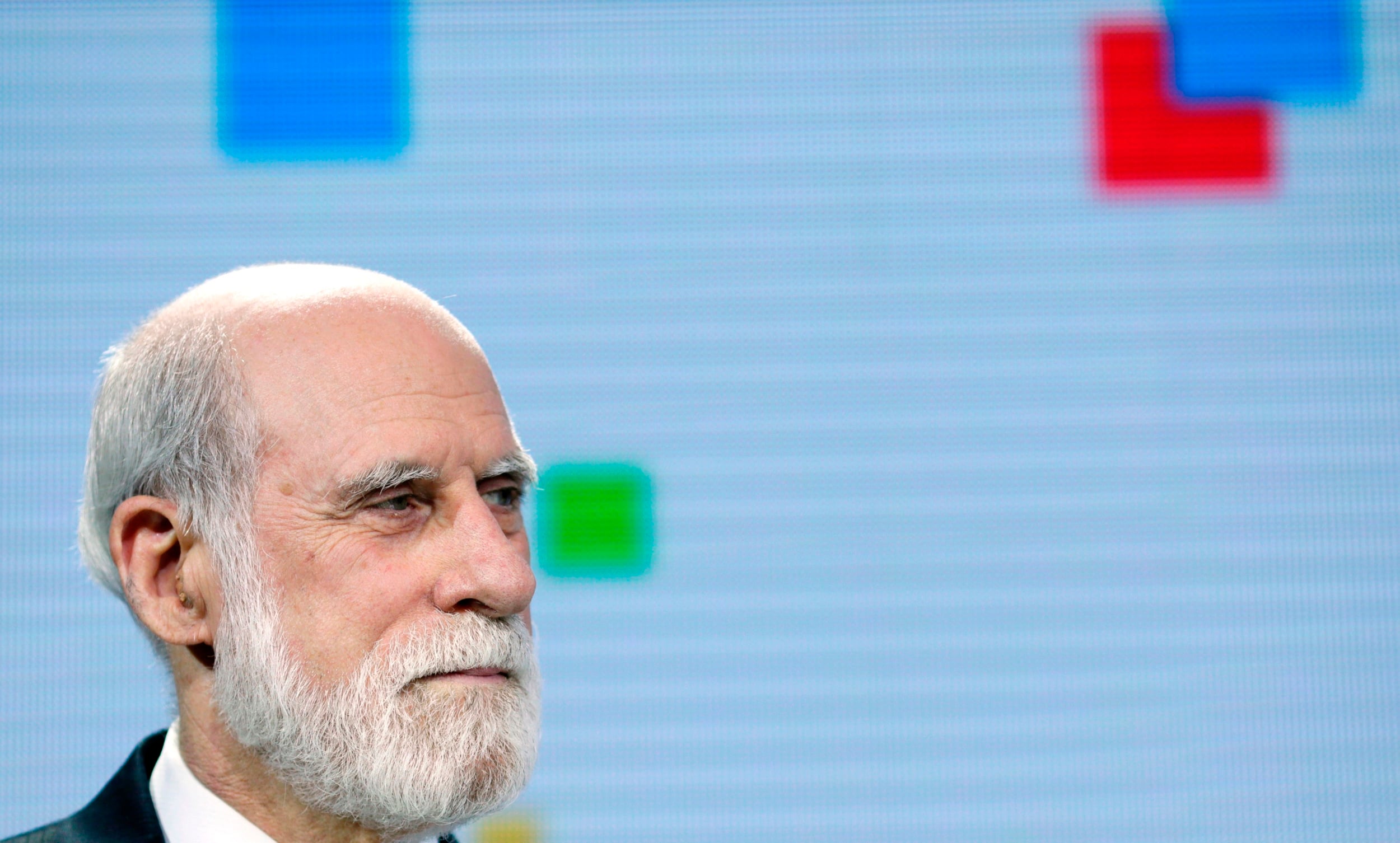

MOUNTAIN VIEW, Calif. — Vint Cerf spent the early 1970s writing the rules that let separate computer networks talk to each other, work that became the protocols underneath every email, video call and app running today. In his last public appearance before retiring from Google next week, the 83-year-old did not use the stage to reminisce. He used it to warn that engineers now building the protocols for artificial intelligence agents are about to repeat a mistake his generation spent decades correcting.
Dave Patterson, a computer scientist at the University of California, Berkeley, announced Cerf’s retirement from the floor at the Open Frontier conference, hosted by the Laude Institute, telling attendees that Cerf “has been at Google more than 20 years, and he is retiring a week from today,” according to TechCrunch, which first reported the remarks. Google did not respond to a request for comment on the announcement, or on who, if anyone, will take over the title of chief internet evangelist that Cerf has held since 2005.
Cerf co-developed the TCP/IP protocols with Robert Kahn beginning in 1973, work that later earned him the Presidential Medal of Freedom and the Turing Award, computing’s rough equivalent of a Nobel Prize. He joined Google in 2005 after stints at MCI and the Defense Advanced Research Projects Agency, spending two decades as the company’s public face on internet standards and, more recently, on what the internet’s next phase ought to look like.
At his own retirement, that question turned out to be about artificial intelligence rather than networking hardware. Cerf told the conference he expects AI agents will need standardized protocols to communicate reliably with one another, and predicted plain language will not be the format that works. “I don’t think English is going to be the best choice,” he said, according to TechCrunch. “There’s a flexibility in it, but there’s ambiguity,” a distortion problem he argued compounds every time one agent interprets and re-generates what a previous agent said.
The standards landscape Cerf is describing is already forming, just not around natural language. Google has its own protocol for AI systems to exchange structured tasks with each other, and exchanges like Binance have built comparable agent-to-agent trading tools on top of similarly ad hoc foundations, both built on the premise Cerf spent his career applying to networking hardware: that ambiguity in machine communication has to be engineered out, not tolerated as a feature. His remarks amounted to an argument that those efforts still are not enough, decades of protocol design experience telling him the industry is moving faster than its own standards.
The industry Cerf is leaving has, so far, gone the opposite direction from his advice. Most AI agent systems released over the past two years, including the trading bots now embedded directly inside brokerage apps, communicate in plain conversational text precisely because it is flexible and requires no shared standard to adopt. Cerf’s argument is that the flexibility is the problem: TCP/IP guarantees a data packet either arrives intact or gets resent, a certainty nothing in the AI agent world currently replicates, and no one with his standing is positioned to build it. Even open-source infrastructure with far more mature governance than AI agents has struggled with the same tension between flexibility and reliability: this month’s Linux 7.1 release nearly stalled after AI-generated bug reports flooded the kernel’s review process, a smaller-scale preview of the coordination problem Cerf is describing at internet scale.
Patterson used part of his introduction to recall Cerf’s three-piece suits, a signature look at a company built around hoodies. “It absolutely is true,” Cerf said. “I even had a vest, and for some reason I always wanted to stick out.” It was the one lighter note in an appearance otherwise dominated by a technical warning delivered with the same bluntness Cerf brought to standards fights decades earlier.
Cerf’s exact last day, and what role, if any, he intends to keep at Google or in the standards bodies he still sits on, went unaddressed at the conference and remain unclarified since. The man who spent fifty years making sure machines could understand each other exactly is, for now, leaving the industry’s newest version of that same problem for someone else to solve.