
CALGARY – The oil sands of northern Alberta are among the most landlocked major energy deposits on Earth. Nearly all of the crude they produce crosses a single border to reach refineries on the United States Gulf Coast, a configuration that has handed Washington leverage over Canada’s largest export industry every time trade tensions rise. On Thursday, Canada announced it intends to build a way out.
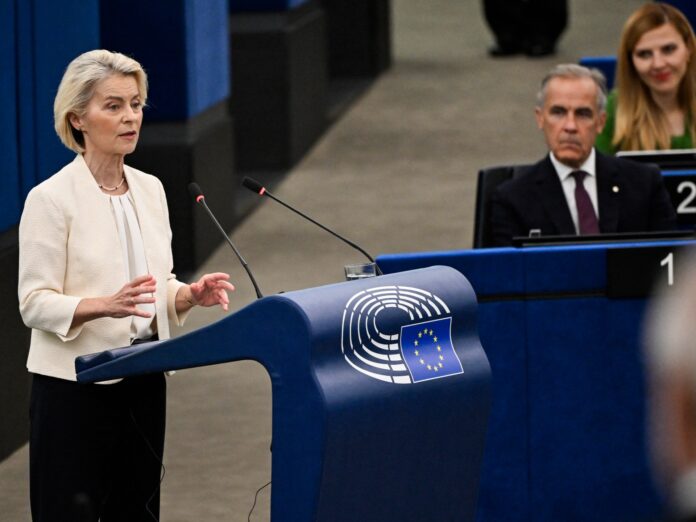
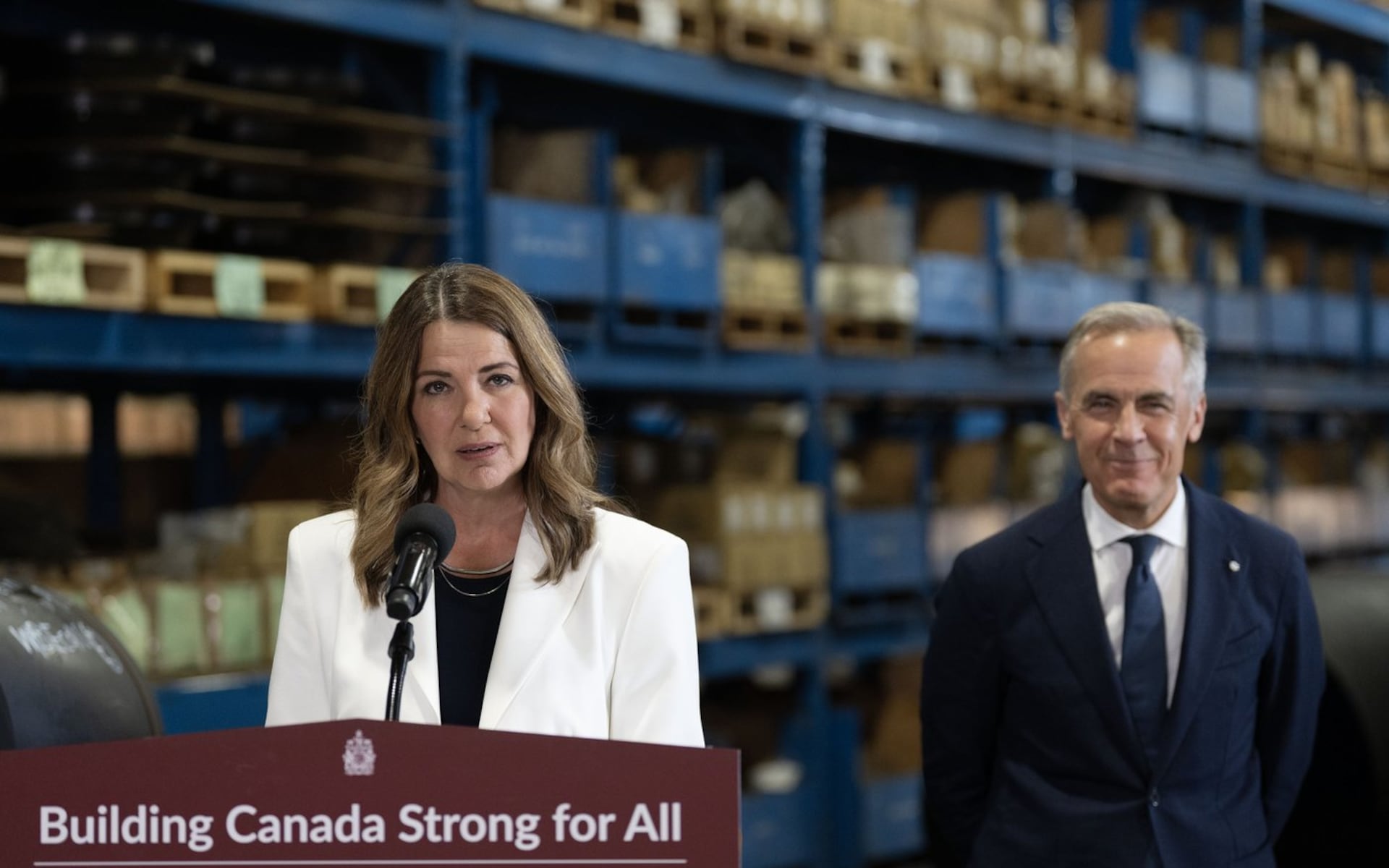
Prime Minister Mark Carney and Alberta Premier Danielle Smith jointly unveiled a framework for a new bitumen pipeline running from Alberta to British Columbia’s Pacific coast, targeting a capacity of one million barrels per day. The announcement, paired with a multibillion-dollar memorandum of understanding between Ottawa and British Columbia, represents the most substantive federal commitment to an Alberta export diversification project since Trans Mountain completed its expansion to the Westridge Marine Terminal in Burnaby last year.
“You asked for it, we promised it, now we are delivering,” Carney told reporters. Smith called the project a “nation building” endeavor, deploying the phrase Canadian leaders have historically reserved for rail lines and constitutional bargains, the kind of infrastructure that reshapes the country’s economic anatomy.
The pipeline is structured as a public-private partnership, with Trans Mountain Corporation and Pembina Pipeline Corporation named as interested parties. No private developer has formally committed. The project must still clear federal environmental review and Indigenous consultation processes whose timelines no official has publicly bounded. What was announced is a preferred route concept and a lineup of potential builders. The announcement is a signal of political will rather than a construction contract.
The signal itself is significant. Canada exports approximately four million barrels of oil per day, and more than 95 percent of that volume moves to the United States. The Trans Mountain expansion added roughly 370,000 barrels per day of Pacific-facing capacity when it came online, reducing but not fundamentally altering that dependency. A one-million-barrel-per-day addition would do more than any previous project to diversify the buyer pool, routing Canadian crude toward Asian refiners in Japan, South Korea, China, and India who would compete with US buyers rather than serving as the only alternative.
The political arithmetic behind the July 3 announcement has more moving parts than the infrastructure math. Washington let the Canada-United States-Mexico Agreement renewal deadline pass on July 1 without a deal, as EH reported on the USMCA non-renewal, triggering a decade-long window of trade uncertainty that strips the Canadian energy sector of the tariff floor it has relied on. US tariffs on Canadian energy products have come and gone under the Trump administration with enough frequency that Alberta’s industry now treats the next threat as a structural assumption. The pipeline project is partially a response to that assumption.
But the announcement arrived with a built-in contradiction. The same day Carney endorsed the pipeline framework, he confirmed that Ottawa will maintain the federal ban on oil tankers along British Columbia’s northern coast. The ban, enacted in 2019 to protect the Great Bear Rainforest and Haida Gwaii marine environment, covers the stretch of coastline where a northern route pipeline would most naturally terminate. BC Premier David Eby, who signed the multibillion-dollar MOU with Ottawa, accepted the pipeline in principle while extracting commitments for environmental compensation and confirming his government would not pursue litigation against a federally approved project.
The result is a pipeline with no confirmed port. The most developed pipeline infrastructure on Canada’s Pacific coast currently loads tankers at Westridge in Burnaby, at the southern end of the province, where the tanker ban does not apply. Whether the new project would follow a southern corridor or find a route that threads regulatory and environmental constraints along the northern coast is one of several material questions the announcement did not answer. Neither did it address the fundamental challenge that faces any bitumen export terminal on BC’s coast: the engineering difficulty of loading diluted bitumen, which sinks rather than disperses when spilled, onto tankers navigating waters where a spill response would be logistically complex.
Opposition Leader Pierre Poilievre responded by calling on the federal government to “get out of the way,” framing the project as a burden of state process rather than a state achievement. The criticism reflects a persistent divide in Canadian conservative politics over whether federal involvement accelerates major infrastructure or merely adds regulatory layers to what private capital would eventually fund on its own.
The Canadian energy sector has watched three major pipeline projects fail to complete in the past decade under the weight of regulatory timelines and Indigenous opposition, before Trans Mountain finally delivered its expansion last year. That history has produced a political constituency that treats any announcement without a construction date as a statement subject to revision. Pembina and Trans Mountain’s interest establishes commercial intent; it does not establish commercial commitment. An asset of this scale, one requiring well over ten billion dollars to construct and potentially two or three times that when fully costed, needs more than political goodwill to reach a final investment decision. According to Natural Resources Canada, the federal government’s energy development mandate explicitly prioritizes export diversification as a component of long-term energy security.
What Thursday’s announcement establishes is that Canada’s federal government and its most oil-dependent province have agreed, for the first time in recent memory, that reducing reliance on a single export customer is a national priority worth pursuing together. The dispute over how, where, and whether Indigenous and environmental review can be satisfied without blocking the project is the work that comes after the announcement. That work has not started.