
CALGARY – For years, Canada’s oil industry had one persistent problem: the province that sits between Alberta’s fields and the Pacific Ocean would not say yes to another pipeline. On Thursday, British Columbia said yes.
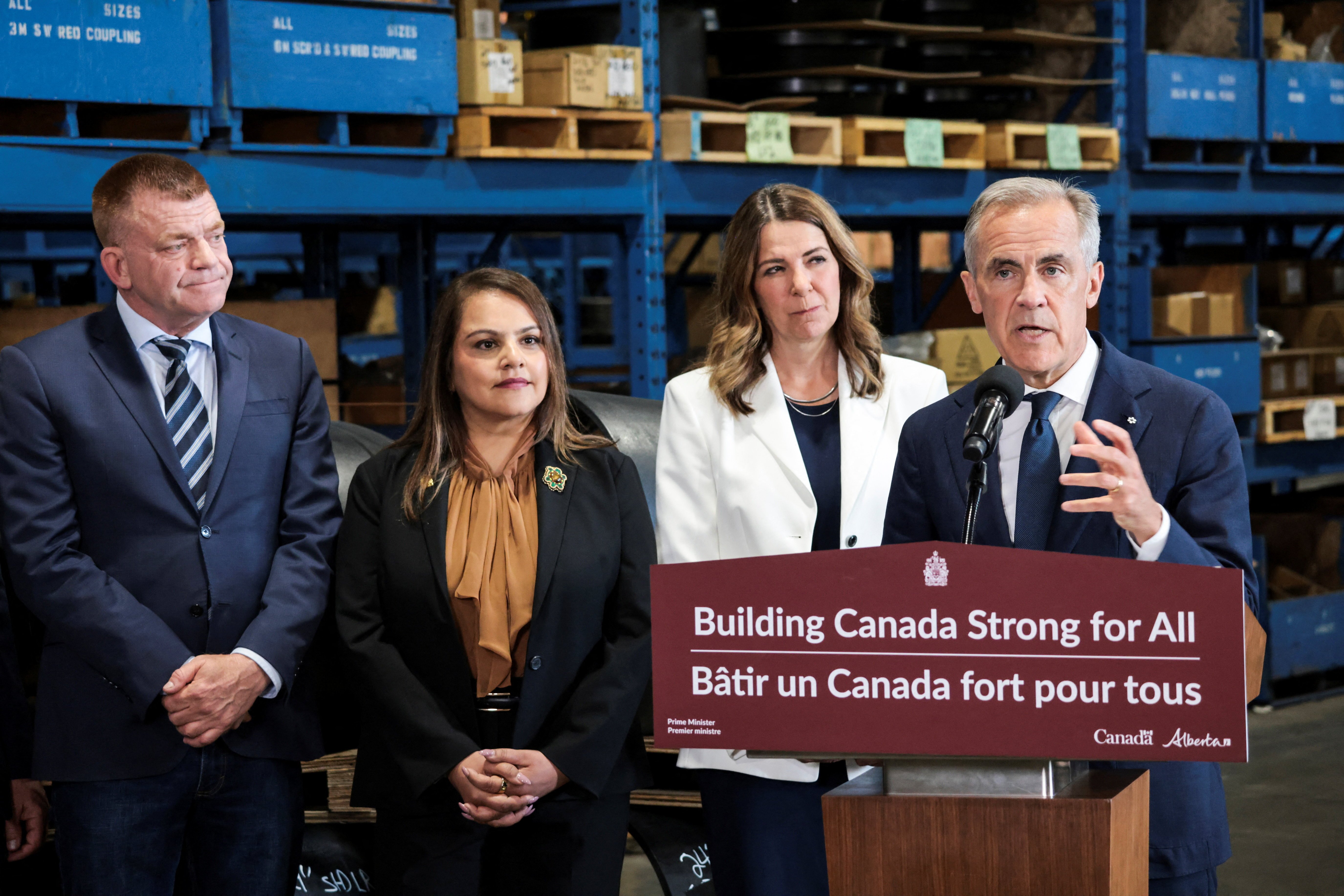
Prime Minister Mark Carney and Alberta Premier Danielle Smith stood at Trans Am Piping Products in Calgary to announce that the federal government would back a new pipeline running from Bruderheim, northeast of Edmonton, to the southern British Columbia coast – following the route carved by the existing Trans Mountain corridor. Standing beside them was British Columbia Premier David Eby, who had secured the condition Carney was willing to accept: the ban on oil tankers off British Columbia’s northern coast would remain permanently in place. Federal compensation for environmental risks associated with the southern pipeline, held in trust by the province and First Nations, was also committed.
The pipeline, to be built by the federally owned Trans Mountain Corporation in partnership with Calgary-based Pembina Pipeline, is designed to carry more than one million barrels per day to tankers bound for Asian markets. Alberta submitted its formal planning package to the federal Major Projects Office on Thursday, as Al Jazeera reported. Construction is targeted to begin no earlier than September 2027, pending environmental review, a national interest listing expected by October 1, 2026, and the completion of Indigenous consultations. The estimated cost ranges from $35.2 billion to $43.7 billion including contingencies – making it the largest energy infrastructure commitment Canada has announced since the Trans Mountain expansion opened in 2024.
The political logic behind Thursday’s announcement runs through Washington. Since US President Donald Trump imposed tariffs on Canadian energy exports, Ottawa has been searching for a credible answer to the question of what Canada sells, and to whom, if the US market becomes a liability rather than a guarantee. Carney offered the pipeline as that answer. “The best route for a new pipeline is one that goes through one that already exists,” he told reporters at the Calgary press conference, “south through the Trans Mountain corridor, to our Pacific Coast – the gateway to the world’s fastest-growing markets.” He confirmed Thursday that the tanker ban off British Columbia’s northern coast would stay in place, an assurance that became the price of Eby’s agreement.
Smith’s pitch was framed with a longer horizon. “The world is asking Canada to step up and provide stable, democratic and reliable energy supply,” she said. “This is not just another energy project. It’s a nation-building project that will unlock wealth and opportunity.” Her stated goal is to double Alberta’s total oil production to eight million barrels per day within fifteen years – an ambition the new pipeline would be a necessary but insufficient condition for achieving.
The Trans Mountain expansion provides the commercial precedent Thursday’s announcement is borrowing from. When that pipeline opened in 2024, between two-thirds and three-quarters of the crude moving through it went to Asian buyers – a proportion that has grown steadily as Canadian producers have moved to diversify their markets away from the US Gulf Coast. At more than one million additional barrels per day, the new pipeline would more than double Canada’s current Pacific export corridor in a single project. Canada’s Pacific crude is already finding Asian buyers at scale; this pipeline is designed to make that structural rather than opportunistic.
Carney also announced a separate Cooperative Prosperity Agreement with British Columbia on Thursday, which he said would unlock “more than $200 billion in new investment” with British Columbia as the federal government’s commercial partner for Pacific trade. The specific commitments within that agreement are more granular than the headline figure: a $3.9 billion North Coast Transmission Line, a $3 billion contribution to the George Massey Tunnel replacement, a $500 million Red Chris Mine expansion that would raise copper output by fifteen percent, and support for multiple liquefied natural gas export projects along the BC coast. Eby called the deal a path to a “generational prosperity” for British Columbia.
What neither agreement can guarantee is how long the pipeline’s regulatory path will take, or what it will cost when it arrives. The Trans Mountain expansion entered planning at an estimated $7.4 billion and was completed at approximately $34 billion – a cost that grew nearly fivefold through litigation, scope changes, and renegotiated contracts. The new pipeline’s $35.2 billion to $43.7 billion estimate is a pre-approval figure, produced before a full environmental assessment, before a complete round of consultations with the more than one hundred Indigenous communities that Alberta’s government has identified along the corridor in Alberta and northern British Columbia, and before the engineering teams have produced a confirmed construction schedule.
The Alberta Indigenous Opportunities Corporation is to support Indigenous co-ownership of the project – a structural commitment that reflects lessons from the Trans Mountain expansion’s contentious approvals process. But the substance of those co-ownership arrangements, and whether they will be sufficient to sustain the project through the legal challenges that have accompanied every major Canadian pipeline in the past decade, remains to be negotiated. Alberta’s government has engaged more than one hundred Indigenous communities in both provinces as part of the early planning process, but formal consultation under Canadian law is a different process from early engagement, and its outcome is not predetermined by the terms of Thursday’s announcement.
Thursday’s announcement ends one impasse – the provincial one, the argument about whether British Columbia would ever agree to a pipeline south through Trans Mountain’s corridor. What it opens is a regulatory process whose duration no government has committed to, at a cost that no pipeline in Canadian history has come in on time or on budget to meet.