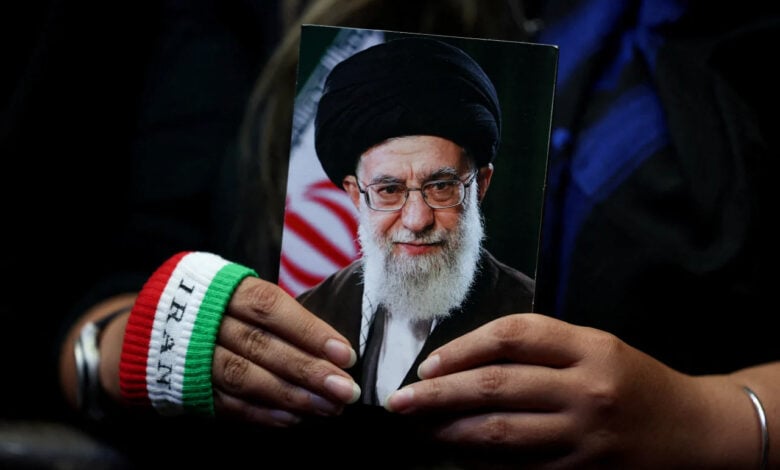

BAGHDAD – Iran did not ask Baghdad whether routing Ayatollah Ali Khamenei’s body through the holiest cities in Shia Islam, days before Iraq’s prime minister is due in Washington, was convenient. A spokesperson for the prime minister’s office confirmed as much to Alhurra: neither the government nor the Foreign Ministry had requested the ceremonies. The initiative came from Iraq’s ruling Shia Coordination Framework, the bloc of Iran-aligned parties whose leverage within parliament regularly exceeds the authority the government exercises on its own behalf.
The procession will reach Najaf on July 7. On July 8, the body will lie at the shrine of Imam Ali before ceremonies proceed to the shrines of Imams Hussein and Abbas in Karbala. Then it returns to Iran for burial at the Imam Reza shrine in Mashhad on July 9. The National reported that more than 1.7 million Iraqis have already registered to attend some portion of the route – a number that will produce one of the largest public gatherings Iraq has hosted in years.
The route itself is making an argument. Najaf is not simply a pilgrimage city. It is the seat of Grand Ayatollah Ali al-Sistani, the highest Shia religious authority in the world and the representative of a theological tradition – quietist, deferential to civil governance, skeptical of clerical rule – that stands in implicit tension with the entire framework of velayat-e-faqih that gave Khamenei his authority. Routing his body through Sistani’s city is a request for a form of posthumous recognition that Najaf is under no obligation to extend and Tehran cannot demand. That the ceremonies are proceeding suggests the request was not refused.
Baghdad was on the schedule until it wasn’t. A ceremony at the Kadhimiyah shrine district had been confirmed; it was then removed, with Maj Gen Saad Maan, Iraq’s government spokesman, citing “limited time.” The explanation is logistical. The decision is political. Iraq’s prime minister is scheduled in Washington in mid-July, arriving shortly after Khamenei’s body reaches Mashhad and the mourners go home. The concern, as a source close to his office described it to Alhurra, is that Iraq hosting the Baghdad ceremony would read in Washington as evidence that the country “automatically aligns itself with Iran on regional issues” – a characterization the source said was false.
The Shia Coordination Framework’s calculation runs the other way. The Framework’s leadership had been coordinating with the Iranian Embassy before the route was announced; the Baghdad stop appears to have been its initiative, not the government’s. Removing it represents a rare instance of the prime minister’s office overriding the Framework on a question of public symbolism, rather than legislation or ministry appointments, where the Framework’s leverage is harder to escape. Whether that override holds – whether Baghdad formally rejoins the route before July 8 – remains open.
The funeral’s six-day span is compressing the diplomatic calendar regardless of the route’s final configuration. US-Iran talks in Doha concluded July 1 with a communications hotline agreed and partial movement on frozen assets, but the Hormuz toll question and nuclear inspections were left unresolved. The Doha round explicitly deferred those questions, and the funeral now holds the next round until at least July 9. Of the 60-day MoU window, 38 effective negotiating days remain. They will not begin until Mashhad receives the body and Iran’s mourning period formally closes.
What Mojtaba Khamenei, who succeeded his father as Supreme Leader on March 9, gains from the procession’s scale is separable from what the Shia Coordination Framework gains. The Qom stop – where Mojtaba Khamenei studied and later taught theology, building his clerical networks among grand ayatollahs – projects continuity within Iran’s own religious establishment. The Iraq leg extends that claim outward, into the broader Shia world, where the new Supreme Leader’s authority is not yet assumed. The guest list for the July 3 ceremonies in Tehran already indicated which governments were prepared to recognize the new order; the procession through Najaf and Karbala asks the same question of Shia civil society, and expects a larger answer.
The Iraqi government cannot control the answer. It can remove Baghdad from the schedule. It cannot remove the 1.7 million Iraqis already registered, or the millions more expected without formal registration, or the political significance that attaches to a procession through Imam Ali’s shrine regardless of who requested it. What Baghdad has achieved is a narrow lane of plausible deniability: the government did not organize this, cannot fairly be said to have invited it, and will present its prime minister in Washington weeks after the mourners have dispersed. Whether that framing survives the spectacle is a question Iraq’s government is hoping it will not have to answer directly.