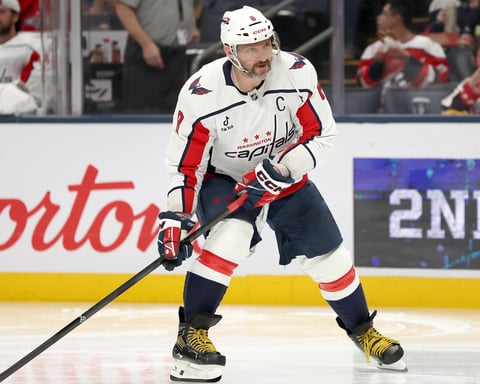
WASHINGTON – When Alexander Ovechkin’s sons asked whether their father was coming back, they weren’t thinking about NHL history. They just wanted to stay in Washington.
He decided to stay too. The day after becoming an unrestricted free agent, the Capitals announced on Wednesday that Ovechkin had signed a one-year contract – and the man who already owns every goal-scoring record worth owning posted two words that settled months of speculation: “I’m back!”
The deal, valued at $4.25 million against the salary cap, is structured in three parts: a $1 million base salary, a $3.25 million signing bonus paid upfront, and a $4.75 million games-played bonus triggered after just 10 appearances. The architecture of the contract reveals something about the negotiations. Washington was eager enough to front the money immediately; Ovechkin was not prepared to commit to more than one year at 40. One season. See where it leads.
What it leads to immediately is entry into the NHL’s smallest fraternity. Only four players in the league’s history have spent 22 seasons with a single franchise: Gordie Howe and Alex Delvecchio, both with the Detroit Red Wings; Stan Mikita with the Chicago Blackhawks; and Steve Yzerman, also with Detroit. This coming season, Ovechkin and Sidney Crosby will become the fifth and sixth members simultaneously – the first time that group has grown since Yzerman played his final game in 2006.
The parallel with Crosby is interesting only to historians. The one with Howe is something else. Howe played until 43 and scored 44 goals at that age, then 31 more the following season before finally walking away from the Red Wings in 1971. He did it on muscle memory and stubbornness refined across two decades in the same building. Ovechkin, heading into his age-41 season, scored 32 goals across 81 games in 2025-26. By the standard Howe set, he is not done.
The context his numbers need: Ovechkin is already the NHL’s all-time goal scorer, by a margin that keeps growing. He surpassed Wayne Gretzky’s 894 goals on April 6, 2025, at Madison Square Garden, and finished last season with 929 career goals – 35 more than anyone in the sport’s history has ever scored. The record that Gretzky set was considered impossible to break for thirty years. Ovechkin has owned it for fifteen months and is still adding to it.
The Capitals spent much of June making the case for a return. Before Ovechkin finalized his decision, Washington acquired forward Jordan Kyrou from the St. Louis Blues and brought in Alex Tuch from the Buffalo Sabres – two additions that signal an organization no longer willing to passively rebuild after missing the 2025-26 playoffs. The message was deliberate. “Obviously, if I want to come back,” Ovechkin said in his announcement, “it has to be a decision on…we’re going to make the playoffs and we have to fight for a Cup.”
He didn’t need more persuasion than that. Neither did his family. His sons have grown up in Washington, in the only hockey world they know. When they asked their father whether he was staying, they were not weighing contracts or records. They were asking whether their world was going to hold still. He gave them the answer they wanted.
“I’m healthy,” Ovechkin added in his statement. “I love playing hockey.” The simplicity is almost jarring. Not the milestones, not the cap figure, not the pursuit of a second Stanley Cup ring – though all of those are true. Just the game. One more year of it.
When he skates out for the Capitals’ opener this October, Ovechkin will cross a threshold no professional athlete in Washington’s history has reached. Walter Johnson pitched for the Washington Senators for 21 seasons between 1907 and 1927 – the longest run any athlete had posted in the capital until now. Ovechkin arrived in 2005. He has outlasted ownership changes, two franchise rebuilds, one Stanley Cup championship in 2018, the retirements of everyone from his generation, and a season without the playoffs. He is still here.
That 2025-26 absence from the playoffs was almost certainly the heaviest factor in his deliberation. A 40-year-old with nothing left to prove on any statistical ledger does not come back for another missed postseason. He comes back when he believes the people around him went out and made the team worth believing in again. Kyrou and Tuch are Washington’s answer to that condition.
Whether this is the last chapter is genuinely unknown. Ovechkin said he will take each season as it comes, and the one-year deal is built precisely for that kind of calculation. He turns 41 in September. Gordie Howe scored 44 goals at that age. Ovechkin scored 32 at 40. The slope of whatever this is – late prime, extended peak, unhurried decline – has been gentler than anyone projected when he first started closing in on Gretzky.
He will score goals in a Capitals jersey again this fall. He will push 929 toward some higher number nobody has started keeping track of yet. And somewhere, at some point, there will be a final one. He just doesn’t know when. Neither does anyone else. That, more than any record, is what 22 seasons looks like when you’re living them.