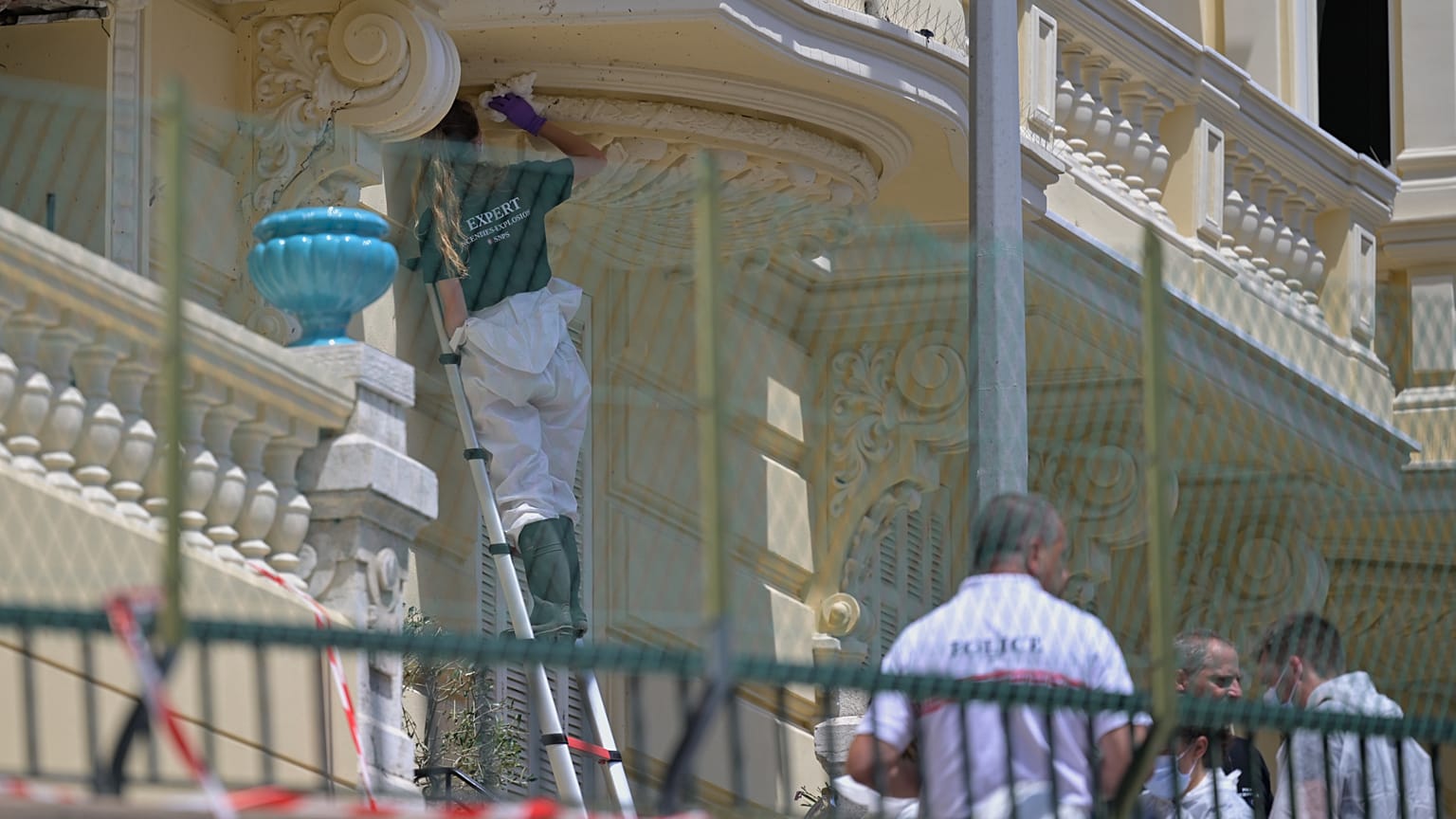

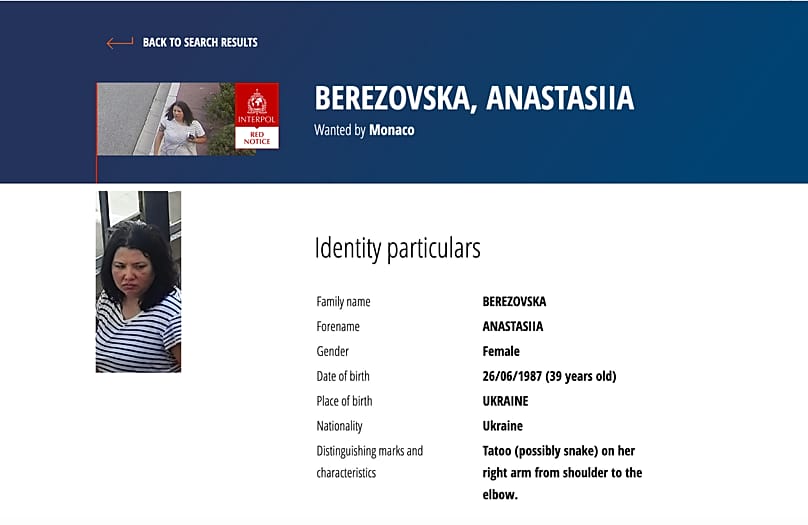
MONACO – Sitting on a bench at Place des Moulins, she waited. When Vadym Yermolaiev and his family appeared in the doorway of their apartment building, she turned to face them, pressed a remote control, and walked away. By Thursday, Interpol had issued a Red Notice for her arrest, naming her as Anastasiia Berezovska, 39, Ukrainian, last known address in Germany.
The bomb she placed had detonated four days earlier at the entrance of one of Monaco’s most expensive residential buildings. Yermolaiev, a Ukrainian construction tycoon who renounced his citizenship nearly a decade ago and faced Ukrainian sanctions in 2023 for ties to Russia, was wounded along with his partner and son. His partner remained in critical condition on Thursday.
Interpol’s Red Notice charges Berezovska with attempted murder, placing an explosive device in a public place with criminal intent, and criminal conspiracy. Monaco’s deputy prosecutor, Morgan Raymond, said the device was detonated remotely and that “the relative sophistication of the explosive device and the modus operandi suggest that the person who planted the device did not act alone.”
Investigators initially identified the suspect as a heavily built person appearing male. A review of CCTV footage and witness testimony across Monaco’s extensive camera network established that the suspect was a woman who had disguised herself. Berezovska, who speaks German and carries a distinctive tattoo on her upper right arm, conducted several reconnaissance missions to the building before the attack, according to Monaco police. She is considered armed and dangerous.
Her escape route has been partially traced. A car with German number plates was tracked through Monaco, France, and into Italy, then across several other European countries. German police searched a rented apartment in the Main-Taunus district on Thursday, the same day the Interpol notice was issued. She remains at large.
The attack on Yermolaiev came days after a former French intelligence officer said he had discussed a proposal with Yermolaiev’s team for parliamentary hearings in Brussels on alleged corruption inside Ukraine’s government. In reporting from July 1, Claude Moniquet, a retired officer of France’s Directorate General for External Security, said Yermolaiev had been exploring the possibility of organizing expert hearings at the European Parliament on Ukrainian corruption. The relationship between that prospect and the Monday bombing remains a matter of active investigation rather than established fact.
Ukraine sanctioned Yermolaiev in 2023 for what Kyiv described as business relationships that benefited Russia. He had renounced his Ukrainian citizenship years before those sanctions were issued. No Ukrainian government official has commented on the Interpol Red Notice or on the identification of the suspect as a Ukrainian national.
Berezovska’s disguise, her documented reconnaissance of the building, and the remote-detonated device point to a coordinated operation rather than an improvised one. Euronews reported that authorities in Monaco concluded from CCTV and witness accounts that the bombing required planning across multiple visits to the target location. The prosecutor’s phrase that she “did not act alone” leaves open the most consequential question the investigation has not yet answered: who gave the order, who supplied the device, and who arranged the logistics for a cross-border operation in a principality with one of the highest concentrations of surveillance cameras in the world.
Interpol Red Notices are requests to member law enforcement agencies to locate and provisionally arrest a named suspect. They are not international arrest warrants. Berezovska’s last confirmed location was in Germany before her movements crossed into other European states. The investigation is continuing. The identity of anyone who may have directed her is not yet part of any official charge.