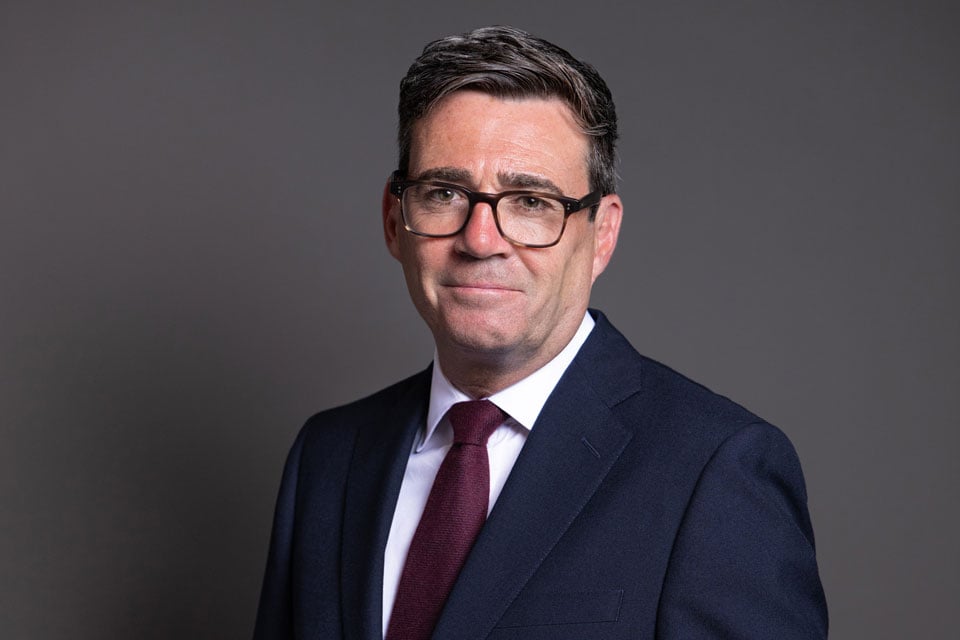

MANCHESTER – On his fourth day as Prime Minister, Andy Burnham bypassed Downing Street entirely. He flew to Glasgow instead, where Scotland’s First Minister John Swinney was waiting with a measured response to the week’s most significant domestic announcement: Number 10 North, a Manchester-based policy hub Burnham describes as the foundation for the most ambitious restructuring of British governance in a generation.
“Rhetoric alone will not cut it,” Swinney said.
The bluntness of that response, delivered before Burnham’s administration has even held a second cabinet meeting, captures both the promise and the risk of Number 10 North. As a statement of intent, relocating devolution and local growth policy functions from the housing ministry and Treasury into a Manchester headquarters at Heron House is genuinely unprecedented. As a policy, it has transferred not a single pound of additional spending power to the regions it is meant to empower.
The written ministerial statement establishing Number 10 North describes what will move to Manchester and how it will be staffed. Caroline Simpson, the former chief executive of the Greater Manchester Combined Authority, has been appointed Burnham’s deputy chief of staff in charge of daily operations. A permanent base, a Government Digital Campus whose completion is planned for 2032, remains years away.
Burnham insists Number 10 North is “not a gimmick.” He has pledged to work from Manchester at least one day per week, and his team emphasises that the initiative costs taxpayers nothing additional. What it does not yet contain, and what critics across the political spectrum are noting with varying degrees of frustration, is money. The United Kingdom remains the most fiscally centralized country in the G7: approximately 95 percent of tax revenue flows to Whitehall before any portion is distributed outward. Burnham’s Manchester office can move functions, staff, and intent, but the budgets that translate policy into services still originate and return to London.
Mirte Boot of the Institute for Public Policy Research North summarised the gap plainly: Number 10 North “establishes the plumbing, but the water isn’t flowing yet.”
That diagnosis will ring familiar to anyone who followed Burnham through his years as Greater Manchester’s Metro Mayor, when he made the devolution case always conditional on the Treasury releasing its grip. Scotland and Wales have spent months mapping their own constitutional futures, contingency plans that are now operationally active in the event Westminster fails to transfer meaningful power. Number 10 North is either the beginning of that transfer, or a reason to keep those contingencies on standby.
Scotland’s reaction carries particular weight because it is the most politically loaded. Swinney did not dismiss Number 10 North as irrelevant. He said it was insufficient. Al Jazeera’s analysis of the Glasgow meetings noted that Burnham deliberately excluded Scottish independence from the agenda, framing the encounter as a conversation about growth rather than constitutional politics. The SNP has won four consecutive Holyrood elections arguing those two subjects cannot be separated.
Wales took a more cooperative line. First Minister Rhun ap Iorwerth called the Glasgow meetings “constructive” but outlined two concrete demands: a new Wales Bill granting policing and justice powers, and a renegotiation of the Barnett Formula, the funding mechanism governing how money is distributed among the UK’s four nations. Without both, ap Iorwerth suggested, Number 10 North risks becoming “Whitehall with a different postcode.”
Reform UK’s Nigel Farage warned that dual offices “will fight against each other.” Jonathan Carr-West of the Local Government Information Unit called Burnham’s agenda “the most ambitious statement from a senior politician in a generation,” while noting that English councils currently lack the funding to match it. Malcolm Morgan, a transport researcher at the University of Leeds, argued that genuine devolution requires “spending, taxation and regulatory power, not just relocated functions.”
On the streets of Greater Manchester, responses were predictably divided. Debe Conway, a 56-year-old Scottish-born bookseller in Bury, remains unconvinced and wonders about sustainability. Rich Carver, who has run a pizza restaurant in Manchester for 15 years, is more optimistic, saying the city has been building toward something for a long time and hoping Burnham delivers it.
That gap between skepticism and hope is where Number 10 North currently sits. Burnham’s first cabinet pledge was to deliver the most significant reforms Britain had seen in 40 years. Number 10 North is, in structural terms, the first visible evidence of that intent. What it does not yet show is whether intent carries the fiscal weight to make good on itself.
“Whether that time produces growth, or just relocated offices, is the question Number 10 North still has to answer,” Carver said.