
KYIV — The counter-drone system Ukraine spent three years building has a ceiling. It sits at approximately 300 km/h — the maximum speed of the interceptor UAVs that Ukraine has fielded in large numbers to bring down Russian kamikaze drones before they reach populated areas. Russia has now deployed attack drones that fly faster than that. The margin is not small: the newest variants reach 500 km/h. The people who built the interceptor system did not build it for this.
Russia’s deployment of jet-powered drones alongside conventional propeller-driven kamikaze UAVs has been accelerating since late 2025, when the first Geran-3 appeared over Ukrainian airspace. The shift represents a deliberate tactical decision: overwhelm not just with volume, but with speed profiles that force Ukraine’s layered defenses onto a different and more expensive tier of response. Ukraine’s Air Force spokesperson Colonel Yurii Ihnat confirmed the threat directly. “These drones are no longer within the reach of interceptor drones, whose speed is up to 300 km/h,” he told reporters last week.
The Geran program — Russia’s domesticated evolution of Iranian Shahed designs — has moved through generations at a pace that keeps Ukraine’s countermeasures in a state of permanent catch-up. What made the program militarily significant in 2022 was volume: cheap, expendable propeller drones launched in swarms that exhausted Ukrainian air defense resources. What makes it strategically significant in 2026 is the jet-propulsion upgrade that renders the most cost-effective countermeasure, the interceptor drone, unable to intercept.
The two current jet-powered variants mark distinct steps in that evolution. The Geran-3 entered combat in September 2025 equipped with a turbojet engine, achieving 370 km/h across a 1,000-kilometer range — already above the interceptor ceiling. The Geran-5 went further: first confirmed in combat in January 2026, it carries a 90-kilogram warhead over the same range, reaches speeds exceeding 500 km/h, and incorporates a 12-channel Cometa satellite navigation system alongside a Raspberry Pi-based tracker using 3G and 4G modems. The electronics package inside what is effectively a throwaway weapon is, by almost any measure, more sophisticated than the Shahed-136 that provided the initial template.
Iran’s role in that template is not disputed. The Shahed-136, licensed and then adapted into the Geran-2, gave Russia its mass-production foundation for the kamikaze drone campaign that began in earnest in autumn 2022. Whether Tehran continues to supply components for the jet-powered variants, or whether Russia has fully domesticated its manufacturing chain, is a question neither Ukrainian military intelligence nor Western defence analysts have answered publicly. What Ukraine’s military intelligence agency, known by its acronym HUR, has confirmed is that the Geran-5 is in active combat deployment.
Ukraine’s overall interception rate remains high. Commander-in-Chief Oleksandr Syrskyi acknowledged in early June that Russia plans to raise the share of jet-powered strike drones to 50 percent of its total aerial assault package — a declaration he presented as documented intent derived from intelligence assessments. Despite limited air defense missile stockpiles, Syrskyi said Ukraine has maintained interception rates exceeding 90 percent across all drone categories combined. That figure, however, does not disaggregate the faster jet variants from the propeller-driven ones. Ukrainian officials have not published separate interception statistics for the Geran-3 and Geran-5, leaving open whether the 90 percent rate holds against the drones Ihnat described as beyond reach.
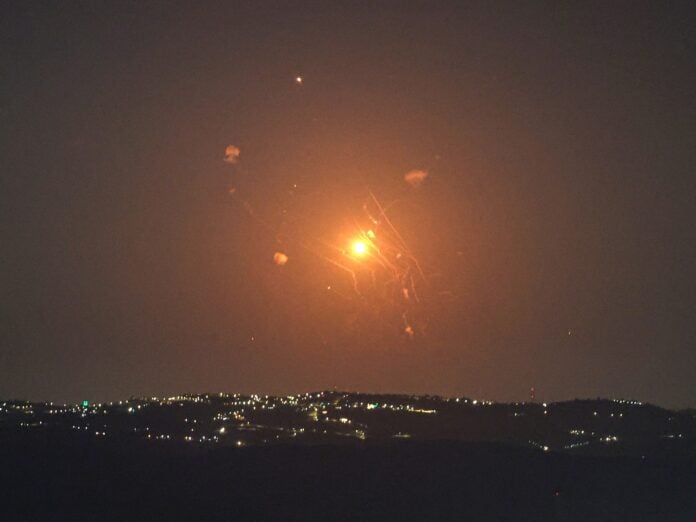
The strategic logic of the 50 percent target is not difficult to parse. Ukraine’s interceptor drones are cheap relative to surface-to-air missiles. Every kamikaze UAV brought down by a counter-drone costs a fraction of what it would cost to intercept with a Patriot or NASAMS round. Russia’s mass-drone campaign was partly designed to exhaust that tier of the defense through sheer volume. The jet-powered shift adds a second pressure: force Ukraine to engage faster targets with the expensive tier because the cheap tier cannot reach them. Russia’s largest air assault of 2026 — 570 missiles and drones against Kyiv on July 2 — laid bare the interception math Ukraine faces at scale when both tiers are deployed simultaneously.
The program’s evolution from Shahed-136 to Geran-5 over roughly four years represents something beyond an incremental drone upgrade. It represents an adversary who studied what Ukraine built to defeat one generation of weapon, and built the next generation around defeating the countermeasure. Ukraine’s interceptor drone program — one of the more cost-effective defensive innovations of the conflict — may now be facing the same cycle of obsolescence it imposed on older Russian air defense approaches. Euronews reporting on the deployment cited Ukrainian Air Force officials describing this shift as a qualitative change in the threat environment, not merely a quantitative one.
How quickly Ukraine can develop or procure counter-drone systems capable of matching the 500 km/h speed ceiling — or whether Western partners will supply different technologies to close the gap — had not been publicly addressed as of Wednesday. Zelenskyy’s standing requests to Western governments focus primarily on surface-to-air missile replenishment for the Patriot and NASAMS systems that handle the ballistic and cruise missile threat. Counter-drone capability at the jet-speed tier is a different request requiring different hardware, and it has not yet emerged as a named priority in Western defence commitments.
The Nord Stream sabotage charges filed in Germany on Wednesday underscored how many dimensions the conflict is developing simultaneously. Russia is deploying faster weapons while Ukraine manages international legal exposure, Western military support negotiations, and an air defense system whose most cost-effective tier is now slower than the fastest thing Russia is sending.
What Russia’s jet-powered expansion cannot do is describe itself as a permanent advantage. Every countermeasure eventually finds an answer. The Geran-5’s Raspberry Pi tracker suggests a program comfortable with low-cost improvisation on a mass-production schedule. Ukraine’s challenge is either to improvise faster than that schedule, or to obtain from Western partners technologies that operate outside the speed ceiling Russia has now set. Neither path has a clear timeline. The interceptor drone solved a problem Russia gave Ukraine in 2022. Russia has now made that problem significantly harder.