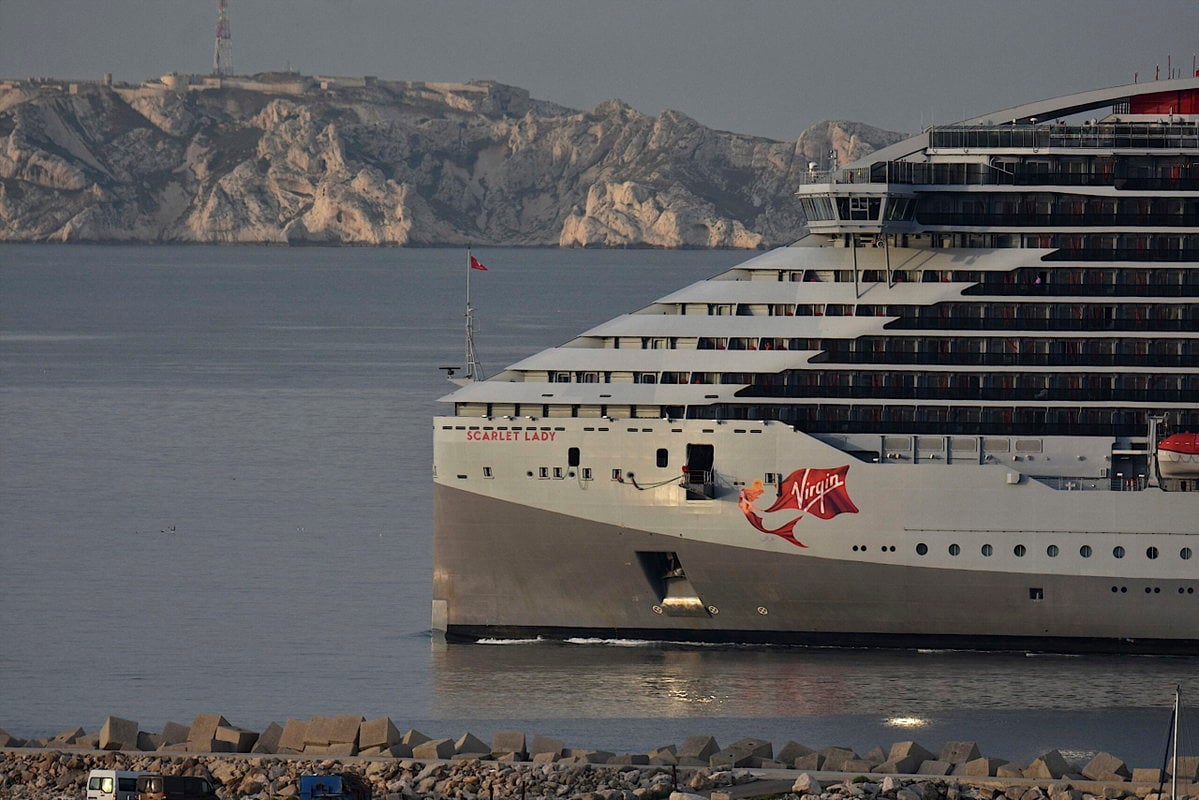

ANKARA — Thirty-six years and more than 150 voyages, and Rich Campbell had never been told his company’s passengers could not dock because of who they are. That ended on Thursday. Turkish authorities barred the Scarlet Lady, a Virgin Voyages ship chartered by Campbell’s Atlantis Events for approximately 1,900 LGBTQ travelers, from docking at two planned Turkish ports. The reason, as Aydin province officials stated it: groups “known for behaviors incompatible with the fabric of our society and our moral values.” Campbell told CNN it was the first exclusion in the company’s history based purely on identity.
The Scarlet Lady was due to depart Greece on its “Athens to Venice” cruise on July 5, with planned stops in Kuşadaşı, a port town on Turkey’s Aegean coast, and Istanbul. Aydin province officials declared there was “absolutely no possibility” of the group visiting the province. Istanbul authorities separately raided a bar after discovering an Atlantis Events brochure on the premises. Atlantis notified passengers Thursday that the two Turkish ports had been removed from the itinerary “due to circumstances beyond our control.” The cruise will now call at Cairo, Egypt, and the Greek island of Crete instead.
The passenger list runs to approximately 1,900 travelers, of whom roughly 1,100 are American, with the remainder from the United Kingdom, Canada, and Australia. Campbell, speaking to CNN, said he had contacted the US State Department and the US Ambassador to Turkey about the incident; as of Thursday, no formal government response had been made public. He noted that Turkey had provided no legal basis for the exclusion. Port authorities appear to have exercised discretionary power rather than invoking any statute, which leaves Atlantis Events without an obvious legal lever.
Turkey’s phrasing was careful in its vagueness. “The fabric of our society and our moral values” is not a law. It is language that has accumulated in official Turkish communications about the LGBTQ community for roughly a decade under President Recep Tayyip Erdogan’s AKP government. Istanbul banned Pride marches in 2015, a ban enforced with water cannons and rubber bullets when activists attempted to proceed. Erdogan has made his personal position explicit in public statements, using language that characterizes homosexuality as incompatible with Turkish social values. What the port ban on the Scarlet Lady did was apply that language to a concrete logistical decision: a ship was approaching, and Turkey turned it away.
The European Union has been measuring the gap between Turkey’s official positions and its own rights standards for years. Last month, the European Parliament moved to sanction Turkey’s Justice Minister Akın Gürlek for what the bloc described as violations of judicial independence and fundamental rights. Ankara’s response, according to an Eastern Herald report, was to send an AKP lawmaker to ask what Turkey could do to have the minister’s name removed from the sanctions list. Brussels said no. Turkey remains a NATO member and an EU accession candidate in name; in practice, the two sides are further apart on rights questions than at any point since accession talks formally stalled. The Scarlet Lady ban adds a tourism and commercial dimension to that divergence, making explicit what diplomatic language usually obscures.
For the passengers, the practical resolution was arranged in hours: new ports, adjusted schedule, the voyage continues. What no company policy can substitute for is the specific experience of discovering, days before departure, that your identity is the stated reason a country will not receive your ship. Campbell framed it plainly. “It’s very concerning to me when a country decides they can pick and choose which tourists are allowed in,” he told CNN.
Turkey is among the world’s most visited countries, its tourism sector accounting for a significant share of GDP, and Ankara has spent years building a reputation for welcoming European and American visitors. The Scarlet Lady ban introduces a public exception to that reputation. It is not a local official acting outside state policy; it is state policy, expressed at the level of port administration, applied to a scheduled commercial vessel.
What is not known is whether this marks an intensification of Turkey’s approach or simply the first time it has been enforced against a cruise ship large enough to generate international attention. Campbell said he had never seen it before in 36 years. The Scarlet Lady will reach Venice. The question the ban raises about what kind of country Turkey intends to be for visitors whose identities its government has officially decided are incompatible with its values does not travel with the ship.