
ANKARA – For nearly seven years, Turkey has occupied an uncomfortable position within NATO, formally a member of an alliance that collectively operates the most advanced western combat aircraft in existence while possessing none of it. That anomaly, the product of a 2019 decision to expel Ankara from the F-35 program after it acquired a Russian air defense battery, may be approaching its end.
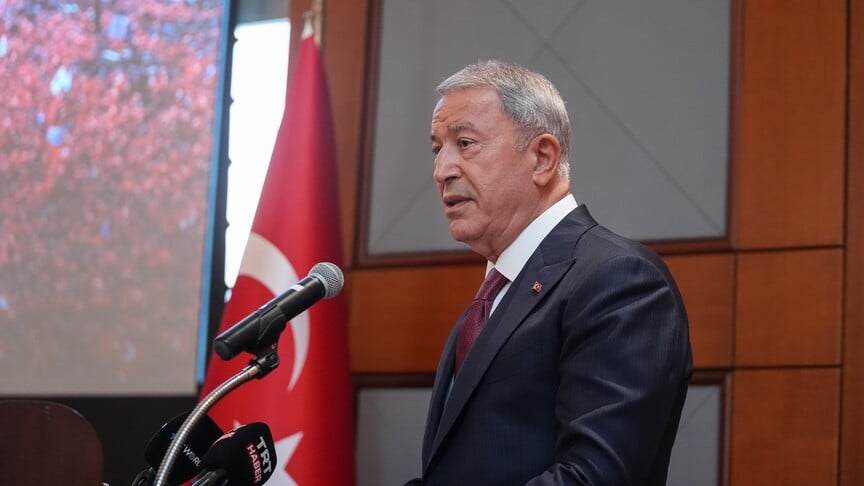
A Turkish parliamentary delegation led by Hulusi Akar, the former defense minister and current chairman of the Grand National Assembly’s defense committee, met Thursday with senior members of the US House Armed Services, Intelligence, and Foreign Affairs committees, as well as NATO Parliamentary Assembly leadership, in Washington. The meetings produced what officials on both sides described in unusually direct terms as a near-term path forward.
Representative Mike Turner of Ohio, who chairs the House Intelligence Committee, told Akar directly that he believed Turkey could rejoin the F-35 program, Anadolu Agency reported. Akar said the talks took place in an “extremely positive, productive and constructive atmosphere” and that “once the S-400 issue is removed, the F-35 program will naturally resume.” He also addressed reports that Turkey intended to transfer the S-400 systems to the United Arab Emirates, saying Ankara was not and had not been planning to do so.
That denial is notable less for what it confirmed than for what it implies: the question of where the S-400 systems might go, if Turkey proceeds with disposing of them, is live enough that a senior official felt compelled to specifically exclude one destination. Turkey’s National Defense Ministry spokesperson Zeki Akturk said separately that work on the S-400 is “continuing in multiple dimensions” and that specifics would be shared “when there are concrete developments.” The ministry offered no further detail.
Deputy Foreign Minister Levent Gumrukcu, speaking the same day, offered the most optimistic characterization of the negotiations in the history of the dispute. “This time we really feel closer. We feel that we might be able to resolve this issue,” Gumrukcu told Anadolu Agency. He added that for the first time in ten to fifteen years of difficult bilateral relations, Ankara has “full confidence in the United States administration that when we reach a deal, they are going to deliver their part.” A joint political and military working group has been established to examine what he described as “many different options” for satisfying American legal requirements while accommodating Turkish political and economic considerations.
Turkey purchased the S-400 from Russia in 2019 after the United States declined to sell it Patriot missile defense systems at terms Ankara considered acceptable. Gumrukcu characterized that purchase as a “one-off procurement” to fill an “immediate gap” in air defense needs when no western alternative materialized. Ankara has maintained across successive governments that the acquisition was a reluctant defensive decision rather than a strategic embrace of Russian military technology. Whether that framing satisfies US legal conditions is a separate question from whether it has persuaded Washington politically.
The path to F-35 reinstatement requires Turkey to clear two distinct American legal hurdles. The Countering America’s Adversaries Through Sanctions Act, or CAATSA, under which Washington sanctioned Turkey’s defense procurement agency, requires executive action to lift. Separate restrictions in the National Defense Authorization Act require independent congressional action, and a mandatory 90-day congressional review applies once a certification is submitted that Turkey no longer possesses the S-400 systems. The NATO Ankara summit in early July gave the issue renewed political energy, with Erdogan pressing Trump directly on the F-35 question as host nation and NATO ally.
None of the current diplomatic activity has produced a public statement from Ankara on what it intends to do with the S-400 hardware. The legal framework requires Turkey to certify it no longer possesses the systems before the CAATSA relief process can begin. Turkey accepted delivery of the Russian equipment in 2019 but never integrated it into active operations under sustained American pressure. Whether the batteries remain in storage, have been deactivated through a negotiated agreement, or are the subject of discussions involving a third country remains publicly unknown. Akar’s specific denial of the UAE destination, without naming an alternative, suggests the disposal question has not been settled.
Turkey’s leverage in this dispute has always derived from its geography and NATO membership. Ankara controls the Bosphorus Strait, hosted the alliance’s most recent summit in early July, and provides land connectivity between Europe and the Middle East that no other NATO member can replicate. The current security environment in Europe, shaped by the ongoing Russian military operation in Ukraine, has made Turkish reinstatement in the F-35 program strategically significant for the alliance at a time when every available aircraft slot matters. That calculus applies pressure on Washington as much as it does on Ankara.
What specifically is happening with the S-400 systems, what the resolution will look like, and when Ankara will provide the certification the US law demands, the joint working group has not said. Gumrukcu acknowledged he could not “yet detail what a deal might look like or when it could come.” Both governments say they are closer than ever. Both have said something like that before.