
JODHPUR — Prime Minister Narendra Modi stood inside a new terminal built to move 20 lakh passengers a year and launched a national aviation scheme whose last version left half its routes empty.
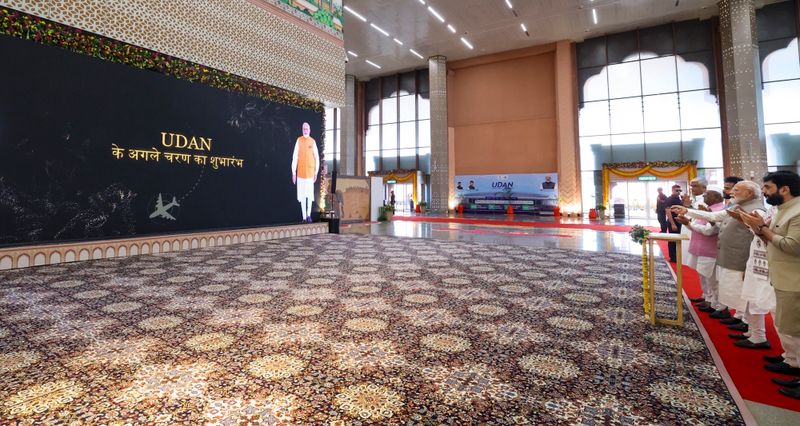
Modi inaugurated Jodhpur airport’s new terminal building on Friday, a Rs 480 crore facility with six aerobridges and an apron built to hold eleven A-321s and an ATR-72, and used the occasion to formally launch the Modified UDAN Scheme, the government’s ten-year, roughly Rs 29,000 crore attempt to fix a regional connectivity program whose first version did not work as advertised. Rajasthan Governor Haribhau Bagde, Union Civil Aviation Minister K. Rammohan Naidu, Culture and Tourism Minister Gajendra Singh Shekhawat and state Chief Minister Bhajanlal Sharma stood alongside him.
The ceremony arrived attached to an inconvenient set of numbers. Of the 663 regional routes launched under the original UDAN scheme since 2017, only 336 are still operating commercial flights, according to government data reviewed this week. Three hundred and twenty-seven routes, roughly 49 percent of everything the program has ever launched, have gone dark. A Comptroller and Auditor General review found that only 7 to 10 percent of UDAN routes remained financially viable once their initial subsidy period ended, a conversion rate that leaves the overwhelming majority of subsidized routes either permanently dependent on government support or simply dead once it is withdrawn.
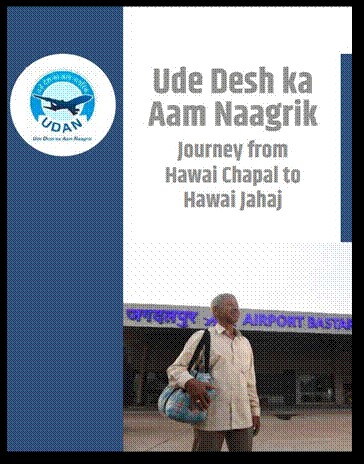
UDAN, formally Ude Desh ka Aam Nagrik, or “let the common citizen of the country fly,” was built on a specific wager: that regional air travel in India’s Tier-2 and Tier-3 towns was suppressed by cost and absent infrastructure rather than by an absence of demand, and that a temporary subsidy could bootstrap routes into self-sustaining commercial viability before the money ran out. The Jodhpur launch is the government’s answer to the CAG’s finding that the bet mostly did not pay off: not retrenchment, but a bigger, longer version of the same wager.
The Modified UDAN Scheme extends the subsidy window on each route from three years to five and shifts the funding burden more fully onto the central exchequer, allocating Rs 12,159 crore to developing 100 aerodromes from currently unserved airstrips, Rs 3,661 crore for 200 new helipads, and Rs 10,043 crore in viability gap funding to keep regional airline operations afloat while they build a passenger base. The three-year subsidy window, in retrospect, was the design flaw the CAG report keeps returning to: building a sustainable passenger base on a route connecting a district headquarters to a state capital takes longer than three years in most cases, particularly when regional carriers lack the network effects that let a major airline cross-subsidize a thin route with profits from a dense one.
Airport readiness compounded the problem from the ground up in the scheme’s first phase. Several airstrips slated for UDAN service were not upgraded on schedule, held back by regulatory delays and compliance costs that fell disproportionately on smaller state governments and airport operators without the balance sheets of AAI’s flagship hubs. A route that exists on a government notification but lacks a runway certified for the aircraft assigned to it is not a route. It is a pending liability, and Jodhpur’s new terminal, sized for nearly a dozen narrow-body aircraft at once, is the government’s answer to that specific failure mode: build the capacity first, and let the routes follow.
None of this is India’s first attempt at solving the underlying problem. The country’s aviation growth story of the past decade, anchored by the opening of new capacity like Noida International Airport, the capital region’s second air hub, which began commercial flights this June, has been concentrated overwhelmingly at the metro and near-metro level, where private capital and passenger volume make new infrastructure self-justifying. UDAN was meant to be the policy instrument that extended that growth into the country’s interior, where the market alone was not going to build the case for a scheduled air route. Jodhpur, a tourism gateway to Rajasthan rather than a Tier-3 hinterland town, is a more forgiving test case than the routes that actually failed.
What the ceremony did not resolve is the harder structural question underneath the funding mechanics: whether a five-year runway is enough time for genuinely thin regional markets to develop the kind of self-sustaining demand that the original three-year window failed to produce, or whether some of the 327 dark routes were never going to work on any subsidy timeline because the underlying passenger demand simply is not there at a price point Indian regional carriers can operate profitably. The government has wagered ten years and Rs 29,000 crore on the answer being the former. A gleaming terminal in a city that already draws tourists is not the hardest place to test that wager. The routes that already went dark are.