
NEW DELHI — The paperwork that makes a trade deal real arrived Friday. India’s Central Board of Indirect Taxes and Customs notified the rules of origin for the Comprehensive Economic and Trade Agreement between India and the United Kingdom, the final administrative step before the pact takes force on July 15 and opens duty-free access for Indian exporters across nearly the entire British market.
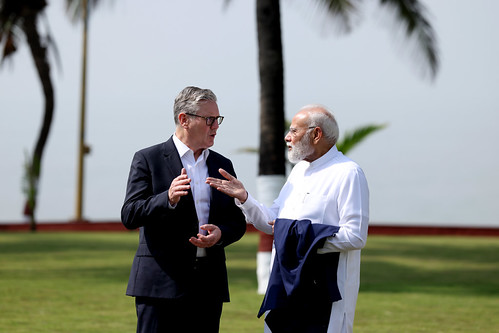
The notification is not the event most people watched — that was the initial signing in July 2025, when Prime Ministers Modi and Starmer stood together and described the agreement as historic, which by most measures it is. What CBIC issued on Friday was the operational machinery: the rules that tell an exporter in Surat or Chennai or Agra exactly what makes their product “Indian” in the eyes of British customs, and therefore eligible for zero duty.
Those rules matter enormously to the people they govern. The question of origin is the question of whether a shipment of leather shoes assembled in Tamil Nadu from Vietnamese hides qualifies for the tariff preference, or whether a pharma bulk drug manufactured in Hyderabad from imported active pharmaceutical ingredients counts as Indian enough. The answer, under the CBIC notification, depends on whether the good is wholly obtained in India, produced from originating materials, or — in the case of goods that use inputs from outside — whether those inputs have undergone a sufficient change in tariff classification or meet a minimum value-content threshold. Simple operations — repackaging, relabelling, washing — cannot confer originating status. The notification sets a 12-month validity on origin certificates and requires exporters to maintain records for five years.
The sectors that stand to gain are concentrated and specific. Textiles, leather and footwear, marine products, sports goods, toys, gems and jewellery, engineering goods, auto components, and organic chemicals together represent the bulk of India’s export basket to Britain. These sectors carried $13.44 billion in Indian exports to the UK in 2025-26, when the two countries traded $25.12 billion worth of goods — up 8.62 per cent on the previous year and growing even before the tariff wall came down.
From the British side, 90 per cent of UK products will enter India at preferential rates, with whisky, high-end food, and electrical equipment among the categories that lobbied hardest for inclusion. The UK government’s own modelling, based on the agreement’s full implementation, projects a £4.8 billion per year boost to British GDP by 2040, with Indian GDP expected to gain £5.1 billion annually. Those projections come with the usual caveats attached to decade-long trade forecasts, but the near-term picture is less contested: Indian textiles and pharmaceuticals have a price advantage in British markets that the tariff structure was suppressing, and that suppression ends next week.
The agreement has been four years in the making. Negotiations between the two governments began in 2022 and collapsed twice before the July 2025 deal was finally struck, with Modi and Starmer both needing to show their domestic constituencies something tangible at the moment of signing. For India, CETA is the country’s most commercially significant bilateral trade agreement with a major Western economy. For Britain, it is the most substantial trade deal since Brexit that does not involve a neighbour.
The CBIC notification issued Friday — formally titled the Customs Tariff (Determination of Origin of Goods under Comprehensive Economic and Trade Agreement between India and the United Kingdom of Great Britain and Northern Ireland) Rules, 2026 — is the piece that exporters have been waiting for since the deal was signed. The tariff schedules were agreed in the treaty; the origin rules are what translate those schedules into operational instructions. Without them, importers and customs officials on both sides would have no agreed framework for deciding which shipments qualify. They have it now, with eleven days to spare.

What is not yet clear is how quickly the manufacturing and export communities in India will adapt their supply chains to optimise for the new preferences. The rules permit cumulation — inputs from one partner treated as originating in the other for further processing — which creates opportunities for Indian manufacturers to source UK components without losing the tariff preference on the finished product. How aggressively Indian firms exploit that provision will determine how much of the projected trade gain materialises in the near term versus the medium term.
India’s broader trade posture has shifted markedly since 2022. The country has concluded agreements with the UAE and Australia, opened framework negotiations with the European Union, and signed the US-India bilateral trade framework that set the terms for preferential access in specific sectors. The UK deal is the capstone of this run, and the one with the most direct relevance to the manufacturing sectors that dominate India’s export economy. As the Eastern Herald has reported on the surge in India-linked foreign direct investment, the trade infrastructure being laid now is designed to absorb precisely that kind of capital.
July 15 is not a finish line. It is when the race begins. The test is whether the origin documentation, the export certification infrastructure, and the customs processing on both sides can handle the volume that preferential access is expected to generate. The rules are in place. The administrative machinery has eleven days to be ready.