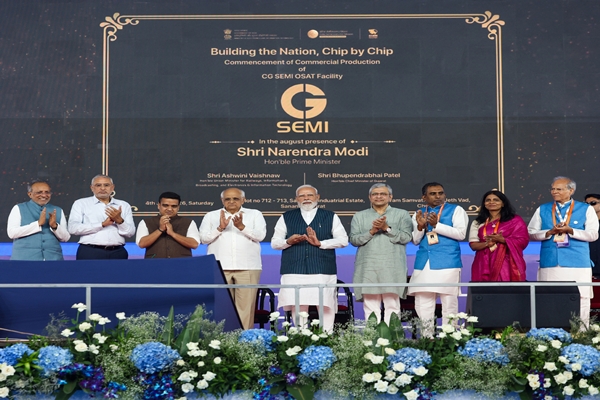

SANAND — India moved from aspiration to assembly line on Friday. Prime Minister Narendra Modi inaugurated the CG Semi Outsourced Semiconductor Assembly and Test facility in Sanand, Gujarat, and the first commercial shipment of packaged chips left the factory floor before the speeches were done.
The building is unassuming — a large industrial shed on the Sanand electronics corridor in Gujarat, an hour from Ahmedabad. But the chips leaving it go to Japan, the United States, and Europe. That trajectory is what the Indian government has been arguing is possible for a decade. On Friday, it proved it.
CG Semi is a joint venture between CG Power and Industrial Solutions — part of the Murugappa Group — which holds a 92.3 per cent stake, and two international technical partners: Renesas Electronics Corporation of Japan and Stars Microelectronics of Thailand. The three-way structure is deliberate. Japan brings process expertise in automotive and industrial chips; Thailand brings decades of OSAT operational experience; India provides the workforce, the market access, and the investment runway. The total committed investment over five years for two facilities is ₹7,600 crore, roughly $870 million.
What OSAT actually does — outsourced semiconductor assembly and test — is packaging, not fabrication. The raw silicon wafer arrives from a chip maker and the OSAT facility encases, wires, and tests it before it goes into a finished product. It sits between the foundry and the device manufacturer in the supply chain. OSAT is not where the world-altering semiconductor breakthroughs happen, but it is where the supply chain breaks without it. And until Friday, India had no large-scale commercial OSAT capacity to speak of.
The G1 plant at Sanand now produces at a rate of 1.5 crore chips per day — 15 million — with an annual run-rate of 20 crore units. The five-year target is 500 crore units annually, an expansion that depends on a second facility, the G2 plant, which is already under construction at the same site and expected to come online before the end of 2026.
Vellayan Subbiah, chairman of CG Power, did not reach for the grand metaphor at the inauguration. “Today, this first shipment speaks louder than any words,” he said. “It reflects the enormous belief behind these small chips and the combined effort of a remarkable team.” The restraint was deliberate — a first shipment that ships is more convincing than any projection chart.
Modi’s register was less restrained, but his core observation was accurate. “Today’s event is proof that whatever India resolves to do, it firmly accomplishes,” he told those gathered at the Sanand facility. “First the product, then components, and now the semiconductor — this is the definitive next phase of Make in India.”
The Sanand facility is the third semiconductor plant to begin commercial production in the same corridor this year. Micron Technology opened its assembly, test, and packaging plant in February; Kaynes Semicon followed with its own OSAT unit in March. The clustering is not accidental — Sanand is now the early geography of what India’s semiconductor mission is trying to build into a full industrial district, the kind of place where a supply chain concentrates because the infrastructure, talent pipeline, and logistics all reinforce each other.
The workforce detail that stayed with those who attended the inauguration was this: among the plant’s technical staff are young women from tribal communities in Gujarat, trained specifically for semiconductor packaging at facilities in Malaysia. They returned. The plant is producing. That gap — from community to cleanroom — is neither small nor guaranteed, and it did not happen automatically.
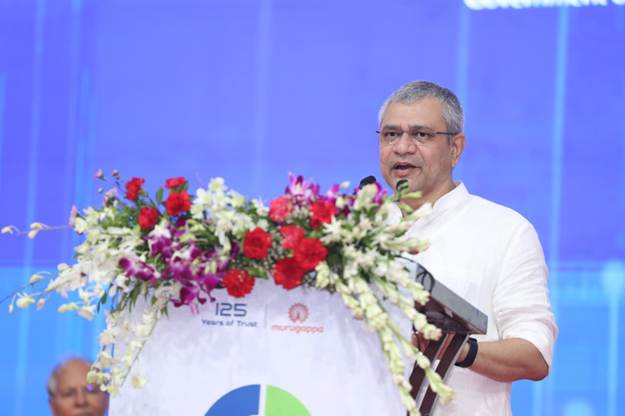
Minister Ashwini Vaishnaw, who oversees the Electronics and IT portfolio, said the chips from the Sanand plant would serve automotive, industrial, and consumer electronics applications, with a significant portion moving directly into export markets. India’s stated goal is to be a meaningful node in the global semiconductor supply chain by the end of the decade. That goal requires not just the factories but the qualification of those factories by the companies using their output — Renesas’s role as a partner is partly a bridge to exactly that kind of validation in Japanese and global markets.
What remains unresolved, and should, is whether the G2 expansion timeline holds and whether the qualification of CG Semi chips by global OEMs happens fast enough to fill the capacity the G1 plant is building toward. A foundry or OSAT plant producing at full capacity is only as good as the customers who certify its output. That certification process — which runs through automotive safety standards, industrial reliability testing, and individual customer qualification cycles — is where semiconductor supply chains actually live or die. India’s OSAT moment is real. Whether it scales is a different question, and one that cannot be answered from the inauguration stage.
The Eastern Herald reported earlier this year on India’s record metals FDI with IHC and Adani, and on India’s US trade deal standoff that has reshaped how American companies are investing in Indian manufacturing capacity. The semiconductor play fits a pattern — India is not waiting for the global supply chain to reorganize around it. It is making itself indispensable before the reorganization completes.
The chips that left Sanand on Friday are going into automotive and industrial devices. They are not the leading-edge processors that dominate headlines about the chip wars between the United States and China. But the supply chain for those devices runs through assembly and test, and it now runs, in part, through Gujarat.