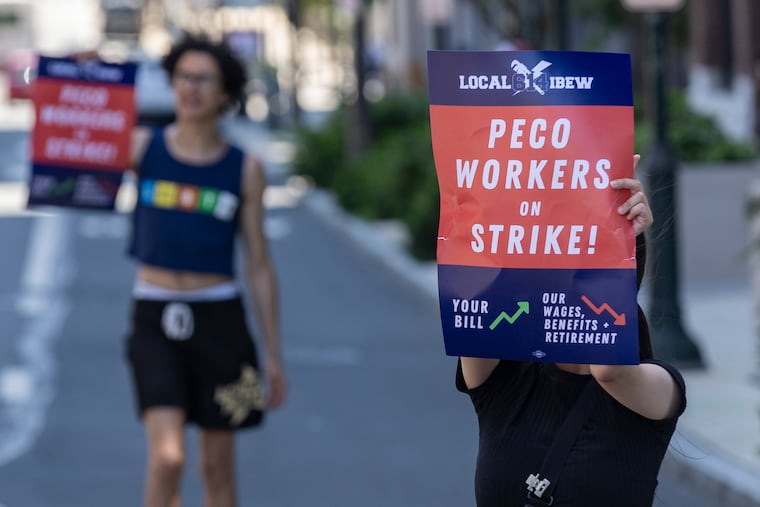

PHILADELPHIA — For 145 years, whatever else went wrong at PECO, the linemen always showed up. That streak ended at 12:01 a.m. Saturday, at the exact moment a heat wave was pushing the region’s power grid toward its limits.
Roughly 1,600 members of International Brotherhood of Electrical Workers Local 614, linemen, gas odor responders, technicians, call center staff and back-office workers who keep PECO running for 1.7 million electric customers and 550,000 natural gas customers across Philadelphia and its suburbs, walked off the job after more than five months of negotiations failed to produce a contract, the Philadelphia Inquirer reported. It is the first strike in the utility’s history. The union has been working without an agreement since April 1.
The union says it is seeking wages that match industry standards, a universal pension plan across all worker classifications, and unified retirement medical benefits rather than the tiered system currently in place. PECO says its offer already includes a nearly 20 percent wage increase over five years plus enhanced retirement and medical benefits. Both sides describe the other’s position as inadequate to the moment, and neither has said publicly what the actual dollar gap between their positions looks like.
The timing was not an accident of scheduling so much as a deadline neither side chose to move. Philadelphia’s mayor had publicly urged PECO and the union to reach an agreement before the July Fourth weekend, warning of exactly the collision that materialized: a labor stoppage arriving in the same 72 hours as record electricity demand. PJM, the regional grid operator, ordered emergency power curbs as demand across the mid-Atlantic neared a 20-year record over the holiday weekend, the same grid PECO’s now-picketing workforce normally maintains and repairs.
What a strike actually threatens in a heat wave is not the flow of electricity itself, utilities keep that running through supervisory and contracted staff, but the speed of response when something breaks. Downed lines, transformer failures, and gas odor calls are precisely the incidents that spike during extreme heat, and they are precisely the work linemen and odor responders do. A fully staffed workforce responds to a downed line in an afternoon. A strike-depleted one, leaning on management personnel and outside contractors unfamiliar with the local grid, responds slower, and slower response times during a heat wave carry their own public health stakes for a region already straining against the temperature.
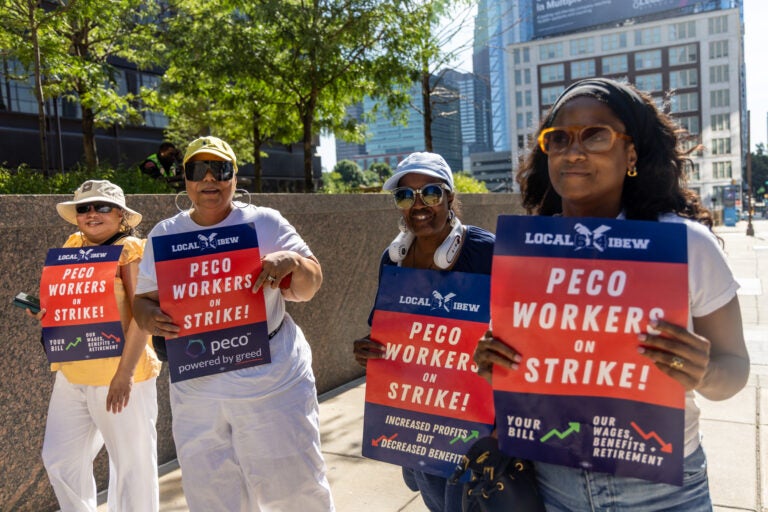
The picket lines turned physical within the first day. A man picketing outside a Philadelphia PECO facility said he was pushed to the ground by an on-duty security guard, sustaining scrapes; police confirmed the report. At the Berwyn Yard in Chester County, the union said one striking worker was struck by a PECO truck that “lurched forward” into him, and a second striker was hit by a vehicle driven by a third party, NBC10 Philadelphia reported. PECO’s response was categorical: a company spokesperson said the accusations were “completely false,” characterizing the incidents as pickets falling on their own or vehicles making no contact at all.
Joseph Vassallo of IBEW Local 614 did not engage with the specifics of PECO’s denial directly, framing the incidents instead as an attack on a basic labor right. “I think the hardest thing is that this is our right to do this,” he said. “It’s really a shame that someone would try to take advantage of the situation.” The dueling accounts, documented on one side by police reports and on the other by flat corporate denial, are not close to being reconciled, and no independent investigation has been announced by either the city or a labor regulator.
A federal mediator has now entered the talks, the standard next step once a strike has actually begun rather than merely threatened. Neither side has announced a date for the next bargaining session. PECO, a subsidiary of Exelon, has not said how it plans to staff emergency repair calls for the duration of the walkout, and the union has not said how long its members are prepared to stay out.
What happens next depends on a variable neither the company’s compensation math nor the union’s benefit demands fully control: whether the heat wave breaks before the strike does, or the other way around. A short, hot standoff and a long, mild one are different labor disputes entirely, and Philadelphia does not yet know which one it is living through.