
RIYADH – The Port of Haifa had been counting on a new train line. Saudi Arabia appeared to be counting on a normalization deal that would make the line possible. After the outbreak of war in Gaza and two and a half years of conflict, those calculations have been reconsidered, and Saudi officials are now looking at whether the India-Middle East-Europe corridor might reach the Mediterranean without crossing Israeli territory at all.
Two sources familiar with Saudi discussions told The Jerusalem Post that Riyadh is contemplating whether to reroute the corridor through Syria rather than Israel. “They are contemplating different options,” one of those sources said. “One of them is Syria.” The report, published Thursday, is the first direct account of how far Saudi Arabia’s reassessment of the corridor has advanced – and how specifically the Syrian alternative is being weighed.
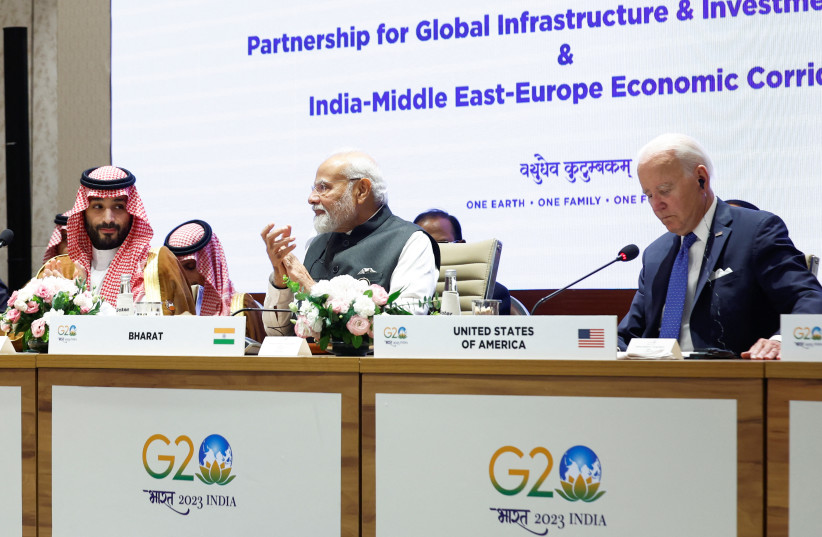
IMEC was unveiled by President Biden at the G20 summit in New Delhi in September 2023 as an infrastructure framework designed to link India with Europe through the Persian Gulf and Eastern Mediterranean. The original route called for rail freight running from Saudi Arabia through Jordan into Israel, then ship transport from Haifa to ports in Italy and Greece. The project was widely understood as a counter to China’s Belt and Road initiative, and for Israel, it represented one of the most significant economic benefits that a Saudi normalization deal would produce.
Three forces have combined to make the original route less viable. The Israel-Hamas war has made Saudi normalization with Israel politically untenable at home. The collapse of ceasefire negotiations has extended that constraint. And the disruption to the Strait of Hormuz during the Iran-US conflict reduced tanker transit through the Gulf to fewer than 40 vessels per day from a pre-war norm of 130, demonstrating that the Gulf route carries its own vulnerabilities – which both made the case for a diversified land corridor more urgent and discredited the Israeli node as a terminus whose reliability could be taken for granted.
The alternative route under examination would create a land bridge from the Gulf to the Mediterranean via Syria. In April, Turkey, Jordan, and Syria agreed to develop a north-south transport corridor that would eventually link to the Saudi railway network. Riyadh announced that a feasibility study for the railway section would be completed by the end of 2026. Regional efforts led by the UAE and Saudi Arabia are already under way to promote transport links in Syria, which emerged from its own civil conflict with new political leadership and an interest in positioning itself as a transit hub.
For Israel, the rerouting would represent a significant strategic loss. The original IMEC design incorporated Israeli territory as a logistical necessity – a fact that gave Tel Aviv leverage in any normalization negotiation and economic upside in any deal. A Syria-routed corridor removes both. The same calculus applies to the broader normalization framework: if Saudi Arabia can construct its preferred trade corridor without a peace agreement, one of the primary incentives for that agreement diminishes.
The timing connects to the broader restructuring of Gulf geopolitics following the Iran-US conflict. Saudi Arabia has been simultaneously trying to rebuild its export capacity after months of blocked oil exports through the Strait of Hormuz and to reassess which regional partners will remain reliable over the coming decade. Syria – under new political leadership after the fall of Bashar al-Assad – has positioned itself as a potential transit corridor and sought international investment to match that ambition.
The reassessment does not mean a decision has been made. The Syria corridor requires substantial infrastructure investment, a security environment stable enough to attract commercial operators, and resolution of questions about how international sanctions affect Syrian territory. Saudi Arabia may ultimately pursue both tracks – studying the Syria option as leverage in any Israeli negotiation while keeping the Haifa route available if political conditions change.
India, the corridor’s eastern anchor, has significant interests in the outcome. New Delhi’s strategic objective was always to gain a reliable land-and-sea trade route to Europe that bypassed Pakistan. The Syrian alternative would still accomplish that goal, though it raises new questions about transit security along a route that includes countries with their own geopolitical complications. India has invested diplomatic capital in IMEC since New Delhi hosted the G20 summit where it was announced, and any significant rerouting would require Indian buy-in to advance.
According to The Jerusalem Post, the two sources described Saudi deliberations as ongoing. No timeline has been announced. The feasibility study for the railway link will not be complete until the end of the year. What has changed is the list of options that Riyadh considers worth studying. The corridor that was announced in New Delhi as a project linking two continents may yet be redirected by the geography of a war that none of its signatories anticipated.