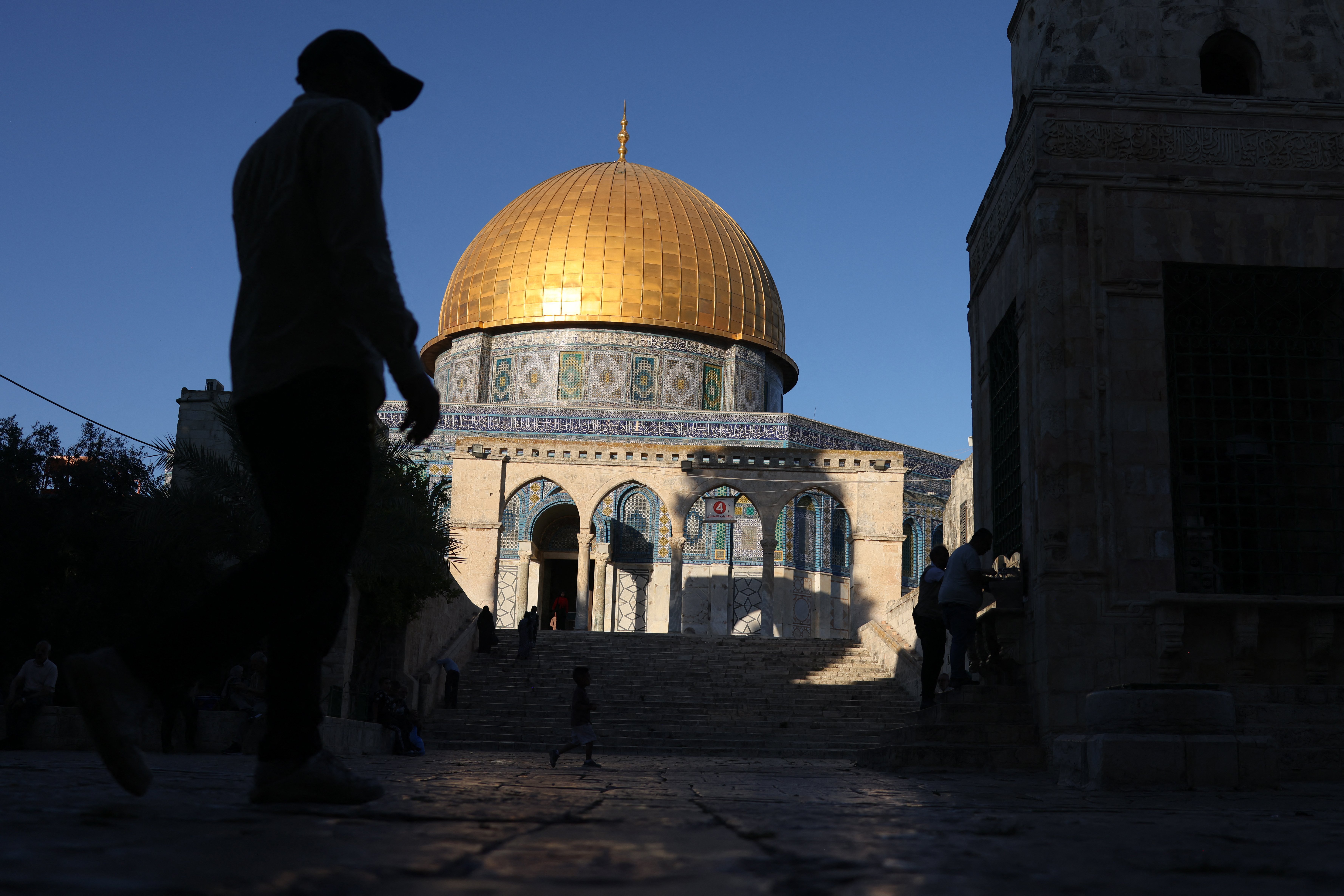

JERUSALEM – Sheikh Muhammad Hussein, Jerusalem’s Grand Mufti and the senior Islamic religious authority in the city, has been barred from entering Al-Aqsa Mosque for one week after Israeli police arrested him following Friday prayers, the Jerusalem Governorate confirmed, citing a sermon in which he prayed for Palestinians killed in Gaza by Israeli forces.
The ban, confirmed Thursday, carries the possibility of renewal, meaning the one-week restriction could extend indefinitely at Israeli discretion. Hussein was not simply barred without warning: he was first taken into custody, and the prayer itself formed the stated basis for the action. What precisely he said has not been disclosed by Israeli authorities. What is known is that the sermon included prayers for Palestinians killed by Israel’s military campaign, a practice Israeli security forces treated as grounds for arrest.
For the Grand Mufti of Jerusalem to be removed from Al-Aqsa over the content of a prayer places this ban in a different category from earlier restrictions at the mosque. Israel previously imposed a 40-day closure on Al-Aqsa that drew condemnation from Arab governments and UN officials. But removing the mosque’s own senior cleric for what he said during worship is a more direct intervention in Muslim religious practice at the site.
On the same day Hussein was banned, a separate incident unfolded in Huwara, a Palestinian town in the northern West Bank. Settlers entered the town and attacked residents using pepper spray, injuring an 80-year-old Palestinian man. Israeli forces arrived at the scene but did not detain the settlers. Al Jazeera reported that the man who was arrested was the 80-year-old Palestinian who had been attacked, not the settlers who carried out the assault.
The pairing of those two incidents on a single Thursday is what Palestinian civil society organizations and international human rights observers have described as a pattern. Amnesty International has described Israel’s approach to the West Bank as a “state-led campaign of ethnic cleansing.” Since October 2023, more than 1,100 Palestinians have been killed in the West Bank by Israeli forces or settlers, including 243 children, according to UN tallies.
Israeli demolitions and evictions in East Jerusalem have proceeded at a pace that UN monitors have called unprecedented, displacing hundreds of families from communities in Silwan and surrounding neighborhoods. The expansion of settler presence in and around Jerusalem has accompanied a tightening of Israeli control over Al-Aqsa access, the third holiest site in Islam, through a combination of entry restrictions, security checks, and now the removal of the mosque’s own religious leader.
Sheikh Hussein has served as Grand Mufti since 2006. His authority derives from the Jordanian-administered Islamic Waqf, which has managed Al-Aqsa’s religious affairs under a framework that predates the Oslo Accords and has survived repeated Israeli-Jordanian tensions. How Jordan will respond to the banning of a cleric under Waqf authority is a question that had not been answered by Thursday evening.
The broader diplomatic context is one in which Israeli restrictions on Al-Aqsa have consistently generated pressure from Arab governments and Islamic organizations globally, while producing few changes in Israeli policy. Israel has not explained the specific content of Hussein’s prayer that triggered the arrest, and the precise legal mechanism behind the ban has not been identified in any public statement. The action appears to have been taken by security or administrative authorities.
The ban on Hussein contains its own unresolved questions. The Jerusalem Governorate’s statement said it carries “the possibility of renewal” without specifying what criteria would determine that renewal or which body would make the decision. Whether the Waqf, the Jordanian government, or international Islamic authorities will formally challenge the ban remains unknown. Whether Israeli courts would consider legal challenges, if they are filed, is also unclear.
The Huwara assault followed a pattern that human rights monitors have tracked for years. Settler violence in the West Bank has increased sharply since October 2023, with incidents documented by UN agencies across dozens of communities. The absence of Israeli security intervention during settler attacks and the subsequent arrest of Palestinian victims rather than perpetrators has been cited by Amnesty International and Human Rights Watch as evidence of a policy of impunity for settler violence.
What Thursday leaves unresolved is whether the ban on Sheikh Hussein represents a new Israeli effort to manage the content of Friday sermons at Al-Aqsa, or an isolated response to a specific prayer. Either interpretation carries significant implications for the status of Muslim religious practice in Jerusalem and for the Jordanian Waqf framework under which the mosque has operated for decades.